Smart Heating Solutions
What Is the Best Industrial Heater for Your Business?
Choosing the right industrial heater can shape production costs, product quality, and workplace comfort. The U.S. Department of Energy reports that process heating accounts for about 51% of energy use in American manufacturing. That figure makes heater selection a practical business decision, not a minor equipment purchase. Yet no single technology suits every plant.
As energy-efficiency expert Amory Lovins is widely quoted: “The cheapest energy is the energy you don’t use.” His point is useful here: compare the heat a process truly needs before comparing equipment prices. A food facility drying ingredients, for example, may need steady, even heat; a metal shop may need rapid, high-temperature cycles. Fuel availability, ventilation, controls, maintenance access, and operating hours all matter. Small details matter.
This guide compares common industrial heater types, including electric, gas-fired, infrared, and hydronic systems. It also considers efficiency, installation demands, emissions, safety features, and total cost of ownership. The International Energy Agency’s reports on industrial energy use underline why efficiency deserves attention, though broad sector data cannot predict one facility’s savings. Real plants are messier. A technically efficient heater may still be a poor fit if it cannot meet production schedules or integrate with existing equipment. Some decisions remain uncertain until operating conditions are measured. The best choice starts with process temperatures, load patterns, and a clear account of what the current system gets wrong.
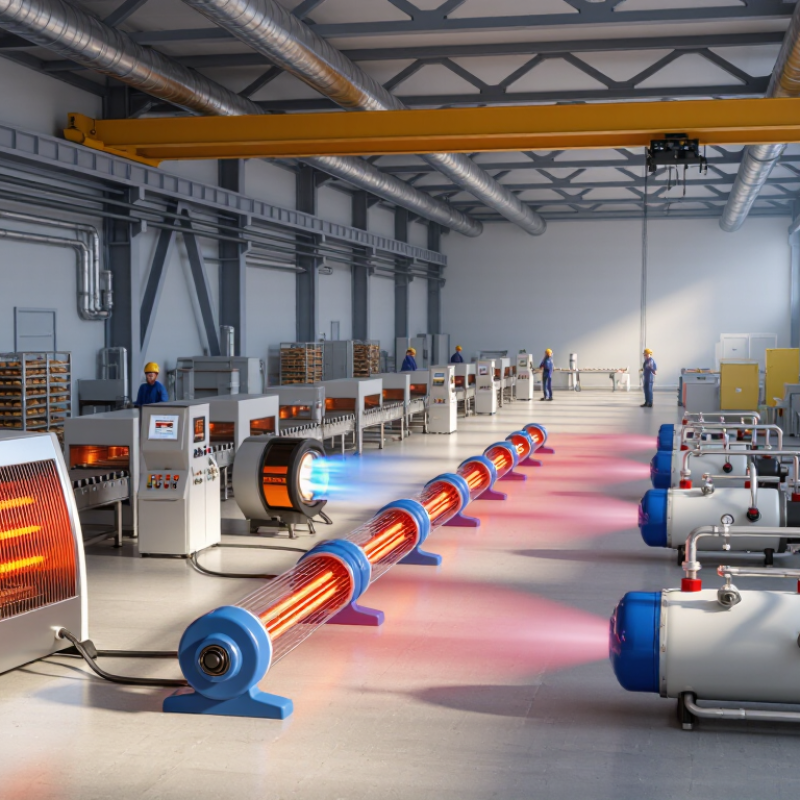
Define the Heat Load: DOE Estimates Process Heating Uses ~20% of U.S. Manufacturing Energy
Process heating accounts for roughly 20% of U.S. manufacturing energy use, according to the U.S. Department of Energy’s process-heating resources. That figure signals scale, not the right heater size for one facility. A bakery oven, curing line, and metal-treatment furnace have very different heat loads. Still, averages can mislead.
Start with the product, temperature, throughput, and hours of operation. Include heat lost through doors, exhaust, and conveyor openings. DOE’s process-heating guidance recommends assessing the whole system, including controls and heat recovery, rather than comparing heater ratings alone. The Energy Information Administration’s 2018 Manufacturing Energy Consumption Survey identifies natural gas as manufacturing’s largest energy source. That makes fuel availability and operating cost worth checking alongside electrical capacity. Measure actual demand during cold starts and steady production; a warm afternoon test may miss the hardest shift. Small detail. Record scrap and temperature variation, too. A heater that reaches setpoint quickly may still produce uneven parts. Use the measured load to compare technologies, then revisit the assumptions after a production trial. The first estimate may be wrong. That is useful to know.
What Is the Best Industrial Heater for Your Business? — Define the Heat Load: DOE Estimates Process Heating Uses ~20% of U.S. Manufacturing Energy
| Heating option | How heat reaches the process | Typical applications | Potential advantages | Key considerations | Useful heat-load questions |
|---|---|---|---|---|---|
| Electric resistance | Electrical elements convert electricity into heat, which is transferred by radiation, convection, or conduction. | Ovens, dryers, curing systems, tank heating, and process-air heating. | Precise temperature control; no combustion at the point of use; suitable where electricity is available and clean process air is important. | Operating cost and emissions depend on electricity prices and the power-generation mix. Check electrical service capacity and peak demand. | What temperature and warm-up time are required? How many operating hours are expected? Is sufficient electrical capacity available? |
| Direct-fired gas | A burner’s combustion products contact the process stream directly. | Some dryers, ovens, kilns, and processes where direct contact with combustion gases is acceptable. | Can deliver high heat-transfer rates and may suit processes with large, continuous heat demand. | Combustion products enter the process stream, so product compatibility, ventilation, burner control, and applicable safety requirements must be assessed. | Can the product tolerate combustion gases? What are the required airflow, exhaust, and temperature-control conditions? |
| Indirect-fired gas | A burner heats a separate surface or heat exchanger; the process is heated without direct contact with combustion products. | Ovens, dryers, and process-air systems that need fuel-fired heat while keeping flue gases separate from the product. | Separates combustion gases from the process stream while using a fuel-fired heat source. | Heat-exchanger design and condition affect heat transfer. Fuel use, emissions, maintenance, and exhaust requirements should be included in the evaluation. | Does the process need clean air? What temperature uniformity and exhaust conditions are required? |
| Infrared (IR) | Radiant energy heats exposed surfaces; the process material absorbs the radiation to varying degrees. | Coating and paint curing, surface drying, and targeted heating of materials or components. | Can provide rapid, localized surface heating and may reduce the need to heat a large surrounding air volume. | Performance depends on material absorption, distance, line of sight, surface geometry, and product movement. Shadowed areas may heat differently. | Is surface heating sufficient, or must the entire product reach temperature? Does the material absorb the selected radiation effectively? |
| Induction | An alternating electromagnetic field induces heat in electrically conductive materials. | Metal heating, forging, heat treatment, melting, and localized component heating. | Can heat conductive workpieces quickly and selectively, with heat generated within the workpiece rather than by direct flame contact. | Applicability depends on the material, part geometry, coil design, and required heating pattern. Equipment and electrical capacity need careful sizing. | Is the workpiece electrically conductive? What part size, production rate, heating depth, and temperature profile are needed? |
| Industrial heat pump | Uses electricity to move heat from a source to a higher-temperature process; it does not create heat through combustion or resistance alone. | Low- and some medium-temperature process heat, hot water, and systems with a usable waste-heat source. | Can deliver more heat energy than the electrical energy it consumes when operating conditions are favorable; can recover and upgrade waste heat. | Feasibility depends on required delivery temperature, source temperature, temperature lift, system integration, and electricity cost. Not suitable for every high-temperature process. | What are the source and delivery temperatures? Is recoverable waste heat available, and can the process use heat continuously? |
Selection note: Start by quantifying the required process temperature, useful heat output, operating schedule, warm-up time, airflow or material throughput, and allowable temperature variation. The U.S. Department of Energy estimates that process heating uses about 20% of energy consumed by U.S. manufacturing; the share for an individual facility varies by industry and process. Compare total operating and installation costs, energy availability, emissions, maintenance, and safety requirements before selecting a heater.
Related Posts
-
10 Tips for Choosing the Right Industrial Heater?
-
Top 10 Industrial Heater Types for Global Buyers
-
Why Choose an Industrial Electric Heater for Your Business?
-
What Are the Top Industrial Electric Heater Types in 2026?
-
How to Choose the Right Industrial Heater for Your Needs?
-
10 Best Industrial Heaters for Global Buyers