Smart Heating Solutions

China Top 10 Programmable Thermostat Suppliers

China’s programmable thermostat sector is moving from basic temperature control toward connected, data-based energy management. Grand View Research estimates that the global smart thermostat market reached approximately USD 2.57 billion in 2023. It expects strong growth through 2030. MarketsandMarkets also forecasts rapid expansion, although its figures differ because it defines smart and programmable products differently. That difference matters. Market numbers are useful, but not perfect.

For buyers, Chinese suppliers compete through factory scale, OEM flexibility, mobile applications, and export experience. A reliable programmable thermostat should offer stable temperature sensing, clear scheduling, safe relay design, and compatibility with local heating systems. In a real home, these details decide whether a device performs well beside a cold window or a noisy boiler. Certification support and documented quality controls also deserve close attention.

David Nemtzow, former director of the U.S. Department of Energy’s Building Technologies Office, described the thermostat as “the gateway to the smart home.” His observation remains relevant. A thermostat sits at the center of daily energy decisions. It can influence comfort, operating costs, and equipment runtime.

This guide reviews China’s top ten programmable thermostat suppliers through practical criteria. These include product capability, manufacturing depth, certifications, customization, delivery reliability, and after-sales support. Supplier rankings can change quickly. Therefore, readers should verify current certificates, test reports, factory evidence, and warranty terms before purchasing. Not every attractive specification reflects long-term performance. That is the uncomfortable part.
China Top 10 Programmable Thermostat Suppliers

What Programmable Thermostats Are and How They Work

Programmable thermostats are control devices that adjust indoor temperature according to a chosen schedule. Unlike a basic thermostat, they can lower heating or cooling during sleep and restore comfort before people wake. This reduces unnecessary runtime without requiring constant manual changes. The device uses a temperature sensor, a control circuit, and programmed time settings. Some models also include humidity sensors, occupancy detection, or remote access.

The operating process is straightforward. The sensor measures room temperature at regular intervals. The thermostat compares that reading with the selected target, then sends a signal to the heating or cooling equipment. A relay may start a furnace, heat pump, or air conditioner. When the room reaches the target range, the system stops or changes mode. Small timing differences matter. A five-minute delay can prevent rapid cycling and reduce equipment wear.

In practical installation work, compatibility deserves careful attention. Voltage, wiring terminals, heat-pump stages, and backup heating can differ widely. A schedule also works only when it reflects real habits. An empty home does not need the same setting as a crowded evening room. The perfect program is uncommon. I have seen users create complex schedules and then ignore them. A simpler plan, checked against actual comfort and energy use, is often more reliable. Sensors should also avoid direct sunlight, drafts, and warm appliances. Otherwise, the thermostat may react to a false temperature.

Criteria for Selecting China’s Top 10 Thermostat Suppliers

Selecting China’s top ten programmable thermostat suppliers requires more than comparing online prices. A reliable evaluation starts with factory capability, product consistency, and documented testing. Request production photos, quality records, and a recent factory audit. Check whether the supplier controls key processes, including sensor calibration, circuit assembly, and final inspection.

Technical performance deserves close attention. Compare temperature accuracy, scheduling flexibility, display readability, and power consumption. Ask for test data at different room temperatures. A good thermostat should maintain stable readings, not merely show attractive specifications. Review relay endurance, battery performance, firmware updates, and compatibility with common heating or cooling systems. Sample units should run for several weeks before approval.

Compliance documents also matter. Verify applicable safety and electromagnetic compatibility reports through independent laboratories. Examine warranty terms, spare parts support, packaging strength, and response times. A supplier with clear English documentation usually reduces installation mistakes. However, communication quality can change after an order is placed. Test this early. No scorecard is perfect. A low price may hide slow engineering support, while a large factory may overlook small customization requests. Record findings in a weighted comparison table, then inspect production samples before ranking the final ten suppliers.

China Top 10 Programmable Thermostat Suppliers - Criteria for Selecting China’s Top 10 Thermostat Suppliers

The following evaluation framework compares programmable thermostat suppliers in China without displaying company or brand names. Scores should be verified through technical documents, samples, audit reports, and regulatory certificates.

Rank Selection Criterion Suggested Weight Recommended Verification Benchmark Evidence to Request
1 Product Safety and Control Standards 20% Demonstrated design conformity with IEC 60730-1 and, where applicable, IEC 60730-2-9 for temperature-sensing controls. Test reports, safety evaluation, insulation specifications, relay ratings, and protection design documentation.
2 Export Compliance Coverage 15% Applicable compliance for the destination market, such as RoHS Directive 2011/65/EU with Amendment 2015/863, REACH Regulation (EC) No. 1907/2006, FCC Part 15, or the EU Radio Equipment Directive 2014/53/EU. Valid certificates, declarations of conformity, restricted-substance reports, and country-specific test records.
3 Temperature Accuracy and Stability 12% Published operating range, measurable control accuracy, sensor tolerance, and repeatability should be clearly defined rather than described only as “high accuracy.” Calibration procedure, temperature test results, sensor datasheets, and sample measurement records.
4 Programmability and User Functions 10% At least daily or weekly scheduling, temporary override, holiday mode, permanent hold, low-battery indication, and power-loss recovery where required. Functional specification, firmware revision record, user manual, and demonstration sample.
5 System Compatibility 10% Verified compatibility with the buyer’s HVAC voltage, wiring arrangement, load type, heating or cooling stages, and installation environment. Wiring diagrams, terminal specifications, supported-load list, installation guide, and compatibility test results.
6 Connectivity and Cybersecurity 8% For connected models, verify the wireless protocol, encryption approach, account protection, firmware-update process, and data-handling policy. Network architecture, security questionnaire, privacy policy, update policy, and independent vulnerability-test results where available.
7 Manufacturing Quality Management 8% A documented quality system, controlled production records, incoming inspection, process inspection, final testing, and traceability for critical components. Quality certificate, process flow chart, inspection plan, corrective-action records, and factory-audit results.
8 Customization and Engineering Capability 7% Ability to support enclosure changes, display language, firmware configuration, packaging, private labeling, and destination-specific documentation. Engineering team profile, change-control procedure, development schedule, prototype process, and customization quotation.
9 Supply Capacity and Delivery Control 5% Transparent production capacity, component-sourcing plan, lead-time assumptions, contingency planning, and shipment documentation. Capacity statement, production schedule, component lead-time list, order history references, and logistics process.
10 Warranty and After-Sales Support 5% Clearly defined warranty duration, replacement or repair procedure, response-time target, spare-parts policy, and technical support channel. Warranty terms, service-level agreement, troubleshooting guide, spare-parts list, and escalation contacts.
Total Evaluation Weight 100% Use weighted scores supported by documents, sample testing, and an on-site or third-party audit.
Recommended scoring method: Rate each criterion from 0 to 10, multiply the rating by the suggested weight, and rank suppliers by the resulting weighted score. A high score should not replace verification of samples, compliance documents, production controls, and actual HVAC compatibility.

Profiles of the Top 10 Chinese Programmable Thermostat Suppliers

China’s programmable thermostat supply base is broad, but quality varies sharply.

This profile reviews ten Chinese suppliers through product depth, export experience, certification support, and after-sales capability. Grand View Research projects the global smart thermostat market to grow at a strong double-digit CAGR through 2030. That growth is pushing factories beyond basic weekly scheduling.

Several of the ten suppliers focus on OEM production for residential HVAC systems. Their strengths include injection-molded housings, relay control, touchscreen interfaces, and multilingual firmware. Others specialize in Wi-Fi and app-connected thermostats, using common wireless protocols and cloud dashboards.

A smaller group serves hotels, offices, and light commercial buildings with centralized control. Factory audits should examine calibration records, component traceability, and temperature testing between 5°C and 35°C. These details reveal more than polished product photos.

The U.S. Department of Energy reports that correctly managed programmable settings can reduce heating and cooling costs, although actual savings depend on climate and user behavior. This limitation matters when assessing supplier claims.

A supplier offering open communication protocols may support easier integration. Another may provide stronger customization but slower engineering changes.

One weakness remains: public supplier data is often incomplete. Buyers should request recent test reports, warranty procedures, sample firmware, and production references. Ten profiles can narrow the search, not replace verification. In practice, the best choice balances control accuracy, software stability, documentation, and responsive technical support.

Key Products, Technologies, Certifications, and Customization Options

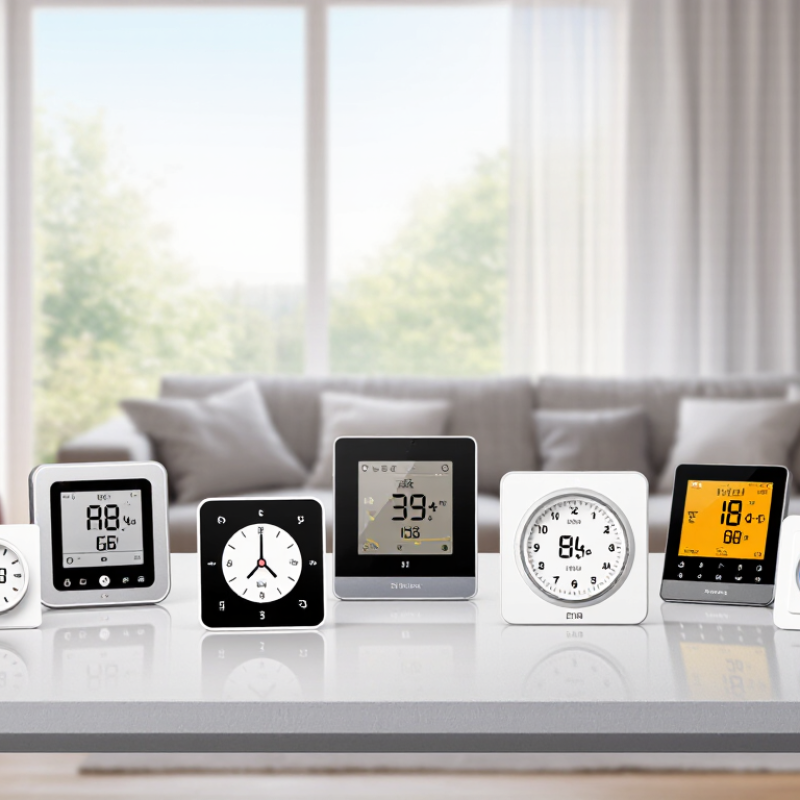
China’s top 10 programmable thermostat suppliers typically offer wall-mounted, fan-coil, floor-heating, and heat-pump controllers. During supplier evaluations, inspect wiring terminals, screen visibility, button response, and sensor accuracy. These small details affect installation time and user trust.

Common technologies include Wi-Fi, Zigbee, RS485, Modbus, and app-based remote control. Advanced models may support scheduling, geofencing, open-window detection, adaptive learning, and proportional temperature control.

Ask suppliers for test reports, firmware update procedures, and communication protocols. Certifications may include CE, RoHS, FCC, UKCA, or regional safety approvals. Certification coverage can differ by model, market, and electrical configuration, so verify the actual certificate number and testing scope. ISO 9001 quality systems can strengthen confidence, but they do not replace product-level testing.

Customization options often include private-label enclosures, logo printing, screen languages, terminal layouts, firmware logic, mobile applications, packaging, and cloud API integration. Some suppliers also adjust mounting plates and temperature ranges for specific projects.

No supplier is perfect. A polished interface may hide weak manuals or delayed technical support. I would request pilot samples, installation videos, calibration data, and a small production trial before placing a larger order. Check standby power, relay life, electromagnetic compatibility, and recovery behavior after a network failure. Ask clear questions. That often reveals more than a sales presentation.

How to Choose a Supplier for Quality, Price, and Support

China Top 10 Programmable Thermostat Suppliers

Choosing among China’s top programmable thermostat suppliers requires more than comparing unit prices. The U.S. Department of Energy reports that proper temperature setbacks can reduce heating and cooling energy use. However, savings depend on building insulation, schedules, and user behavior. Ask suppliers for calibration records, relay-cycle tests, temperature accuracy, and failure-rate data. A neat sample proves little.

Price should include tooling, firmware changes, packaging, freight, taxes, and replacement parts. Request a landed-cost quotation, not only an ex-factory price. The ENERGY STAR program reports that certified smart thermostats can save households about 8% on heating and cooling costs, or approximately 50 dollars annually. That figure is useful, but it is not a guaranteed result for every programmable model. Test a small pilot batch first.

Support often separates a reliable supplier from a cheap one. Confirm response times, English technical documentation, spare-part availability, and warranty handling in writing. Verify certifications required in the target market, such as electrical safety and electromagnetic compatibility approvals. Independent laboratory reports are stronger than marketing claims. I would also inspect production records and software-change controls. A supplier may offer excellent communication before payment, then respond slowly after delivery. That uncomfortable possibility deserves testing. Short answers are a warning.