Smart Heating Solutions
Carbon Graphite Rods appear simple, but their performance depends on structure, purity, and processing. A thin rod may look identical to a thick electrode. It may behave very differently under heat, electrical load, or chemical exposure. Grain size matters. So does density.
The U.S. Geological Survey’s Mineral Commodity Summaries 2025 identifies graphite as an essential industrial and energy material. The report also highlights China’s dominant position in global graphite production and processing. The International Energy Agency’s Global Critical Minerals Outlook 2024 further describes graphite as a major battery-material concern, especially because supply chains remain geographically concentrated. These findings make material selection more important than appearance alone.
Simon Moores, chief executive of Benchmark Mineral Intelligence, has described graphite as “the largest component in a lithium-ion battery by weight.” That observation reflects graphite’s expanding technical importance, although battery applications represent only one part of the market. Industrial users still rely on rods for furnace components, electrical contacts, laboratory equipment, EDM tooling, and high-temperature fixtures.
The ten types discussed in this guide are separated by practical characteristics, including natural or synthetic origin, fine or coarse grain structure, purity level, and impregnation method. Some rods favor conductivity. Others resist oxidation or mechanical wear. No single grade is best everywhere.
That is the difficult part.
Real operating conditions often expose weaknesses that product tables hide. Temperature cycling, uneven machining, moisture, and poor storage can reduce service life. This guide therefore compares each type through measurable properties, typical applications, and selection limitations. The goal is not to promote one material, but to support a more defensible engineering decision.
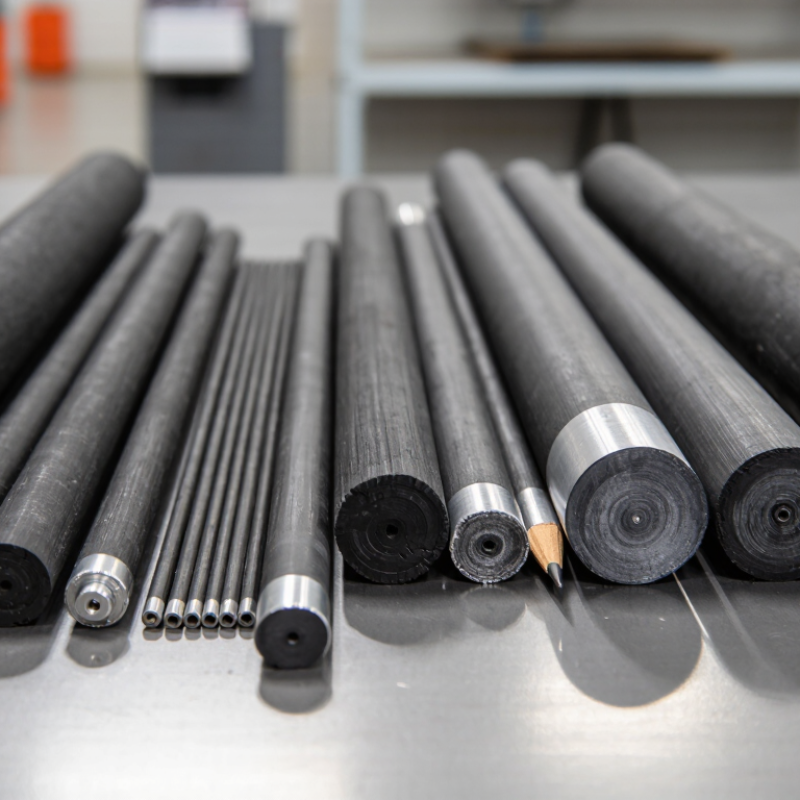
A carbon graphite rod is defined by its material structure, not its cylindrical shape alone. It begins with petroleum coke, pitch, or natural graphite. Manufacturers form these materials, bake them, and often graphitize them above 2,500°C. This treatment changes disordered carbon into layered graphite crystals. That structure enables electrical conductivity, thermal stability, and controlled friction.
A rod’s grade depends on density, ash content, grain size, porosity, and electrical resistivity. Fine-grain rods usually provide smoother surfaces and tighter dimensions. Coarse-grain grades can offer better thermal shock resistance. Impregnated rods reduce open porosity. Flexible grades remain uncommon. They need careful testing.
The ten common categories include extruded, molded, fine-grain, coarse-grain, isostatic, impregnated, high-purity, electrode-grade, conductive, and specialty machinable rods. These labels can overlap, so buyers should check technical certificates instead of relying on names.
The U.S. Geological Survey reported approximately 1.6 million metric tons of natural graphite mine production worldwide in 2023. This figure shows the scale of graphite supply, but it does not represent finished rod output. The International Energy Agency also identifies graphite as a critical material for expanding energy technologies. Quality still varies sharply between suppliers. In practical inspection, a rod should be checked for diameter tolerance, visible cracks, density, resistivity, and impurity levels. A clean surface is useful, but it does not prove internal consistency. That assumption deserves more testing.
Carbon graphite rods are classified by composition, manufacturing route, grain size, purity, and final use. In practice, the top ten types include natural graphite, synthetic graphite, fine-grain graphite, coarse-grain graphite, high-purity graphite, impregnated graphite, extruded rods, molded rods, isostatically pressed rods, and electrode-grade rods. Each category changes performance. Fine-grain rods offer smoother machining, while coarse-grain grades can tolerate heavier thermal shock. High-purity rods suit furnace environments where ash contamination must remain low.
Manufacturing method is equally important. Extruded rods usually have directional structure and predictable dimensions. Isostatic rods provide more uniform density across the cross-section. Impregnated rods reduce open porosity, helping limit gas or liquid penetration. ASTM testing commonly evaluates density, electrical resistivity, flexural strength, and ash content, rather than relying only on commercial grade names. The U.S. Geological Survey reported approximately 1.6 million metric tons of natural graphite mine production in 2024, underscoring the importance of consistent raw-material classification. The International Energy Agency also identifies graphite as a critical material for energy technologies.
Application creates another useful boundary: furnace heating, electrical contacts, laboratory crucibles, semiconductor processing, and metal casting require different rod specifications. A low-ash rod may outperform a stronger rod in contamination-sensitive work. However, classification is not perfectly standardized. Suppliers sometimes describe similar materials differently. Buyers should verify test data, grain size, density, and operating temperature before selection. Names alone can mislead.
| No. | Type of Carbon Graphite Rod | Primary Classification Basis | Typical Characteristics | Common Applications | Indicative Characteristics or Ranges |
|---|---|---|---|---|---|
| 1 | Extruded Graphite Rods | Manufacturing process and grain orientation | Produced by forcing a graphite mix through a die. They generally have directional properties and are suitable for continuous lengths and standard round sections. | Furnace components, heat-treatment fixtures, electrical contacts, laboratory parts, and general machining stock. | Directional structure Commonly supplied in continuous lengths; properties vary between parallel and perpendicular directions. |
| 2 | Molded Graphite Rods | Compression molding and material structure | Formed by pressing a carbon mixture in a mold. They can provide economical production of standard shapes and may have more uniform properties than simple extrusions. | Mechanical seals, furnace supports, electrical components, crucible parts, and machined industrial components. | Moderate grain size Available in a wide range of densities, strengths, and cross-sectional dimensions. |
| 3 | Isostatically Pressed Graphite Rods | Isostatic pressing and isotropic performance | Pressed uniformly from multiple directions, giving relatively consistent properties in different orientations. Usually selected for demanding thermal, chemical, or electrical service. | Semiconductor processing, high-temperature furnaces, vacuum equipment, precision tooling, and laboratory heating systems. | High uniformity Often associated with fine grain, low porosity, and good dimensional stability. |
| 4 | Vibration-Molded Graphite Rods | Vibration molding and bulk structure | Manufactured by compacting the raw mix through vibration. This process is commonly used for large or relatively simple carbon-graphite shapes. | Large furnace parts, thermal-processing supports, industrial electrodes, and applications where very fine microstructure is not essential. | Large-section capability Usually selected for cost-effective bulk components rather than ultra-precision parts. |
| 5 | Fine-Grain Graphite Rods | Particle size and microstructure | Made from relatively small carbon particles, resulting in a smoother machined surface, improved strength, and better suitability for detailed geometries. | Precision fixtures, semiconductor tooling, EDM components, laboratory parts, and small high-temperature components. | Typical grain size: submillimeter Fine-grain grades may offer better surface finish and lower permeability than coarse-grain grades. |
| 6 | High-Purity Graphite Rods | Ash content and chemical purity | Processed to minimize mineral ash and metallic impurities. Purity requirements depend on the thermal, chemical, and contamination limits of the application. | Semiconductor manufacturing, vacuum furnaces, analytical equipment, crystal growth, and high-temperature laboratory systems. | Often specified at ≥99.9% carbon Some applications require ≥99.99% or higher; the exact value must be confirmed by a test certificate. |
| 7 | Impregnated Graphite Rods | Pore sealing or property enhancement | Open pores are filled with resin, metal, or another compatible impregnant. Impregnation can reduce permeability and improve resistance to certain fluids or increase strength. | Bearings, pump components, mechanical seals, corrosive-service parts, and applications requiring reduced fluid penetration. | Lower permeability Service temperature and chemical compatibility depend strongly on the impregnant; resin-impregnated grades have lower temperature limits than unfilled graphite. |
| 8 | Coated Graphite Rods | Surface treatment and protective coating | Graphite is covered with a selected coating to limit oxidation, reduce reaction with a process material, or modify surface wear and contamination behavior. | High-temperature fixtures, semiconductor processing, molten-material handling, and specialized chemical or vacuum equipment. | Coating-dependent performance Common coating families include silicon carbide, pyrolytic carbon, and refractory metals; maximum temperature depends on atmosphere and coating integrity. |
| 9 | EDM Graphite Rods and Electrodes | Electrical-discharge machining grade and electrode performance | Engineered for electrical conductivity, low electrode wear, fast machining, and accurate reproduction of fine details during EDM operations. | Die-sinking EDM, mold and die production, precision cavities, ribs, slots, and fine-feature tooling. | Low electrode wear Fine or ultrafine grades are commonly chosen for detailed work; electrical resistivity and machinability are key selection criteria. |
| 10 | Carbon-Graphite Composite Rods | Material composition and reinforcement | Combine graphite with carbon fibers, binders, or other carbon-based constituents to balance strength, friction, thermal behavior, and wear resistance. | Brushes, sliding contacts, seals, bearings, friction components, and specialized mechanical assemblies. | Property-tailored composition Electrical conductivity, coefficient of friction, strength, and operating temperature vary according to the composite formulation. |
Note: Carbon graphite rods are commonly classified by forming method, grain size, purity, porosity, impregnation, coating, and intended application. The listed characteristics are typical industry guidance rather than universal specifications; exact values should be confirmed from the applicable material datasheet and test standard.
Carbon graphite rods differ by structure, purity, grain size, and surface treatment. The top ten types include extruded, molded, vibration-molded, and isostatically pressed rods. They also include fine-grain, ultra-fine-grain, high-purity, impregnated, coated, and flexible graphite rods. Each type suits a different working condition.
Extruded rods offer consistent dimensions and practical machining performance. Molded rods handle general heating fixtures and electrical contacts. Vibration-molded grades usually provide useful strength at a lower cost. Isostatic rods deliver more uniform density, which helps when temperature changes are severe. Fine-grain and ultra-fine-grain rods machine smoothly. Their surfaces can look almost polished.
High-purity rods reduce contamination in laboratory furnaces and semiconductor processes. Impregnated rods resist gas or liquid penetration better. Coated rods improve oxidation resistance, although the coating may crack after repeated thermal cycling. Flexible graphite rods are less common and serve specialized sealing or contact applications.
Choosing among these types requires more than checking diameter and length. I examine operating temperature, electrical load, atmosphere, machining tolerance, and expected thermal shock. A rod that performs well in air may degrade quickly in an inert furnace. Heat changes everything. Moisture, clamping pressure, and sudden cooling also matter. In practice, suppliers should provide density, ash content, resistivity, and grain-size data. Some specifications remain incomplete, so test samples are wise. The “best” rod is not universal; it depends on the equipment, process stability, and the cost of early failure.
Carbon graphite rods differ mainly through forming method, grain size, purity, and treatment. Extruded rods offer directional strength and consistent dimensions for furnace fixtures and electrical contacts. Molded rods provide economical production for general heating and laboratory use. Isostatically pressed rods have uniform density, so they suit precision electrodes and high-temperature parts. Vibration-molded rods usually contain coarser grains and tolerate thermal shock well. They remain useful in large furnace components.
Fine-grain rods machine cleaner and support sharper edges. Ultra-fine-grain grades deliver smoother surfaces and better dimensional control. High-purity rods reduce contamination in semiconductor, analytical, and vacuum equipment. Resin-impregnated rods seal open pores, improving leak resistance and mechanical durability. Metal-impregnated rods can improve conductivity, but their thermal limits require careful review. Coated rods add surface protection against oxidation or chemical attack. The coating may crack during repeated thermal cycling.
The categories overlap. That matters. A rod can be isostatic, high-purity, and coated at the same time. According to the USGS Mineral Commodity Summaries 2024, global natural graphite mine production reached about 1.6 million metric tons in 2023, supporting continued investment in graphite processing. The International Energy Agency’s Global Critical Minerals Outlook 2024 also projects strong graphite demand growth from battery and clean-energy systems. These figures do not automatically prove that one rod grade is better. In practice, engineers should compare density, ash content, flexural strength, resistivity, pore volume, and maximum service temperature. I have seen specifications fail when users ignored atmosphere, heating rate, or machining direction. Performance is never only a catalog number.
Choosing carbon graphite rods starts with service conditions, not a catalog ranking. The ten common categories include extruded, molded, isostatic, vibration-molded, fine-grain, medium-grain, coarse-grain, high-purity, impregnated, and EDM grades. Each behaves differently under heat, current, friction, or chemical exposure. For continuous heating, fine-grain or isostatic rods usually offer better uniformity. For rough machining, extruded grades can reduce cost. That is not always true.
Check density, open porosity, electrical resistivity, flexural strength, maximum operating temperature, and ash content. Ask for lot-specific certificates, not only nominal values. The USGS Mineral Commodity Summaries 2024 reported about 1.6 million metric tons of natural graphite mined globally in 2023. The IEA Global Critical Minerals Outlook 2024 states that one country controls over 90% of graphite refining capacity. This concentration makes purity and delivery verification important. Match diameter and length to current density and mechanical load. A thinner rod may heat faster, but it may also sag. Impregnation can limit gas leakage, yet it may change electrical behavior. Do not treat “high purity” as a complete specification. I would recheck the datasheet. Test the rod under its actual atmosphere and ramp rate when failure is costly. Market reports provide context, not a substitute for batch testing.