Smart Heating Solutions
Choosing the right LED stop turn tail lights in 2026 requires more than comparing brightness claims. Global buyers need dependable performance, verified documentation, and practical compatibility across vehicles, climates, and road conditions. This guide examines leading options for trucks, trailers, buses, agricultural equipment, and specialty vehicles. It focuses on real purchasing concerns, including 12V and 24V systems, mounting depth, connector design, lens clarity, and resistance to water, dust, vibration, and temperature changes.
A reliable LED stop turn tail lamp should produce a clear red tail signal, a strong brake warning, and a distinct amber or red turn indication, depending on the vehicle and market. Good products manage heat effectively and maintain stable output after repeated braking cycles. Look for tested ingress protection, traceable manufacturing information, warranty coverage, and installation instructions that match your application. Compliance markings can support responsible purchasing, but buyers should still confirm current requirements with local authorities or qualified vehicle professionals.
Performance is not always perfect. Some lamps advertise exceptional brightness but provide poor beam spread from side angles. Others fit easily yet suffer from weak seals or loose connectors. Field experience shows that small details matter, especially on trailers exposed to road spray and constant vibration. We compare design quality, optical performance, installation effort, durability, and supplier reliability rather than trusting one specification alone. The best choice may differ between a long-haul trailer, a city bus, and an off-road vehicle. Careful verification remains essential.
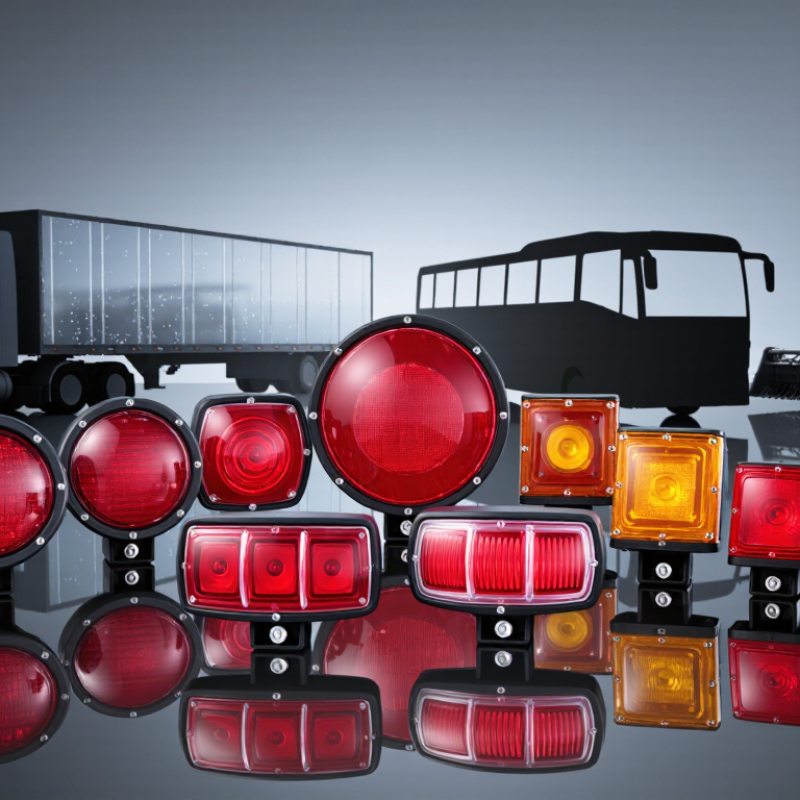
LED stop turn tail lights are vehicle signal lamps that combine braking, turning, and rear visibility functions. They use light-emitting diodes instead of traditional incandescent bulbs. When the brake pedal is pressed, the stop function produces a strong red signal. The turn function flashes on the selected side. The tail function stays dimmer during normal night driving.
The main components include LED chips, a printed circuit board, a current driver, and a protective lens. The housing supports these parts and helps manage heat. Seals reduce water and dust entry around the lens and wiring. Connectors transfer power to the lamp, while mounting brackets keep its position stable. Some assemblies also include resistors or diagnostic circuits for vehicle compatibility.
In practical inspections, I check the light pattern from several angles, not only directly behind the vehicle. A lamp can appear bright but still distribute light unevenly. This is easy to overlook. Thermal performance also matters because repeated braking can raise internal temperatures. A reliable design should maintain consistent output, resist vibration, and tolerate moisture during ordinary road use. Buyers should verify voltage, connector type, mounting dimensions, color, and flashing behavior before ordering. Product descriptions are sometimes incomplete. That uncertainty deserves careful checking, especially when vehicles operate across different climates. A simple bench test can reveal flickering, loose terminals, or delayed activation before installation.
For global buyers, the best LED stop, turn, and tail lights in 2026 should prove performance under real vehicle conditions. Brightness matters, but controlled light distribution matters more. A strong unit gives a clear stop signal without dazzling nearby drivers. Check response time, uniform illumination, and visible angles during daylight and darkness.
Voltage stability is essential for trucks, trailers, and commercial vehicles. Evaluate performance across voltage changes, cold starts, and long operating hours. Look for thermal management, sealed housings, corrosion-resistant materials, and dependable connectors. An IP rating can indicate water and dust protection, but test evidence is more valuable than a label. Ask for photometric data, vibration results, electromagnetic compatibility records, and production quality reports. These documents improve purchasing confidence.
Tips: Compare samples before placing a large order. Test lights on a vibrating vehicle, not only on a clean workbench. Inspect wiring seals after repeated rain exposure. Confirm compatibility with the vehicle’s electrical system and mounting space. I once trusted a bright sample that became noticeably dim after extended use. That mistake changed my inspection process. Do not ignore heat. Also, review warranty terms, replacement access, and batch consistency. A reliable supplier should answer technical questions clearly, provide traceable test information, and accept reasonable quality inspections. Availability can vary by region, so confirm packaging, spare parts, and delivery protection before shipment.
| No. | Evaluation Dimension | Recommended 2026 Performance Target | Verification Method or Reference | Why It Matters to Global Buyers |
|---|---|---|---|---|
| 1 | Regulatory Compliance | Select the correct approval pathway for the destination market: UNECE Regulations Nos. 6, 7 and 48, or applicable North American requirements such as FMVSS 108 and SAE lighting practices. | Review approval markings, photometric test reports, installation instructions and country-specific certification documents. | A lamp can be technically functional but still fail vehicle inspection, import approval or road-use requirements. |
| 2 | Light Output and Photometry | Stable, compliant luminous intensity across the required observation angles for stop, turn and tail functions; avoid evaluating brightness by eye alone. | Use a calibrated photometer or an accredited laboratory to verify intensity, distribution, color and visibility angles. | Correct photometry improves recognition in daylight, darkness, rain and congested traffic without creating excessive glare. |
| 3 | Response Time | Target a clearly visible LED response typically below 0.2 seconds after receiving the electrical signal, subject to the vehicle control system. | Measure signal-to-light delay with an oscilloscope and calibrated light sensor under normal voltage. | Fast activation can provide following drivers with more time to recognize braking or a lane-change intention. |
| 4 | Color Consistency | Use red light for stop and tail functions and amber or red turn signaling according to local regulations; maintain consistent chromaticity throughout the lamp. | Check chromaticity with a colorimeter or goniophotometer at the specified operating temperature and viewing angles. | Consistent color prevents signal confusion and supports compliance across different vehicle markets. |
| 5 | Electrical Compatibility | Support the vehicle's nominal 12 V or 24 V system, with an operating range and transient protection appropriate to the vehicle platform. | Test at minimum, nominal and maximum system voltage; verify reverse-polarity protection, open-load behavior and transient immunity. | Correct compatibility reduces flicker, warning messages, premature failure and installation problems on mixed vehicle fleets. |
| 6 | Current Draw and Thermal Control | Low and stable current consumption with thermal management that prevents excessive LED junction temperature during continuous operation. | Record current at operating voltage and conduct thermal imaging or thermocouple testing during extended stop and tail operation. | Efficient thermal design helps protect service life, wiring, connectors and vehicle control modules. |
| 7 | Ingress and Moisture Protection | At least IP67 is a practical baseline for many exterior applications; higher protection may be suitable for severe off-road, marine or high-pressure wash environments. | Verify the exact IP rating through an IEC 60529-based test report and inspect seals, vents and cable entries. | Water and dust intrusion are common causes of corrosion, condensation, short circuits and optical deterioration. |
| 8 | Vibration and Shock Resistance | A sealed solid-state design with mechanically supported circuit boards, LEDs and connectors; testing should reflect the vehicle's duty cycle. | Request vibration, mechanical shock and connector-retention test results based on an applicable automotive or customer test specification. | Durability is essential for trucks, trailers, buses, agricultural equipment and vehicles operating on uneven roads. |
| 9 | Temperature Performance | Specify a tested operating range suitable for the destination climate; many exterior automotive applications require testing well below freezing and above normal summer ambient temperatures. | Review low-temperature, high-temperature, thermal-cycle and start-up tests using the intended housing and wiring configuration. | Stable output across climate zones helps avoid dimming, seal failure, cracking and intermittent operation. |
| 10 | EMC and Radio Interference | The lamp should not create unacceptable conducted or radiated interference and should remain functional near common vehicle electronic systems. | Request electromagnetic compatibility test evidence against the destination-market vehicle or component requirements. | Good EMC performance reduces interference with radios, sensors, communication networks and driver-assistance electronics. |
| 11 | Service Life and Reliability | Evaluate lumen maintenance, driver reliability, seal durability and solder-joint performance rather than relying only on a nominal LED lifetime claim. | Review accelerated life, temperature-humidity, power-cycling and lumen-maintenance data with defined test conditions. | Whole-lamp reliability is more meaningful than the theoretical lifetime of an individual LED package. |
| 12 | Installation and Interchangeability | Confirm mounting dimensions, connector type, polarity, cable length, lamp orientation and available space before purchasing. | Use dimensional drawings, connector pinouts, installation instructions and a physical fitment sample. | Accurate fitment lowers installation labor, returns, wiring modifications and fleet downtime. |
| 13 | Optical Design and Visibility | Use a validated lens and reflector design that provides uniform illumination without visible dark spots, excessive hotspots or unacceptable glare. | Inspect the illuminated surface and verify photometric distribution at the required horizontal and vertical angles. | Uniform light makes the signal easier to identify from different distances and viewing positions. |
| 14 | Flasher and Fault Compatibility | Confirm compatibility with the vehicle's flasher relay, body control module and bulb-failure monitoring; load resistors should not be treated as the only solution. | Test normal flashing frequency, tell-tale behavior, diagnostic warnings and fault detection on the target vehicle. | Compatibility testing prevents hyper-flashing, error codes, excess heat and unnecessary wiring changes. |
| 15 | Documentation and Traceability | Require datasheets, revision-controlled drawings, batch identification, test reports, installation guidance and a clearly defined warranty process. | Audit the technical file and confirm that production samples match the tested configuration. | Traceable documentation supports customs clearance, quality audits, warranty claims and repeat purchasing. |
2026 Best LED Stop Turn Tail Lights for Global Buyers?
Choosing LED stop, turn, and tail lights starts with vehicle compatibility, not appearance. Check the lamp dimensions, mounting points, voltage, and connector shape. A light designed for a 12-volt system may not suit a 24-volt truck. Measure the original housing before ordering. This simple step prevents costly returns.
Wiring requires equal care. Identify the brake, turn signal, tail, ground, and reverse wires with a service manual or multimeter. Wire colors vary between vehicles and production years. Do not trust color alone. Use sealed connectors near the rear bumper, where water, road salt, and mud collect. An inline fuse may protect the circuit, if the vehicle design allows it. Some newer vehicles need a load resistor or control module to prevent rapid flashing. Heat can build up when resistors are poorly mounted.
Installation should leave no sharp bends or loose wires. Clean the mounting surface, secure the lamp firmly, and test every function at night. Check brightness from several angles. A workshop technician can confirm polarity and circuit behavior when the vehicle has complex electronics. I have seen apparently correct installations fail after rain because the connector was exposed. That mistake is easy to repeat. Buyers should also verify local lighting requirements before shipment and installation. Product photos cannot confirm real road compatibility.
Typical nominal vehicle electrical-system voltage by vehicle category. Confirm the actual voltage, connector layout, ground polarity, and lamp regulations before installation.
2026 Best LED Stop Turn Tail Lights for Global Buyers?
Global compliance begins with the vehicle, not the lamp’s brightness. The World Health Organization’s Global Status Report on Road Safety 2023 records about 1.19 million annual road deaths worldwide. Clear rear signaling remains a practical safety layer. However, LED performance must match regional rules, mounting height, spacing, color, and visibility angles.
European-market products should be checked against UNECE Regulations R7, R6, R48, and the newer R148 framework, depending on lamp function and vehicle category. United States applications generally require compliance with FMVSS 108, including photometric output, identification, and installation requirements. Australia, Japan, China, and other markets may apply different approval marks and test methods. One global housing is not automatically compliant.
Look closely at the details. A reliable unit should survive vibration, moisture exposure, thermal cycling, voltage variation, and connector corrosion. Its red stop signal should remain distinguishable from the amber turn signal at dusk, in rain, and beside reflective road surfaces. NHTSA reported 40,901 U.S. traffic fatalities in 2023, showing why small visibility failures deserve serious attention. I would not approve a product from photographs alone. In practice, suppliers should provide photometric test reports, EMC results, ingress ratings, material records, and traceable approval documents. Even then, mistakes happen. A connector may fit but reverse polarity. A lamp may pass bench testing yet fail after heat buildup behind a sealed lens. Global buyers need regional validation, not only attractive specifications.
Global buyers should compare LED stop, turn, and tail lights beyond the quoted unit price. Ask suppliers for lumen data, input voltage range, housing material, connector type, and rated service life. A clear specification sheet prevents costly misunderstandings. It also exposes vague claims.
Request production samples before placing a large order. Check brightness in daylight, sealing around the lens, wire flexibility, and heat after continuous operation. Test several pieces, not only one. Manufacturing variation matters. Compare supplier costs by including tooling, packaging, inspection, freight, and replacement rates. A cheaper lamp can become expensive after repeated failures.
Supplier reliability needs evidence. Review factory capacity, quality records, traceable batch numbers, and response times for technical questions. Ask how failed units are analyzed and corrected. Independent test reports can support the supplier’s claims, but they should match the exact model. Verify performance against the requirements of each target market. This is not always simple. One comparison may still miss seasonal production changes or connector shortages. A written quality agreement, sample approval record, and realistic warranty process reduce those risks. Keep communication precise, even when the supplier seems trustworthy.