Smart Heating Solutions
Choosing the right baby bottle now involves more than comparing shapes, colors, and prices. For global buyers, safety, material transparency, feeding comfort, and supply reliability matter equally. This guide explores the 2026 Top BPA Free Feeding Bottle Types for Global Buyers, with practical details from product evaluation and everyday use.
A feeding bottle bpa free should use clearly identified materials, such as food-grade polypropylene, silicone, glass, or stainless steel. Buyers should check whether the bottle, nipple, collar, and cap have separate material information. A soft silicone nipple may help newborns latch comfortably, while a wide-neck design can simplify cleaning and formula preparation. Glass bottles feel solid in the hand, but they may need protective sleeves for travel. Lightweight plastic bottles are easier for caregivers to carry, although scratches can become a hygiene concern over time.
Small details matter.
This overview considers anti-colic vents, leak-resistant seals, heat tolerance, sterilization methods, and replacement-part availability. It also examines how bottle types perform across hospitals, homes, nurseries, and retail channels. Compliance claims should be supported by current test reports and supplier documentation, not vague packaging language. Requirements differ between markets, so buyers must verify local standards before placing large orders.
No bottle is perfect. A design that works well for one baby may frustrate another. Caregivers may also overlook cleaning instructions when production schedules become busy. Therefore, responsible purchasing requires more than a BPA-free label. It requires clear evidence, realistic testing, and honest attention to daily handling.
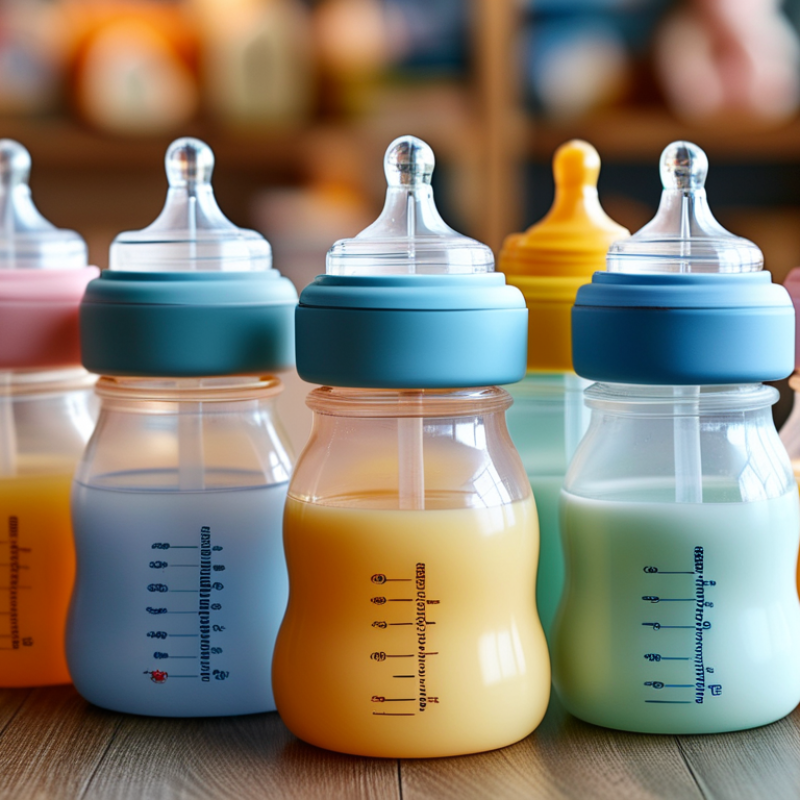
BPA-free means a feeding bottle contains no intentionally added bisphenol A. It does not automatically mean chemical-free or risk-free. Common materials include polypropylene, glass, silicone, and BPA-free copolyesters. Polypropylene is light and practical for travel. Glass resists odors but can break. Silicone usually serves as a soft nipple or sealing part.
EFSA’s 2023 scientific opinion reduced BPA’s tolerable daily intake from 4 micrograms to 0.2 nanograms per kilogram of body weight daily. That sharp revision deserves attention. European buyers should check Regulation (EC) No. 1935/2004, plastic-migration rules, and EN 14350:2020 for drinking equipment. U.S. buyers can request compliance evidence under relevant FDA food-contact requirements. Ask for independent testing of overall migration, specific migration, heavy metals, and repeated-use conditions. A BPA-free logo is not enough. Heat, scratches, and poor cleaning can still affect performance. I would not treat one laboratory result as a complete safety verdict. Suppliers should provide material declarations, test dates, batch traceability, and clear temperature limits. Small details matter.
Choosing the right BPA-free feeding bottle depends on the baby’s age, feeding method, and daily routine. Standard narrow-neck bottles are practical for formula feeding and simple to clean. Their slower-flow nipples can suit newborns who need steady control. Wide-neck bottles often feel closer to breastfeeding. They may help families combine breast milk and bottle feeding, although every baby responds differently.
Anti-colic bottles use vents or internal tubes to reduce swallowed air during feeding. They can be useful for babies who show frequent burping or discomfort. However, more parts also mean more washing mistakes. Glass bottles resist odors and handle repeated heating well, but they are heavier and can break. Food-grade silicone bottles are lighter and flexible. They work well for travel, though some models may retain milk odors after long use.
For busy families, bottles with disposable liners can reduce washing time. Check whether the liner system matches local food-contact requirements. BPA-free labeling is important, but it does not prove that every component is equally suitable. Inspect the nipple, cap, seal, and bottle body separately. Follow the maker’s temperature guidance, especially with hot liquids. I have found that easy cleaning often matters more than clever design. No bottle solves every feeding problem. Replace damaged or cloudy parts promptly. Some babies still reject a bottle after several careful trials.
For global buyers, a BPA-free feeding bottle should be judged by more than its material claim. Check whether the bottle uses food-contact materials and whether testing information is available from a reliable laboratory. BPA-free labeling alone does not explain durability, heat tolerance, or chemical migration performance. Ask for clear compliance documents before placing a large order.
The nipple design deserves close attention. Compare flow rates, softness, shape, and the stability of the venting system. A slow-flow nipple may suit newborn feeding, while older infants often need a different rate. Fit matters more. An uneven seal can cause leaking, swallowed air, and frustrating cleaning. Small parts matter. Inspect the cap, collar, and valve for gaps where milk residue may remain.
Daily handling also reveals practical differences. A wide neck usually makes washing and filling easier, but it can feel less comfortable in smaller hands. Graduated markings should remain readable after repeated sterilization. Glass offers strong odor resistance, while lightweight plastic may be safer during travel, though it can scratch over time. From product evaluations, I have learned that no bottle performs perfectly in every household. A design that looks efficient may still have a valve that is difficult to assemble. Buyers should test samples, review replacement-part availability, and consider local recycling facilities before selecting a long-term supply.
For 2026 global buyers, BPA-free feeding bottles require more than a “BPA-free” label. Market research by Grand View Research valued the global baby bottles market at approximately USD 2.9 billion in 2023. This growth increases the need for reliable compliance evidence, not marketing language. BPA-free claims should cover the bottle, cap, sealing ring, printed surfaces, and nipple. Different materials may require separate testing.
In the European Union, buyers should request a Declaration of Compliance under Regulation (EC) No. 1935/2004. Plastic components should also meet Regulation (EU) No. 10/2011, with applicable migration testing and good manufacturing controls. In the United States, food-contact materials must align with relevant FDA requirements, including 21 CFR provisions. China commonly applies GB 4806.1 and GB 4806.7 for food-contact materials. There is no single global BPA-free certificate. That matters.
Independent laboratories accredited to ISO/IEC 17025 can test specific migration, overall migration, heavy metals, and restricted bisphenols. Ask for reports linked to the exact material grade and production lot. OECD’s Global Plastics Outlook reports that global plastic production reached 460 million tonnes in 2019, highlighting the importance of traceability and material control. A supplier declaration alone may be insufficient. Test the whole system. Some buyers also examine BPS, BPF, colorants, adhesives, and non-intentionally added substances. This is where procurement often becomes difficult. Certification does not replace technical judgment, and even a valid report may become outdated after a formula or supplier change.
Key BPA-related regulatory milestones for major global markets. The year shown is the year of the cited regulatory action or food-contact standard, not a universal certification deadline.
Naturally BPA-free and generally assessed for food-contact safety, heavy metals, thermal shock and migration from coatings or seals.
Commonly used for BPA-free bottles. Buyers should verify resin identification, additives, overall migration and intended-use temperature.
Often used for nipples and soft components. Compliance testing should cover extractables, volatile substances and food-contact limits.
BPA-free as a metal body material. Verify nickel, chromium and other metal migration, plus the safety of internal coatings and plastic parts.
For international purchasing, request a Declaration of Compliance, full material and additive disclosure, accredited laboratory migration reports, traceability records and market-specific labeling evidence. EU Regulation (EU) 2024/3190 introduces broader BPA restrictions, while earlier actions include Canada's 2010 prohibition, the EU's 2011 infant-bottle restriction, the U.S. FDA's 2012 regulatory amendments and China's GB 4806.7-2016 food-contact plastic standard. Requirements should be checked against the destination market and the latest applicable legislation.
Sources: EU Directive 2011/8/EU · EU Regulation (EU) 2024/3190 · Canada SOR/2010-152 · U.S. FDA Food Contact Substances
Global buyers need more than a BPA-free label when selecting feeding bottles. Start with the market’s actual use conditions. Polypropylene bottles are lightweight and cost-efficient for large retail programs. PPSU bottles suit repeated heating and sterilization, but their higher cost affects pricing. Glass offers a strong premium position, although breakage risk increases during transport. Silicone nipples require separate material and performance checks.
Check every component, not only the bottle body. Caps, rings, seals, valves, and printed markings may use different materials. Request current test reports, material declarations, production-lot records, and traceability documents from the supplier. Reports should match the exact product and manufacturing site. Paperwork can look complete. It can still be outdated. Independent laboratory verification is worth considering for new suppliers or revised molds.
Market selection also depends on feeding habits, sterilization methods, climate, and storage conditions. A wide neck may simplify cleaning, while anti-colic valves can add assembly steps and replacement needs. Confirm temperature limits, leak resistance, nipple flow stages, carton strength, and spare-part availability before placing volume orders. Inspect samples after repeated washing and heating, not only when they leave the factory. Supply planning should include realistic lead times, inspection points, and a buffer for rejected units. Even experienced buyers sometimes focus on unit price first. That choice can create higher costs later.
Comparative procurement data for bottle bodies made with BPA-free materials. Actual performance depends on product design, additives, closures, coatings and certified supplier specifications.
| Bottle Type | Main Material | Typical Empty Weight for 240 mL Body | Typical Material Temperature Capability | Sterilization Compatibility | Breakage and Durability | Supply-Chain Advantages | Key Limitations | Recommended Market Positioning | Documents to Request |
|---|---|---|---|---|---|---|---|---|---|
| Polypropylene (PP) | Food-contact polypropylene, specified as BPA-free | Approximately 25–45 g | Common product specifications are approximately 100–120°C; confirm the supplier’s repeated-use rating | Usually compatible with boiling-water and steam sterilization; many designs are dishwasher-compatible | Lightweight and impact-resistant; may scratch, discolor or deform if overheated | Low shipping weight, efficient injection molding, broad availability and generally competitive unit cost | May retain odors; lower heat resistance than PPSU; transparent appearance is limited compared with glass | Mass-market, value-focused and high-volume retail programs | Food-contact declaration, BPA-free test report, migration test, sterilization instructions and material identification |
| Polyphenylsulfone (PPSU) | High-temperature engineering polymer, specified as BPA-free | Approximately 45–70 g | Often specified for repeated exposure around 180–220°C, subject to resin grade and finished-product testing | Generally well suited to repeated steam, boiling-water and dishwasher cleaning when approved by the supplier | High impact resistance and better heat-aging performance than standard PP; may show gradual wear or discoloration | Long service-life potential, strong premium positioning and suitability for demanding sterilization routines | Higher material and molding cost; amber or translucent appearance may not suit every visual specification | Premium, hospital-oriented, frequent-sterilization and long-use product ranges | Resin compliance statement, BPA-free and overall migration reports, heat-aging data, sterilization cycle validation and traceability records |
| Food-Grade Silicone | Platinum- or peroxide-cured silicone suitable for food contact | Approximately 80–130 g, depending on wall thickness and collapsible design | Many food-contact grades are specified around −40°C to 180–220°C; verify the complete assembled product rating | Typically compatible with boiling-water, steam and dishwasher cleaning; inspect for trapped moisture after washing | Highly flexible and resistant to shattering; can tear, attract lint or absorb odors if formulation and cleaning are inadequate | Collapsible formats can reduce storage volume; suitable for travel and compact packaging designs | Higher surface friction, possible odor retention and more complex dimensional control during molding | Travel, outdoor, compact-storage and soft-touch product segments | Curing-system declaration, extractables and migration testing, odor evaluation, tensile data, sterilization instructions and BPA-free statement for all non-silicone parts |
| Borosilicate Glass | Heat-resistant borosilicate glass with BPA-free cap and feeding components | Approximately 180–260 g | Glass can tolerate high temperatures, but safe use depends on thermal-shock limits and the assembled bottle design | Generally compatible with boiling-water and steam sterilization; avoid sudden temperature changes unless specifically approved | Excellent scratch and odor resistance; can break if dropped, so protective sleeves may be required | Stable material properties, clear appearance and strong consumer preference for non-polymer bottle bodies in some markets | Heavy freight, higher breakage risk, more protective packaging and increased handling cost | Premium home-use, low-odor, easy-clean and sustainability-focused ranges | Glass composition or food-contact declaration, thermal-shock test, impact or drop test, migration reports and separate compliance documents for caps, seals and nipples |
| Stainless Steel | Food-contact stainless steel, commonly selected from corrosion-resistant grades | Approximately 90–150 g | Metal body tolerates high temperatures, but coatings, seals, handles and feeding components may have lower limits | Often compatible with steam and boiling-water sterilization; confirm compatibility of all attached components | Strong impact resistance and low shatter risk; dents, surface scratches and potential metal taste complaints must be controlled | Durable for travel and outdoor use; recyclable metal body and reduced breakage-related returns | Opaque, limiting visual volume checks; metal composition, welding quality and corrosion resistance require verification | Outdoor, travel, durable-use and reduced-breakage product segments | Steel grade declaration, food-contact migration testing, corrosion test, weld inspection, coating reports and BPA-free documentation for plastic or silicone components |