7 Twin Shaft Mixer Concrete Buying Tips
Choosing a Twin Shaft Mixer Concrete system is not simply a capacity decision. It is a production, quality, and lifecycle decision.
The International Energy Agency reports that cement production creates roughly 7% of global energy-related carbon dioxide emissions. The Global Cement and Concrete Association also identifies efficiency, durability, and lower material waste as major industry priorities. These pressures make mixer selection more important than ever. A poorly matched mixer can leave dry pockets, increase cycle time, or produce inconsistent slump. Small losses become expensive at a busy batching plant.
Concrete scientist Dr. Karen Scrivener has stated, “Concrete is the most widely used material in the world.” Her point reflects the responsibility behind every mix design. Uniform blending affects strength, pumping behavior, finish quality, and jobsite reliability. This guide examines seven practical buying tips, including shaft speed, paddle arrangement, discharge design, wear protection, motor efficiency, maintenance access, and supplier support. Each detail matters.
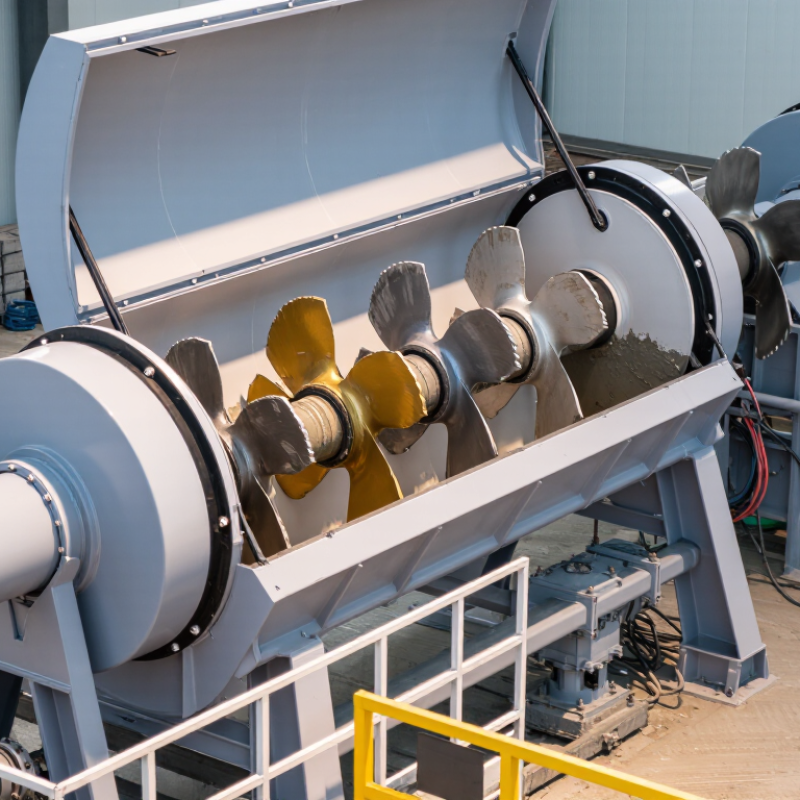
Look inside the machine.
A strong specification can still hide weak service support. That is where buyers sometimes misjudge value. Ask for trial-batch evidence, not attractive catalogue claims. Review test results for your actual aggregates, moisture levels, admixtures, and target output. A mixer that performs well with clean sand may struggle with recycled aggregate or sticky materials. The right Twin Shaft Mixer Concrete solution should deliver repeatable results, accessible maintenance, and measurable operating value. No mixer is perfect. Careful verification reduces unpleasant surprises.
Capacity and Throughput: Size Batches at 60–70% of Rated Volume
A twin shaft mixer’s rated volume is not its ideal production volume. For reliable mixing, size routine batches at 60–70% of that rating. A 3 m³ mixer therefore suits batches of about 1.8–2.1 m³. This headspace helps the shafts lift and fold material without forcing concrete over the cover or stressing the drive system. It also allows for moisture changes and aggregate movement. The Portland Cement Association reports normal concrete density near 2,300–2,400 kg/m³, so a 2 m³ batch can weigh roughly 4.6–4.8 tonnes before equipment loads are considered. That mass needs careful torque and structural checks.
Throughput depends on the complete cycle, not the nameplate volume. Include loading, dry blending, wet mixing, discharge, and cleaning. If a 2 m³ batch takes eight minutes, the theoretical output is 15 m³ per hour. Real output will be lower. A poorly planned discharge layout can waste several minutes per cycle. Small delays become expensive.
During buying trials, measure slump, air content, discharge consistency, and motor current. ASTM C94/C94M uses uniformity checks involving slump, air content, and coarse aggregate distribution. ACI 304R also emphasizes controlled batching and mixing procedures. The 60–70% target is practical guidance, not an ASTM requirement. That distinction matters. A denser mix, sticky admixture, or wet aggregate may require a smaller working batch. I would test the hardest expected recipe, not an easy laboratory mix.
Concrete Quality: Verify ASTM C94 Uniformity Limits and EN 206 Compliance
7 Twin Shaft Mixer Concrete Buying Tips
Concrete production exceeds roughly 14 billion cubic metres annually, according to the GCCA Concrete Future Roadmap. That scale makes uniformity critical. A twin shaft mixer should create consistent colour, slump, air content, and aggregate distribution across each batch. ASTM C94/C94M evaluates uniformity through samples taken from different discharge portions. Check the current edition for applicable limits, including slump variation, air-content variation, and unit-weight consistency. A perfect laboratory result can still hide a weak discharge pattern.
Tips: Request factory batch records and witnessed site trials. Test the first, middle, and final discharge portions. Inspect shaft clearance, paddle wear, liner condition, and clean-out access. Confirm moisture correction for changing aggregate conditions. Ask whether the control system records water, cement, admixture, and mixing time. Review the supplier’s maintenance response time. Do not accept “high capacity” as proof of uniform mixing.
EN 206 compliance requires more than mixer performance. Verify the specified strength class, exposure class, chloride class, consistency class, maximum water-cement ratio, minimum cement content, and conformity-control procedure. National annexes may add requirements. ASTM C94 and EN 206 also depend on sampling and testing discipline, not equipment alone. I have seen purchasing teams overlook discharge segregation after focusing on motor power. That mistake is expensive. A new mixer may pass an empty-load inspection yet struggle with sticky, wet aggregates during peak production. Witness a realistic trial, record test results, and leave room for uncomfortable findings.
Mixing Performance: Compare 30–60-Second Cycles and Moisture Control
When evaluating a twin shaft mixer, focus on real mixing performance, not advertised capacity alone. A 30-second cycle may suit consistent concrete with well-graded aggregates. A 60-second cycle can provide better uniformity when recipes contain fibers, admixtures, or variable moisture. Ask for test data using materials similar to your own production.
Watch the discharge carefully. A strong mixer should release the batch evenly, without dry pockets near the corners or wet streaks beneath the shafts. Moisture control matters just as much as mixing speed. Built-in sensors can measure aggregate moisture before water enters the batch. This helps reduce slumping, strength variation, and unnecessary cement adjustments.
Calibration is essential. Dust on a sensor, changing sand temperature, or poor probe placement can distort readings. I have seen a fast cycle fail because the moisture value was wrong. That mistake was expensive. Operators should compare sensor readings with manual samples and recalibrate regularly. Also check whether the control system records moisture, water addition, cycle time, and batch results. These records make troubleshooting more reliable.
A 30–60-second cycle is only meaningful when loading, dosing, and discharge times are measured separately. Shorter is not always better. Evaluate several batches, inspect consistency, and leave room for seasonal moisture changes.
Durability and Maintenance: Specify Replaceable Paddles and 10–20 mm Liners
Durability should be specified before comparing mixer prices. Twin shaft mixers face repeated impact from coarse aggregate, sand, and cement paste. Replaceable paddles keep mixing performance adjustable after wear begins. They also reduce the need for major shaft repairs.
A practical specification is a 10–20 mm replaceable liner, selected according to aggregate hardness and production intensity. Thicker liners can protect the shell longer, but they also reduce internal volume as wear progresses.
Inspect exposed edges, bolt heads, and paddle clearances every 100 operating hours. This interval is only a starting point. Actual inspection frequency should follow site dust, moisture, and aggregate conditions.
Uniformity matters more than appearance. ASTM C94/C94M identifies concrete uniformity checks involving slump, air content, and coarse aggregate distribution. Worn paddles can create dead zones and inconsistent discharge, even when the mixer looks serviceable. ACI 304R also emphasizes consistent charging, mixing time, and equipment condition for reliable concrete production.
Keep a wear log with liner thickness, paddle clearance, batch count, and repair dates. Replace paddles in matched sets when possible. One badly worn paddle can disturb the mixing pattern.
I would not assume a 20 mm liner always lasts longer economically. A smaller, replaceable liner may reduce downtime and improve access. That trade-off is easy to overlook.
Drive, Safety, and Cost: Check Torque Reserve, CE Guards, and 5-Year TCO
A twin shaft mixer should be bought around its worst load, not its showroom output. In site audits, I check torque reserve before motor horsepower. A useful target is 15–25% reserve above the calculated peak torque, especially for stiff mixes, cold starts, and uneven feeding. Torque matters. A gearbox running near its limit can overheat, stretch maintenance intervals, and stop production at the worst moment.
Drive efficiency also affects five-year total cost of ownership. The U.S. Department of Energy reports that motor-driven systems consume about 70% of industrial electricity. This figure is not mixer-specific, but it explains why efficient motors, correctly sized drives, and soft-start control deserve attention. Record energy use, gearbox oil, wear parts, labor, and expected downtime. Purchase price is only the visible number. That cost hurts.
Safety needs physical evidence, not brochure language. Check fixed guards, interlocked access doors, emergency stops, and safe isolation points against ISO 12100 and EN 60204-1 principles. Equipment sold in the European market should carry appropriate CE conformity documentation, with a risk assessment and technical file available. The European Agency for Safety and Health at Work identifies machinery as a persistent source of workplace injuries, so access protection cannot be treated as decoration. I have seen inspection habits weaken after installation. Build the five-year review into the contract.
Use the torque-reserve target to protect against peak load and material changes, verify that all access points pass the CE guarding checklist, and compare total cost of ownership rather than purchase price alone. The five-year TCO model assumes 2,000 operating hours per year, electricity at $0.12/kWh, scheduled maintenance, and estimated downtime costs; it excludes taxes, freight, and installation.