Smart Heating Solutions
10 Best 5G Components for Global Buyers?
Global 5G deployment is moving from ambitious trials toward dense, commercial networks. GSMA Intelligence reported approximately 1.6 billion 5G connections worldwide by the end of 2023. Its Mobile Economy 2024 report forecasts about 5.5 billion connections by 2030. That expansion increases demand for reliable radio-frequency, power, timing, antenna, and thermal solutions. It also makes component selection less straightforward.
A 5g Component must perform across different spectrum bands, climates, regulations, and network designs. Ericsson’s Mobility Report identifies continued growth in 5G subscriptions and data traffic, while highlighting the pressure placed on network capacity and energy efficiency. Qualcomm President and CEO Cristiano Amon has described 5G as “a platform for innovation.” The statement matters for buyers because components now support factories, vehicles, private networks, and connected devices—not only smartphones.
This guide examines ten important 5G components for global buyers. It considers signal quality, interoperability, lifecycle support, supplier credibility, energy use, and total ownership cost. RF filters may improve selectivity. Power amplifiers may strengthen coverage. Antenna modules, modems, baseband processors, switches, connectors, and timing devices each solve different problems.
There is no perfect shortlist.
A cheaper component may increase testing costs later. A powerful module may create thermal challenges inside a compact enclosure. Regional certification can also change purchasing decisions. These practical details are easy to overlook. They should not be. Our selection therefore combines published industry evidence with real procurement concerns, while acknowledging that network architecture and local requirements continue to evolve.
What Are 5G Components and Why Do They Matter Globally?
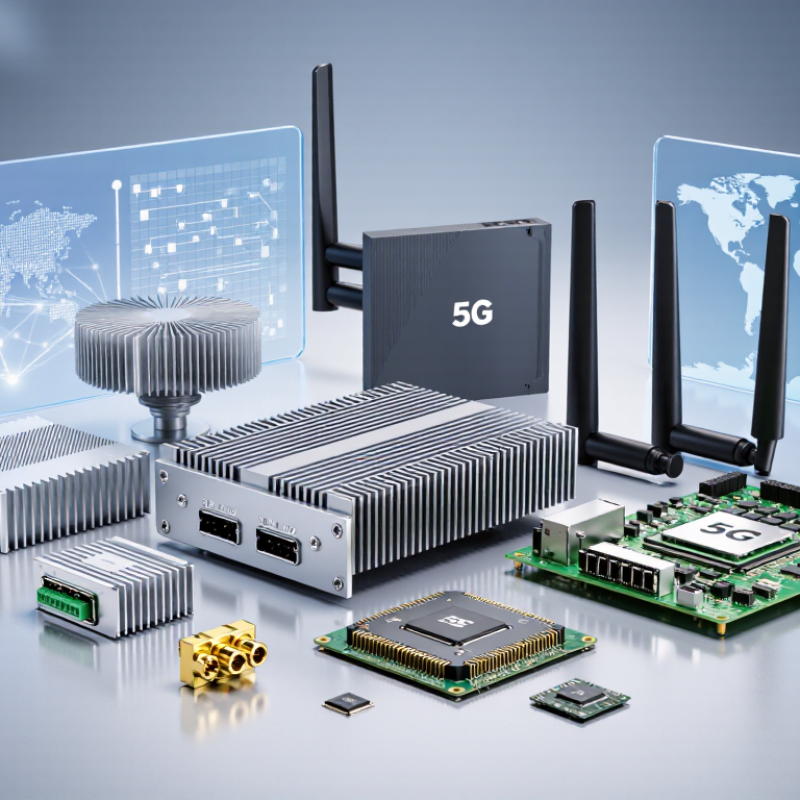
5G components are the working parts behind faster, more responsive wireless networks. They include antennas, radio-frequency filters, power amplifiers, modems, processors, connectors, and thermal-control materials. Each part affects signal strength, energy use, device size, and operating stability. Small parts matter.
For global buyers, compatibility is the central concern. A radio module must support the required frequency bands in its target markets. Antenna designs also need reliable performance inside crowded urban areas, rural sites, and indoor facilities. Buyers should review test reports, operating temperatures, certification records, and supplier traceability. A component that performs well in a laboratory may struggle beside concrete walls or under heavy heat. That difference is easy to underestimate.
Quality also influences long-term ownership. Efficient power amplifiers can reduce battery drain, while strong filters limit interference between nearby signals. Durable connectors help equipment survive vibration, moisture, and repeated maintenance. In practical evaluations, engineers often compare sample performance with production consistency, not just advertised specifications. This matters globally because shipping delays, regional standards, and replacement access can change the real cost. The cheapest part may create expensive redesign work later. I would still question any supplier offering perfect performance claims without clear test conditions. Careful buyers should request measurable data, independent verification, and a realistic failure-response process before placing large orders.
10 Best 5G Components for Global Buyers? - What Are 5G Components and Why Do They Matter Globally?
| Rank | 5G Component | Primary Function | Typical 5G Deployment | Relevant Frequency Range | Key Technical Data | Global Buyer Priorities | Why It Matters Globally |
|---|---|---|---|---|---|---|---|
| 1 | 5G Antenna Arrays | Transmit and receive radio signals while supporting beam steering and spatial multiplexing. | Macro base stations, small cells, fixed wireless access equipment, and user devices. | Sub-6 GHz bands such as 3.3–3.8 GHz; mmWave bands above 24 GHz. | Common massive-MIMO configurations include 32T32R and 64T64R at base stations; mmWave modules may use integrated multi-element arrays. | Gain, radiation efficiency, antenna isolation, size, environmental rating, and local spectrum compatibility. | Antenna design directly affects coverage, capacity, beam quality, and equipment suitability across different national bands. |
| 2 | RF Power Amplifiers | Increase the strength of outgoing radio-frequency signals before transmission. | Base-station radios, small cells, customer-premises equipment, and smartphones. | Sub-6 GHz and mmWave frequencies, depending on the radio design. | Important metrics include output power, power-added efficiency, linearity, gain, and error-vector magnitude. | Thermal behavior, energy efficiency, linearity under wideband signals, and compliance with regional emission limits. | Efficient amplification reduces operating costs while maintaining data throughput and signal quality. |
| 3 | RF Filters and Duplexers | Select required frequency channels and suppress unwanted interference between transmit and receive paths. | Radios, smartphones, routers, repeaters, and distributed antenna systems. | Band-specific; common 5G examples include n41 at 2.496–2.690 GHz and n78 at 3.3–3.8 GHz, subject to national allocations. | Key characteristics are insertion loss, rejection, bandwidth, selectivity, isolation, and power handling. | Exact regional band plan, temperature stability, coexistence performance, and mechanical integration. | Strong filtering is essential where 5G operates near satellite, broadcast, radar, or legacy mobile services. |
| 4 | RF Transceivers | Convert digital baseband information into radio signals and convert received RF signals back into digital data. | 5G radio units, active antennas, small cells, routers, and connected devices. | Sub-6 GHz and mmWave, with support determined by the device architecture. | Evaluation factors include channel count, instantaneous bandwidth, sampling rate, dynamic range, and phase-noise performance. | Supported bands, carrier aggregation, power consumption, software control, and interoperability with the intended modem or baseband. | The transceiver determines how flexibly equipment can support diverse spectrum portfolios and network upgrades. |
| 5 | Beamforming and Beam-Management ICs | Control the phase and amplitude of multiple antenna paths to focus radio energy toward users. | Massive-MIMO base stations, mmWave access points, fixed wireless equipment, and advanced terminals. | Especially important for mmWave bands such as 24.25–29.5 GHz, as well as mid-band massive MIMO. | Relevant metrics include phase resolution, amplitude accuracy, scan range, switching speed, and channel count. | Beam coverage, calibration support, thermal design, control interfaces, and performance under blockage or movement. | Beamforming helps compensate for propagation loss and improves capacity in dense urban and indoor deployments. |
| 6 | 5G Modem and Baseband Processors | Perform protocol processing, channel coding, scheduling, modulation, and high-speed data handling. | Base stations, smartphones, industrial gateways, connected vehicles, and customer-premises equipment. | Designed for the supported 5G NR band portfolio, including low-band, mid-band, and mmWave options. | Typical capabilities include 5G NR standalone and non-standalone modes, carrier aggregation, massive MIMO, and low-latency processing. | 3GPP release support, operating-system compatibility, security features, power consumption, and long-term software support. | Baseband capability determines network compatibility, upgrade potential, device performance, and lifecycle longevity. |
| 7 | Clock, Timing, and Synchronization Components | Provide accurate frequency and time references for radio synchronization and coordinated network operation. | Base stations, transport networks, industrial private networks, and time-sensitive applications. | Frequency-independent at the system level, but critical for all 5G NR bands and TDD networks. | Common technologies include GNSS-assisted timing, IEEE 1588 Precision Time Protocol, SyncE, oscillators, and holdover clocks. | Time error, holdover stability, resistance to GNSS disruption, network topology support, and redundancy. | Accurate synchronization supports TDD alignment, coordinated transmission, mobility, and reliable industrial communications. |
| 8 | Power Management ICs | Convert, regulate, sequence, and monitor power for RF, digital, memory, and control circuits. | All 5G infrastructure and user equipment, from remote radio units to handheld devices. | Not frequency-specific; electrical requirements depend on the radio, processor, and antenna architecture. | Important parameters include conversion efficiency, voltage accuracy, load response, thermal performance, and protection functions. | Energy efficiency, input-voltage range, reliability, protection features, component availability, and thermal margins. | Power management affects battery life, operating expenditure, equipment size, and deployment feasibility in areas with limited electricity. |
| 9 | High-Speed Data Converters | Convert analog RF or intermediate-frequency signals to digital data and perform the reverse conversion for transmission. | Direct-RF radios, active antenna units, distributed radio systems, and advanced test equipment. | Sub-6 GHz and higher-frequency architectures, depending on sampling design and signal bandwidth. | Key specifications include sampling rate, resolution, signal-to-noise ratio, spurious-free dynamic range, and power consumption. | Bandwidth headroom, synchronization, thermal dissipation, digital interface compatibility, and linearity. | High-performance converters enable wider channels, flexible radio architectures, and software-defined network upgrades. |
| 10 | Optical Fronthaul and High-Speed Interconnect Components | Transport digitized radio data between centralized, distributed, and radio units with low latency. | Cloud-native radio access networks, centralized RAN, distributed RAN, small-cell aggregation, and private 5G networks. | Electrical or optical transport rather than a specific air-interface frequency; common optical windows include 1,310 nm and 1,550 nm. | Design factors include link rate, reach, latency, synchronization support, optical budget, and interoperability with open fronthaul interfaces. | Fiber availability, operating temperature, network topology, management compatibility, cybersecurity, and maintenance requirements. | Reliable transport connects radio sites to centralized processing and supports scalable, multi-vendor network architectures. |
Note: Frequency ranges and technical configurations vary by national spectrum allocation, network architecture, and applicable 3GPP specifications. Buyers should verify local regulatory requirements and interoperability before procurement.