10 Best Industrial Cable Reel Suppliers for Global Buyers
Choosing an Industrial Cable Reel supplier involves more than comparing prices or browsing product photos. A reel must suit the cable’s weight, length, bend radius, and working environment. Buyers should also check drum dimensions, winding methods, mounting options, and how the reel performs during repeated use. Small details matter.
This guide introduces 10 suppliers serving buyers across international markets. It considers product range, customization, manufacturing capabilities, quality documentation, delivery support, and communication. These factors can help procurement teams narrow their options, whether they need compact reels for workshops or heavy-duty systems for industrial sites. A polished catalog is not proof. Ask for relevant specifications, drawings, and material details before making a decision.
Supplier information can change, and suitability depends on the actual application. A reel designed for indoor storage may not fit a demanding outdoor installation. Likewise, a low purchase price can become less attractive if spare parts, technical support, or shipping timelines are unclear. Check the details. The comparisons ahead are intended as a practical starting point, not a substitute for engineering review. Confirm critical requirements directly with each supplier, and request written confirmation for any features that affect safety, compatibility, or service life. The best choice is the one that meets documented needs consistently—not simply the one with the broadest claims.
Industrial Cable Reels: Main Types, Components, and Industrial Uses
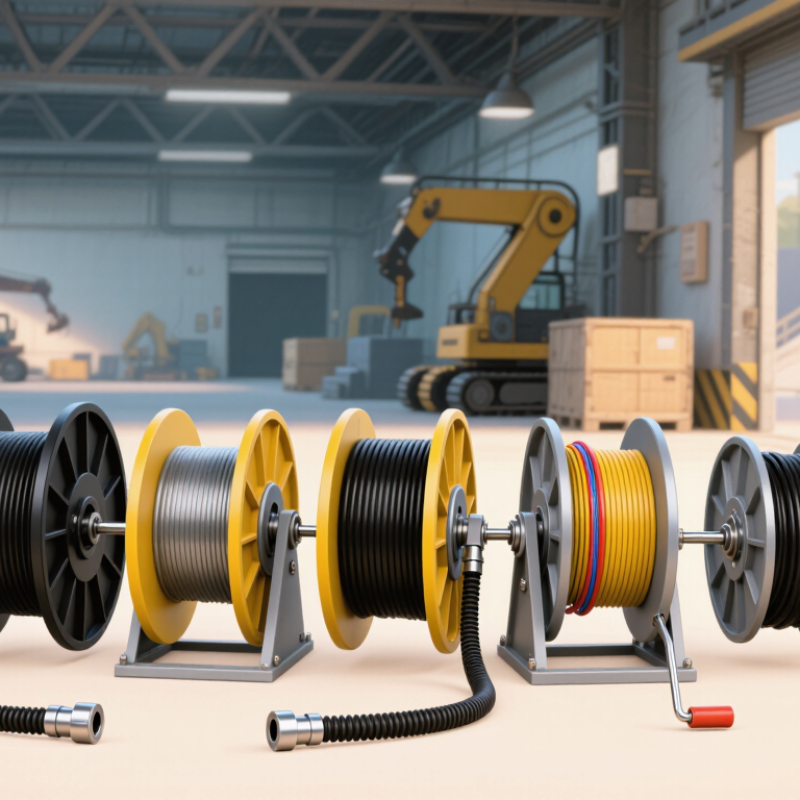
Industrial cable reels keep power, control, or data cables organized where equipment moves or cables face repeated handling. Common types include hand-cranked reels for light-duty work, spring-driven reels for automatic take-up, and motorized reels for longer or heavier cables. Selection depends on cable length, weight, voltage, travel speed, and the working environment. A reel that looks suitable on paper may still wind poorly if its cable diameter or bend radius is mismatched.
A typical assembly includes a drum, side flanges, frame, axle, cable guide, and winding mechanism. Powered models may also use a slip ring to maintain electrical continuity as the drum turns. Brakes, seals, and corrosion-resistant finishes can matter in dusty, wet, or outdoor settings. Reels appear on cranes, production lines, service vehicles, and material-handling equipment. Small details matter. A misaligned guide can cause uneven layers, while an undersized drum may shorten cable life. The right configuration is not always obvious; operating conditions should be checked before purchase.
Tips: Confirm the cable’s outside diameter, total length, and minimum bend radius with the reel supplier. Ask how the reel handles duty cycle, speed, and ambient temperature. Leave room for installation and maintenance access. Then verify the proposed setup against the equipment’s actual travel path.
Supplier Selection Criteria: Cable Length, Current Rating, and Duty Cycle
A reel’s cable length should match the full travel path, not merely the distance between two machines. Allow for routing around guards, bends, and a moving carriage, but avoid excess slack that can snag or pile up. Measure the route on the equipment itself. Measure twice. For global purchases, request usable cable length and stored length separately. Reel capacity can change with cable diameter and winding layout, so a catalog figure may not reflect your setup.
Current rating needs equal care. Check normal load and startup current, then compare them with the reel’s rating under stated conditions. Ask whether that rating assumes a particular ambient temperature, conductor size, or cable extension. Heat changes things. A rating without test conditions is difficult to compare. Duty cycle describes how often and how long the reel operates before cooling; occasional workshop use differs from repeated production shifts. Share a realistic operating pattern, including cycles per hour and typical extension length. Ask suppliers to explain their assumptions. I would also verify termination details and maintenance access before ordering. These points are easy to overlook, and a technically suitable reel can still be awkward in daily use.
Safety Benchmarks: UL 355 and IEC 60529 IP Codes (0–6 Solids, 0–9 Water)
For global buyers comparing industrial cable reel suppliers, safety claims need precise evidence. UL 355 addresses safety requirements for cable reels, while IEC 60529 classifies enclosure protection. They answer different questions. Small numbers matter.
IEC 60529 uses two numerals: the first rates protection against solid objects, from 0 to 6; the second rates water protection, from 0 to 9. Its classification table defines 6 as dust-tight and 9 as protection against high-pressure, high-temperature water jets. A reel marked IP65, for example, has a different water rating from one marked IP66. Check the tested configuration, not just the label. A connector, open cover, or cable exit may affect real-world protection.
Ask suppliers for current test documentation referencing IEC 60529 and applicable UL 355 certification details. Verify voltage, current, cable length, mounting position, and duty cycle against your installation. An IP rating does not establish electrical safety, and UL 355 compliance does not automatically prove a particular IP level. Test conditions are controlled; a muddy factory floor is not. That distinction is easy to overlook.
10 Industrial Cable Reel Suppliers Compared by Products and Global Reach
Industrial cable reel suppliers vary widely in the equipment they offer. Some focus on compact spring-driven reels for workshops, while others supply motorized reels for manufacturing lines, ports, or mobile service vehicles. Their catalogs may include power, welding, data, and fluid-handling reels, but a broad range does not guarantee every model suits demanding duty cycles. Check cable capacity, voltage rating, enclosure protection, and mounting options against the actual installation.
Global reach is more than a list of export destinations. Buyers should compare regional stock, delivery estimates, spare-part access, and technical support across time zones. A supplier with nearby service staff may resolve a damaged slip ring faster than one offering a wider shipping network. Ask how replacement parts are identified and whether drawings or installation guidance are available. Small details matter.
Product descriptions can look complete, yet leave out useful limits, such as operating temperature or recommended retraction speed. Request a datasheet and confirm any required testing or documentation before placing an order. Compare warranty terms and support response times, not just unit prices. No supplier comparison is perfect; local conditions and maintenance capacity can change which option works best.
10 Best Industrial Cable Reel Suppliers for Global Buyers
10 Industrial Cable Reel Suppliers Compared by Products and Global Reach
This chart presents suggested buyer-evaluation weights, not verified scores for individual suppliers. Compare suppliers using documented product specifications, customization options, certifications, delivery coverage, and after-sales support.
Global Buying Checks: Certifications, Lead Times, Warranty, and Service Coverage
A cable reel may look simple on a product sheet, but global purchasing depends on details that are easy to miss. Ask suppliers for certificates relevant to the reel’s materials, electrical rating, and intended environment. Check the issuing body, product model, and validity dates; a certificate for a similar model may not cover the unit you are buying. Check the fine print.
Request test reports for load capacity, cable winding performance, and insulation where applicable. Compare the stated operating temperature and enclosure rating with the actual site conditions, such as a damp factory floor or outdoor loading area. Small details matter. A polished document is useful, but it does not replace clear answers about how the product was tested.
Lead times should include production, inspection, packing, and transport—not just the factory schedule. Ask what happens if a component is delayed, and get milestone dates in writing. Review warranty length, exclusions, claim evidence, and who pays for replacement shipping. Then map service coverage to the places where reels will operate. Confirm local technicians, spare-part availability, and response times. A spreadsheet cannot show how quickly a repair will happen, and promised coverage may be thinner than expected. That uncertainty deserves a direct conversation before the order is placed.