Who Are China Top 10 200kW Soft Starter Manufacturers?
A 200 kW soft starter is more than a line in a catalog. It must bring a heavy pump, compressor, or conveyor up to speed without excessive current or sudden mechanical shock. The International Energy Agency’s report Energy Efficiency Policy Opportunities for Electric Motor Systems notes that motor-driven systems account for a substantial share of global electricity use. That wider context matters, though a soft starter mainly manages motor starting and stopping; it should not be mistaken for a general energy-saving device.
This guide compares China’s leading 200kw Soft Starter manufacturers through practical criteria: rated voltage, starting-current limits, bypass arrangements, protection functions, documentation, and after-sales support. IEC 60947-4-2 provides a relevant technical framework for semiconductor motor controllers and starters. Bimal K. Bose’s published power-electronics work offers useful context for evaluating motor-control technology. The following line is an editorial summary, not a verbatim quotation: “Match the starter to the motor, load, and duty—not just the kilowatt rating.”
That sounds obvious. It is easy to overlook. A 200 kW nameplate does not reveal whether a crusher starts under load, how often a pump cycles, or what the site’s supply can tolerate. Manufacturer claims deserve careful checking against datasheets, test records, and application details. Some comparisons will remain imperfect because public product information varies. This overview therefore treats rankings as a starting point, not a substitute for engineering review. For buyers, the useful question is simple: which supplier can document a suitable unit and support it after installation?
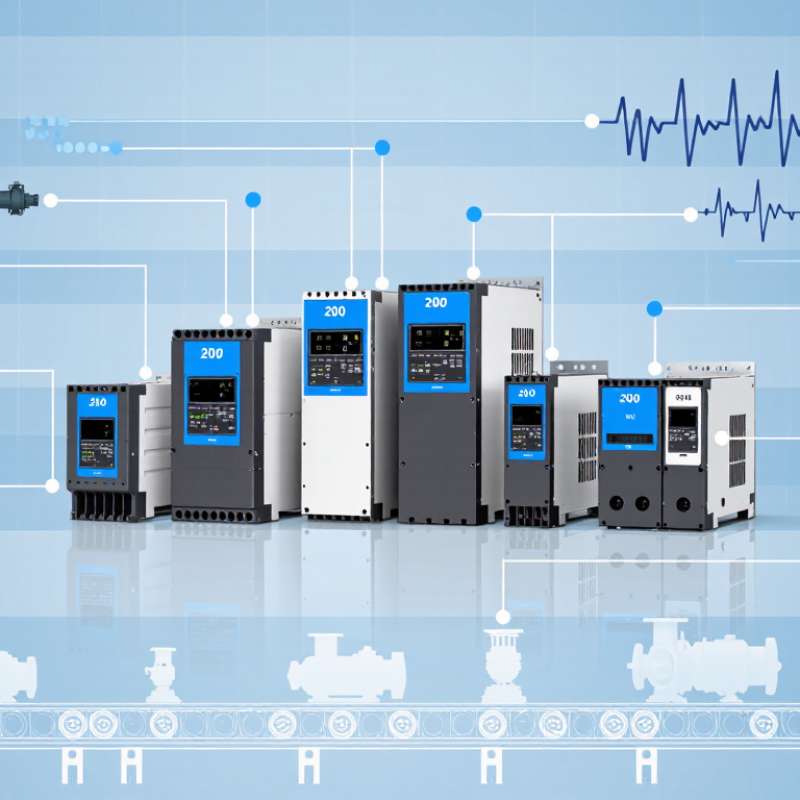
What Is a 200 kW Soft Starter and How Does It Work?
A 200 kW soft starter controls how a large three-phase motor accelerates, rather than simply switching it on at full voltage. Inside, thyristors regulate the voltage delivered to the motor during startup. A controller gradually changes their firing angle, building motor torque and speed over a set ramp time. Once the motor reaches operating speed, a bypass contactor often carries the running current and reduces heat in the starter.
Why use one? Direct-on-line starting can draw roughly five to seven times a motor’s rated current, according to U.S. Department of Energy motor-system guidance. That surge can cause voltage dips, mechanical shock, or both. A soft starter limits the initial electrical and mechanical stress, but it does not provide continuous speed control like a variable-frequency drive. A soft ramp is not magic. Poorly chosen ramp settings may still cause a pump’s water hammer or a conveyor’s belt slip.
The 200 kW label alone does not determine the correct starter size. Engineers check motor full-load current, supply voltage, start duration, starts per hour, ambient temperature, and load inertia. IEC 60947-4-2 covers semiconductor motor controllers and starters, including relevant performance and testing requirements. In practice, a high-inertia fan may need a longer start and greater thermal capacity than a lightly loaded pump. That distinction is easy to miss.
Where Are 200 kW Soft Starters Commonly Used?
A 200 kW soft starter is commonly used where large motors start heavy loads or operate from a limited electrical supply. Typical applications include water and wastewater pumps, industrial fans, air compressors, conveyors, crushers, and mixers. These machines may drive pumps beneath a treatment plant floor or move loaded material along a long conveyor. A controlled voltage ramp can reduce starting current and lessen mechanical shock to couplings, belts, and pipes.
The International Energy Agency’s 2011 report, Energy-Efficiency Policy Opportunities for Electric Motor-Driven Systems, estimates that motor-driven systems consume about 46% of global electricity. That figure shows why motor performance matters, but it does not mean every 200 kW motor needs a soft starter. Selection depends on load inertia, required starting torque, starts per hour, and supply capacity. A soft starter also does not provide continuous speed control after startup. I would still question any selection based only on motor power.
Tips: Check the motor’s nameplate current and the driven load’s starting torque. Confirm the permitted start frequency and cooling time. For pumps, assess water-hammer risk; for conveyors, verify that the reduced starting torque can move a loaded belt.
How to Evaluate China’s Soft Starter Manufacturers
Choosing a 200kW soft starter manufacturer requires more than comparing prices and catalog ratings. Ask for the rated voltage, motor current range, starting duty, and permitted starts per hour. These details should match your motor and load, not just the 200kW label. For a loaded conveyor or pump, request a starting-current curve and acceleration-time guidance. Check how the unit handles overloads, phase loss, overheating, and bypass operation. Clear answers matter.
Tips: Share your motor nameplate and load profile before requesting a quotation. Ask for wiring diagrams, inspection records, and evidence that protection settings can be tested. Confirm enclosure rating, cooling requirements, ambient-temperature limits, and spare-parts availability. A short technical call can reveal whether the supplier understands your installation or is simply repeating specifications.
Evaluate manufacturing quality through documented production checks, component traceability, and realistic delivery commitments. Ask how faults are diagnosed and what support is available during commissioning. If possible, review a sample test report for a comparable unit. A polished brochure is not proof. No checklist catches every site condition, either; cable length, supply quality, and frequent starts can change performance. Leave time for engineering review, even when the quotation looks complete.
Who Are 10 Chinese Manufacturers of 200 kW Soft Starters?
A shortlist of ten Chinese manufacturers of 200 kW soft starters should compare engineering capability, not just catalogue ratings. At 400 V, a 200 kW motor may draw roughly 350–380 A at full load, depending on efficiency and power factor. Check the starter’s rated current, permitted starts per hour, and overload settings against the actual motor and duty cycle. The 200 kW label alone is not enough.
Ask each manufacturer for a wiring diagram, test documentation, and clear guidance on installation and commissioning. Look for practical details: bypass contactor arrangement, cabinet ventilation, motor protection, and settings for ramp-up and current limits. A pump may need a different start profile from a conveyor with a loaded belt.
Small detail, big difference.
Compare response times for technical support and the availability of replacement parts, too. Be cautious when a supplier offers a universal setting without asking about load inertia or supply conditions.
I would verify these points twice; a polished datasheet cannot show how well a unit performs in a real plant.
What to Compare When Selecting a Manufacturer
For a 200 kW soft starter, compare more than the headline rating. At 400 V, full-load current may be around 350–380 A, depending on motor efficiency and power factor. Use the motor nameplate current for sizing. Ask manufacturers to specify rated current, starting duty, starts per hour, and permitted ambient temperature. A 200 kW label alone says little. A loaded conveyor needs different starting torque from a centrifugal pump.
Check evidence, not just claims. Request test records for current limit, acceleration time, bypass operation, overload protection, and temperature rise. Confirm alignment with IEC 60947-4-2, and ask how ratings change above 40°C or at altitude. The U.S. Department of Energy’s Improving Motor and Drive System Performance sourcebook estimates motor-driven systems account for about 68% of electricity use in U.S. manufacturing. Reliable commissioning and service access therefore matter. Compare spare-part availability, response times, wiring support, and warranty terms. A polished datasheet may still omit your toughest start condition; ask how the unit performs against your actual load profile.
Tips: Bring the motor nameplate, supply voltage, load details, starts per hour, and ambient temperature to the quotation review. Ask for the selection basis in writing. Small details matter.