Smart Heating Solutions
Choosing electric baseboard heaters in 2026 requires more than comparing prices and wattage. A suitable model must match the room’s size, insulation, window exposure, ceiling height, and daily heating habits. A cold bedroom with two exterior walls needs different planning than a small, well-insulated office. Measure carefully. Guessing can create uneven comfort and unnecessary energy use.
HVAC educator John Barba offers a practical reminder: “The lowest purchase price does not guarantee the lowest operating cost.” That principle still matters. A basic heater may cost less today, yet a precise thermostat, durable construction, and reliable controls can improve comfort over many winters. Look for listed safety features, clear installation instructions, and compatibility with the home’s electrical circuit. Professional installation may also be wise when circuit capacity is uncertain.
This guide examines electric baseboard heaters through real household concerns, including heat output, thermostat control, placement, noise, maintenance, and long-term running costs. It also considers newer expectations for 2026, such as smarter controls and better energy management. Technology helps, but it cannot fix poor sizing. That is an easy mistake to make. A heater can be powerful, attractive, and still feel wrong in the room. The best choice balances measurable performance with the way people actually live.
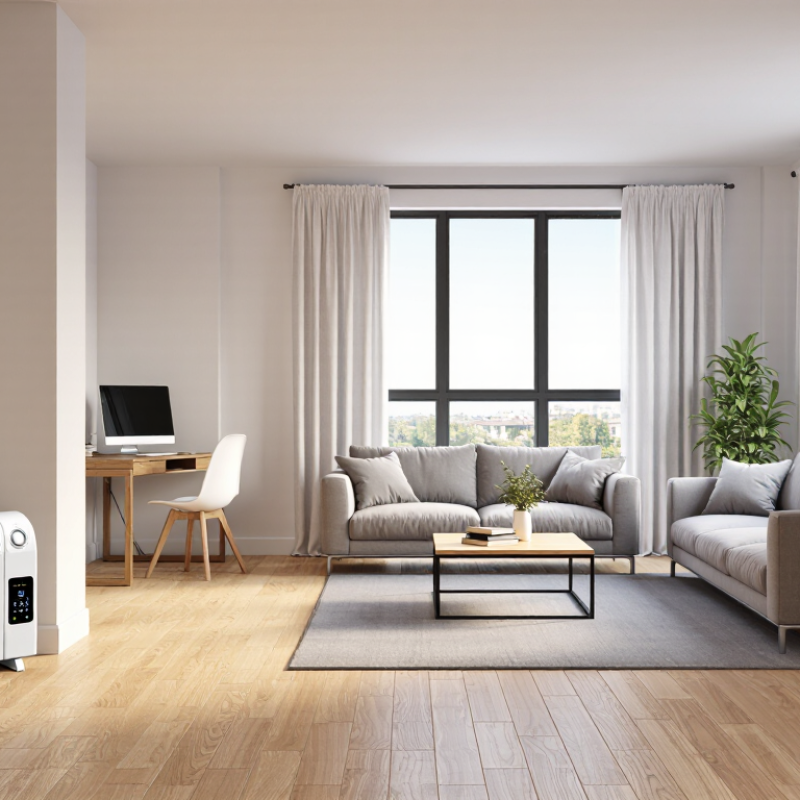
Room heat loss should guide electric baseboard selection. ACCA Manual J evaluates outdoor design temperature, insulation, windows, doors, ceiling height, and air leakage. Measure the room carefully. A cold corner can change the result.
For an early estimate, use the 10 W/ft² benchmark. A 150-square-foot bedroom would need about 1,500 watts. That equals roughly 5,118 Btu per hour. This figure is convenient, but it is not a final load calculation. Older homes may need more. Tight, insulated rooms may need less. The benchmark can oversize equipment in mild climates.
Manual J also accounts for local winter conditions, unlike a simple square-foot rule. The U.S. Energy Information Administration reported that space heating used about 42% of residential energy in its 2020 Residential Energy Consumption Survey. That makes accurate sizing important for operating cost and comfort. Confirm circuit capacity with a qualified electrician.
Electric resistance heat converts electricity to heat efficiently at the room, but electricity prices still matter. I would not trust 10 W/ft² blindly. Compare it with Manual J results, window exposure, and observed drafts. Small errors remain possible. That is why a room-by-room worksheet deserves a second review before installation.
Size the heater by room heat loss, not floor area alone. ASHRAE’s Handbook—Fundamentals supports room-by-room load calculations because windows, insulation, ceiling height, and drafts change demand. Electric resistance heat converts one kilowatt-hour into 3,412 BTUs. The U.S. Department of Energy describes this heating method as nearly 100% efficient at the point of use. A 1,500-watt heater therefore delivers about 5,118 BTUs per hour while operating. That figure is useful, but it is not a complete sizing answer.
Voltage affects wiring and current. It does not automatically increase heat output. A 1,500-watt, 120-volt heater draws 12.5 amps. The same wattage at 240 volts draws 6.25 amps, which may simplify circuit planning.
Confirm the circuit rating, thermostat compatibility, and local electrical requirements with a qualified electrician. Installing a 240-volt model on a 120-volt supply can produce weak performance or damage, depending on the design. Small details matter.
Tips:
Measure the room and inspect cold corners near windows. Multiply rated watts by 3.412 to estimate hourly BTUs. Leave clearance around the heater. A heat-loss worksheet is better than guessing, though even professional estimates can miss hidden drafts. Recheck comfort after installation; real homes are imperfect. The Energy Information Administration’s Residential Energy Consumption Survey shows that heating remains a major household energy use, so efficiency begins with accurate sizing, not simply choosing the largest unit.
Electric baseboard heaters often run for long periods. Under NEC Article 424, fixed electric space-heating equipment is generally treated as a continuous load. Size the branch-circuit conductors and overcurrent protection at no less than 125% of the heater load, plus any noncontinuous load.
For example, a 2,400-watt heater on a 240-volt circuit draws 10 amps. Applying 125% produces 12.5 amps before adding other loads. Multiple heaters on one circuit must be combined before sizing the circuit.
Check conductor ampacity, breaker compatibility, terminal ratings, and voltage drop. A clean calculation can still be wrong if the heater voltage is misread. I have seen installations fail at this simple step.
Tips: Record each heater’s wattage and voltage from its data plate. Add the loads carefully, then multiply the continuous portion by 1.25. Do not choose a breaker by wattage alone. Local code adoption may modify NEC requirements, and service calculations remain separate from branch-circuit sizing. A licensed electrician should verify the final design, especially in older homes with crowded panels or aluminum wiring. Leave space for proper connections. Heat at a loose terminal is not a minor detail.
A line-voltage thermostat directly controls the heater’s electrical circuit. Choose one rated for your home’s voltage, such as 120, 208, or 240 volts. Confirm its amperage capacity before installation. A mismatch can cause poor performance or unsafe overheating.
Comfort starts with control. Look for stated accuracy of ±1°F, not vague claims about “precise” heating. This rating helps reduce temperature swings near desks, beds, and exterior walls.
Placement matters as much as the thermostat’s specifications. Install it on an interior wall, away from sunlight, doors, supply vents, and the heater itself.
Keep furniture from blocking the baseboard heater. A professional electrician should verify wiring, circuit capacity, and grounding. Local electrical requirements may also affect the installation. These details are easy to overlook.
Test the system with a separate room thermometer for several hours. Compare readings during both heating and idle periods. A thermostat can display ±1°F accuracy while the room still feels uneven.
Insulation, drafts, and heater length influence real comfort. I would not judge performance after one cold morning. Allow the room to stabilize, then adjust the setting gradually.
Even accurate control cannot compensate for a poorly sized heater. That is the part many buyers discover late.
Look for a current UL or CSA certification mark linked to the applicable heating-equipment standard. A generic “tested” statement is not enough. The mark should appear on the heater or rating plate, not only in an online listing. Verify the model number, voltage, wattage, and certification details.
Keep curtains, furniture, bedding, and storage boxes away from the heater’s air outlet. Never cover the top grille. Measure the space with a tape measure, especially near windows or long drapes. Required distances vary by design, so guessing is unsafe. A certified heater can still become hazardous when installed incorrectly.
Confirm the unit includes an automatic high-limit control or thermal cutoff. This feature should interrupt power when internal temperatures rise abnormally. It does not replace proper clearance. I would also check for a grounded connection, secure wiring, and a thermostat rated for the heater’s load.
Small details matter. I admit I once treated certification labels as sufficient evidence; that was too simplistic. The installation environment deserves equal scrutiny.