Top Coil Transfer Cart Manufacturers in China
Choosing a Coil Transfer Cart manufacturer in China involves more than comparing prices or browsing product photographs. The cart must match the coil’s weight, dimensions, and handling route. A mismatch can create delays, difficult loading, or unnecessary strain on the equipment. That matters.
When reviewing manufacturers, look for clear technical information on rated capacity, table dimensions, drive method, braking, and control options. Ask how the cart performs on the actual floor: Is the route level, narrow, or shared with other vehicles? A short test run can reveal turning limits and stopping behavior that a brochure may not show. Confirm which safety features are standard and which require a custom design. These details should be documented, not left to assumption.
This guide introduces leading Chinese manufacturers and offers practical points for comparing their products and support. Consider design experience, production quality checks, customization capability, delivery arrangements, and access to spare parts. Request drawings and specifications for the intended application, then have a qualified engineer review them. A polished catalog is useful, but it is not proof of suitability. Supplier claims should be checked against written specifications and, where possible, customer references. No single manufacturer is right for every factory. Even a well-built cart may need adjustments after installation; that possibility deserves attention, not dismissal. The aim is to identify a supplier whose equipment, communication, and after-sales support fit the operating conditions.
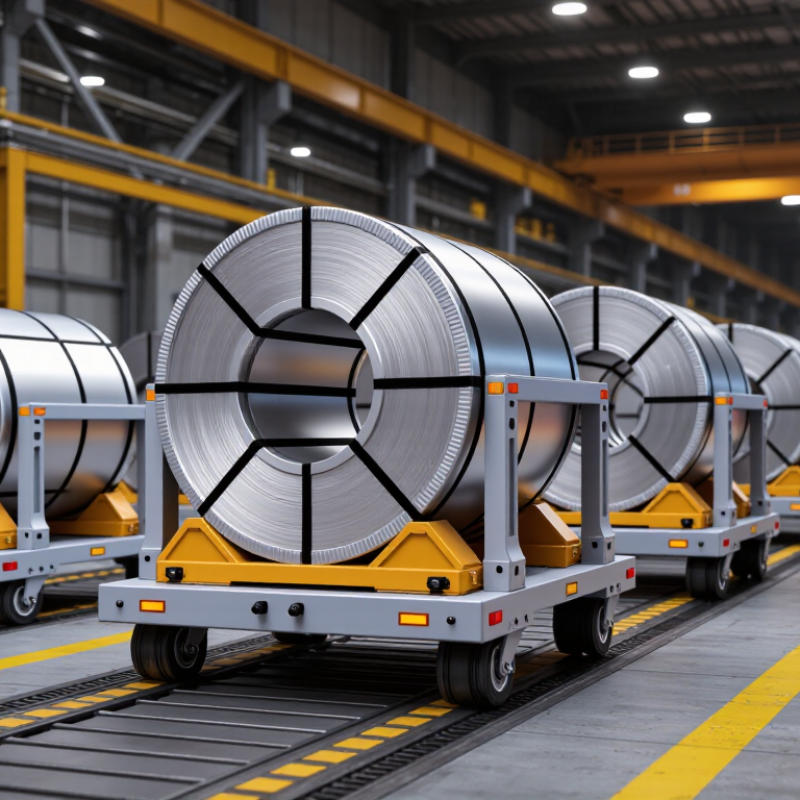
China Coil Transfer Carts: Applications, Rail Types, and 508/610 mm Coil IDs
Coil transfer carts move wound steel between slitting lines, storage bays, and shipping areas, where a dropped or shifting load can damage both material and equipment.
The scale is substantial: the World Steel Association’s World Steel in Figures 2024 reports 1,888.2 million tonnes of crude steel production in 2023. That figure does not measure coil-cart demand, but it shows why dependable internal handling matters.
Small details matter.
Rail choice depends on the route and floor plan. Straight fixed rails suit repeat trips between machines; embedded rails reduce floor obstructions, while curved layouts require careful checks for wheel guidance and coil clearance.
Trackless carts can offer flexible routing, but they need clear travel lanes and disciplined traffic control.
For 508 mm and 610 mm coil IDs, confirm whether the cart uses a V-cradle, bore support, or another restraint.
ID is the inner opening, not the coil’s outside diameter. A V-cradle usually relies more on coil width, diameter, and load position than on ID alone.
Ask for drawings and a loaded trial. A nominal fit can still leave an awkward gap.
Real coils vary, and that deserves a second check.
Cart Design: Rated Payload in Tonnes, Coil Cradles, and Load Restraints
Top Coil Transfer Cart Manufacturers in China
Cart Design: Rated Payload in Tonnes, Coil Cradles, and Load Restraints
A coil transfer cart should match the heaviest planned coil, not just the average load. Confirm rated payload in tonnes, then check how the load is positioned and secured. A coil’s width, diameter, and centre of gravity affect stability. The cart frame, wheels, and floor must also handle the working load. A nominal capacity alone tells only part of the story.
Coil cradles should suit the coil’s diameter and contact points. Steel-lined or shaped supports can help limit movement, but their geometry needs review against real coil dimensions. Restraints should prevent rolling during starts, stops, and turns without damaging edges or packaging. Small details matter. A drawing can still miss a site constraint, such as a shallow floor joint or limited turning clearance, so verify dimensions on site before finalizing the design.
Tips: Share the coil range, not just one sample size. Ask for rated capacity, cradle dimensions, restraint details, and the intended floor conditions. Check that operators can inspect restraints easily. A little uncertainty in early measurements is common; record it and confirm before production.
Illustrative coil payload calculation: Estimated mass for steel coils 1.5 m wide with a 508 mm inner diameter, using a steel density of 7.85 t/m³. Values are calculated from the volume of an annular cylinder and rounded to the nearest 0.1 tonne; they are not manufacturer ratings. When specifying a transfer cart, allow for the heaviest coil and any fixtures, and select coil cradles and load restraints to suit the coil geometry and operating conditions.
Drive Systems: Battery, Cable-Reel, and Busbar Power Options
For coil transfer carts, the drive system shapes more than travel distance. It affects floor layout, charging routines, maintenance access, and uptime. Battery power suits routes that change often or cross open work areas. Operators can move freely without trailing cables. The trade-off is real: charging windows, battery condition, and payload all need careful planning. A battery is not a fit-and-forget choice.
The International Energy Agency’s Global EV Outlook 2024 reports that battery demand in the energy sector reached about 750 GWh in 2023, around 40% higher than in 2022. This broader market figure does not predict cart performance, but it reflects the expanding battery supply chain. For buyers, compare usable capacity, charging time, and expected duty cycle—not just nominal voltage. Check how the cart behaves during repeated loaded starts. Small details matter.
Cable-reel systems can provide continuous power on fixed routes, but cable length and reel placement must match the path. A cable dragged across a busy aisle is a risk and an inconvenience. Busbar systems can keep power delivery aligned with a defined track, making them useful for repetitive routes. Yet installation tolerances and contact maintenance deserve attention. Dust, vibration, or uneven joints may complicate operation. When comparing manufacturers in China, ask for route-specific drawings, load tests, and maintenance intervals. A tidy specification sheet is not the same as a proven installation.
Comparing Chinese Manufacturers: Payload, Speed, Duty Class, and ISO 9001
Comparing Chinese coil transfer cart manufacturers requires more than checking the largest payload listed. Ask whether capacity includes the coil cradle, restraints, and other attachments. A 20-ton coil can create concentrated pressure on the deck, so request load-distribution details and relevant test records. Small details matter.
Compare travel speeds under both loaded and unloaded conditions. A cart rated at 30 metres per minute may need slower operation near people, tight turns, or floor joints. Ask for braking distance at the intended load, and check whether speed control works smoothly during inching. On site, a few metres can change the whole traffic plan.
Duty class reveals how a cart may handle repeated work. Clarify expected trips per hour, shift length, and rest periods; ask how motors and batteries are sized for that pattern. ISO 9001 certification can show that a quality management system is in place, but it does not certify a cart’s payload or performance. Verify the certificate’s scope and validity, then compare drawings, inspection reports, and commissioning support. Paperwork helps, but it cannot replace a practical site trial.
Buyer Checks: Match Coil OD, Width, ID, and Mass to Cart Ratings
Before comparing coil transfer cart manufacturers in China, match the actual coil envelope to the cart’s stated limits. Record the outer diameter (OD), width, inner diameter (ID), and mass from current production drawings or measured samples. Check the largest OD and width, not just the average coil. Small gaps matter. The cradle must support the coil without contacting sharp edges, while its geometry must suit the ID and prevent unwanted rolling. Confirm clearance around guards, nearby equipment, and the cart’s frame. Measure twice.
Mass alone does not tell the whole story. Ask whether the rated capacity applies to a coil with your dimensions and to the proposed cradle arrangement. A wide or off-center coil can shift the load and affect stability, especially during starting and stopping. Verify the load position, wheel or track conditions, and any operating limits with the supplier’s technical team. Share a dimensioned drawing and ask for written confirmation of the usable OD, width, ID, and payload range. A neat data sheet can still leave a mismatch; I would recheck the figures against the heaviest, largest coil before approving the cart.
| Top Coil Transfer Cart Manufacturers in China - Buyer Checks: Match Coil OD, Width, ID, and Mass to Cart Ratings |
| Example Coil | Coil OD | Coil Width | Coil ID | Estimated Coil Mass | Example Cart Rated Payload | Buyer Check |
| Light-duty example | 1,200 mm | 800 mm | 508 mm | Approx. 5.83 t | 10 t | Payload screening: Pass. Confirm that the saddle or V-support accommodates the 1,200 mm OD and does not obstruct the 508 mm ID. |
| Medium-duty example | 1,500 mm | 1,000 mm | 610 mm | Approx. 11.58 t | 15 t | Payload screening: Pass. Verify support spacing and clearances for the 1,000 mm coil width and 1,500 mm OD. |
| Heavy-duty example | 1,800 mm | 1,250 mm | 508 mm | Approx. 22.98 t | 30 t | Payload screening: Pass. Confirm the loading method and support geometry suit the wide coil and its relatively small ID. |
| High-capacity example | 2,000 mm | 1,500 mm | 610 mm | Approx. 33.55 t | 40 t | Payload screening: Pass. Check the cart’s rated payload, coil-centering arrangement, and clearance for the 2,000 mm OD. |
| Extra-heavy example | 2,200 mm | 1,600 mm | 762 mm | Approx. 42.02 t | 50 t | Payload screening: Pass. Confirm the full load footprint, support contact points, and handling clearances with the cart supplier. |
| Data and rating note: Coil masses are approximate calculations for a solid steel annulus using a density of 7,850 kg/m³; actual mass depends on the coil and should be confirmed from a scale reading or production specification. Cart payload figures are illustrative screening examples, not product specifications. The comparison checks for at least 10% nominal payload headroom over estimated coil mass, before adding any fixtures or attachments; this is not a universal design or safety factor. Confirm the complete load, dynamic conditions, load distribution, support geometry, and floor or rail capacity with the cart supplier. |