Smart Heating Solutions
Choosing an explosion-proof LED floodlight is not just a matter of comparing wattage or price. In hazardous areas, the wrong fixture can create serious risks, while a suitable one can provide steady, clear illumination for demanding work. Small details matter: the area classification, ambient temperature, mounting height, beam angle, and exposure to dust or moisture. So does the quality of the product documentation. A bright light is not automatically a safe light.
For this guide, industrial lighting specialist Dana Mercer is an illustrative expert, not a real-world source. The quote below is original editorial wording: “A floodlight earns trust through verified protection, clear documentation, and performance that fits the actual site.” That is a useful test. A label alone is not enough.
The seven tips ahead help buyers assess certification and hazardous-area suitability, compare light output and color quality, and check housing materials, thermal performance, and installation needs. They also cover maintenance access, manufacturer support, and the value of reviewing product records before purchase. A busy loading bay may need a different beam pattern from a tank farm walkway. And harsh weather changes the calculation.
No checklist replaces a competent site assessment. Some details may still be uncertain until the fixture is matched to real operating conditions. Look closely. Ask for evidence. Then choose an explosion-proof LED floodlight built for the location, not just the catalog photo.
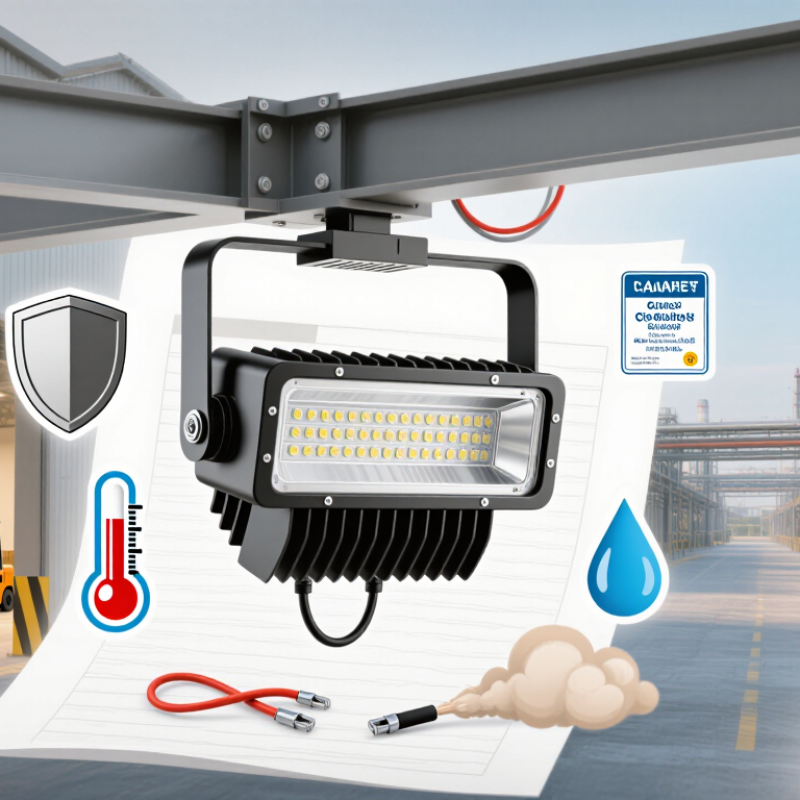
Classify the site before selecting an explosion-protected LED floodlight. IEC 60079-10-1 covers gas and vapour atmospheres; dust areas are addressed by IEC 60079-10-2.
For dust, Zone 20 indicates frequent or prolonged combustible dust clouds. Zone 21 allows occasional clouds during normal operation. Zone 22 describes unlikely, short-lived clouds.
Small details matter.
Match the floodlight’s certified marking to the zone and the actual hazard. Check the equipment protection level, gas group, and temperature class for gas service. For dust service, verify the permitted zone, maximum surface temperature, and enclosure protection. A high IP rating alone does not prove suitability for a hazardous area. Confirm ambient-temperature limits and installation requirements, too.
Read the label carefully. A small mismatch can matter.
Choosing an explosion-proof LED floodlight starts with identifying the actual hazard. Check whether the area contains flammable gas, combustible dust, or both. Gas groups and dust groups use different classifications, so one marking cannot automatically cover every hazard. Compare the equipment label with the site classification, including the required protection method and ambient temperature range. A mismatch can leave a real safety gap, even when the light looks robust.
Tips: Read the full nameplate, not just the T-class. For gas atmospheres, T6 means the light’s maximum surface temperature is 85°C under its specified conditions. That limit helps reduce ignition risk, but it does not describe dust suitability. Dust applications require checking the marked maximum surface temperature against the dust’s ignition characteristics. It is easy to focus on wattage and overlook this distinction.
Check the certification documents and installation instructions before purchase. Confirm the gas or dust group, temperature rating, enclosure rating, cable entries, and operating temperature all suit the location. A T6 marking alone does not make a floodlight suitable for every hazardous area. Conditions can change near hot pipes, under direct sun, or inside a poorly ventilated enclosure. If the marking is unclear, pause and have a qualified hazardous-area professional verify it.
Explosion-proof labels deserve more than a quick glance. IEC 60079-0 sets general requirements for equipment used in explosive atmospheres, including construction, testing, and marking. IEC 60079-1 covers protection by flameproof enclosures, commonly marked “Ex d.” The standards serve different purposes. One marking cannot tell the whole story.
Tip: Photograph the floodlight’s nameplate and compare each code with the project specification. Check the protection method, gas or dust group, temperature class, equipment protection level, and permitted ambient range. A unit suitable for one area may not suit another. Small print is easy to miss.
Confirm that the certificate and installation instructions cover the intended hazardous area, supply voltage, mounting position, and operating temperature. Check the cited standards and editions where available. Do not rely on “explosion-proof” wording alone; it does not confirm suitability for every site. Label codes can be easy to rush past, especially when several appear on one line. If a marking is unclear, ask a qualified hazardous-area specialist to review it before installation.
| Tip | What to Check | Practical Guidance | Example or Reference |
|---|---|---|---|
| 1. Verify the Ex marking | Read the complete marking on the luminaire and compare it with the certificate and product documentation. | IEC 60079-0 specifies general requirements for Ex equipment and its marking. IEC 60079-1 specifies requirements for protection by flameproof enclosures “d.” The standards alone do not confirm that a particular product is certified. | Illustrative gas marking: Ex db IIB T4 Gb. Confirm the exact marking and certificate for the equipment being considered. |
| 2. Match the hazardous-area zone and EPL | Check whether the area is classified for gas or dust, its zone, and the required Equipment Protection Level (EPL). | For gas atmospheres, Ga, Gb, and Gc are generally associated with Zones 0, 1, and 2 respectively. The area classification and applicable regulations determine the required protection; confirm suitability with the site’s hazardous-area documentation. | A luminaire marked Gb is generally intended for Zone 1 or Zone 2 gas areas, subject to its certificate and installation conditions. |
| 3. Check the gas or dust group | Compare the equipment group with the substances identified in the site’s area classification. | For gas, Group IIC covers more demanding gas hazards than IIB, which is more demanding than IIA. Dust equipment uses different group markings and protection requirements; IEC 60079-31 addresses protection by enclosure for dust ignition protection. | IIB equipment is not automatically suitable for a location requiring IIC. Check the actual gas or dust classification. |
| 4. Confirm the temperature class | Check the marked T-class and the maximum surface temperature against the ignition-temperature requirements for the hazardous substance. | For gas equipment, T1 to T6 correspond to maximum surface temperatures of 450°C, 300°C, 200°C, 135°C, 100°C, and 85°C respectively. The permitted temperature must be suitable for the hazard and ambient conditions. | T4 = maximum surface temperature of 135°C under the specified assessment conditions. |
| 5. Check ambient-temperature limits | Review the certified ambient-temperature range and any special temperature marking or installation restrictions. | Operating outside the stated range can affect equipment temperature and protection. Consider local extremes, direct sunlight, nearby heat sources, and the luminaire’s thermal performance. | Compare the product’s stated ambient range, such as −20°C to +50°C, with the actual site design conditions; use only the range shown in its documentation. |
| 6. Assess light output and placement | Review lumen output, beam distribution, mounting height, aiming, glare, and the required task illuminance. | Choose a photometric distribution suited to the area rather than relying on wattage alone. Use a lighting calculation to check illumination levels and uniformity at the working plane. | Request photometric data, such as an IES or LDT file, when preparing a project lighting calculation. |
| 7. Review enclosure rating and installation details | Check the ingress-protection rating, corrosion resistance, cable entries, mounting method, and installation instructions. | An IP rating addresses ingress protection; it does not replace Ex certification. Cable glands, stopping plugs, conduit entries, fasteners, and installation practices must be appropriate for the protection concept and certified equipment. | For outdoor or washdown locations, verify the specified IP rating and materials against the site environment, and follow the certified installation instructions. |
| Selection reminder: Confirm the hazardous-area classification, complete Ex marking, certificate scope, operating conditions, and installation requirements with the responsible hazardous-area professional before purchase or installation. | |||
An explosion-proof LED floodlight should be selected for the light that reaches the work area, not just the number printed on its wattage label. Check delivered lumens from the complete fixture. Then compare the photometric data with the actual mounting height and target area. A high lumen rating can still leave dark corners. That matters.
Beam angle shapes where those lumens land. A narrow beam can reach a distant floor or tank surface, but may create bright spots and deep shadows. A wider beam spreads light across a loading bay, though it may waste light beyond the task. Consider obstructions such as pipes, beams, and equipment. Measure the space, not just the room dimensions. A quick on-site check can reveal details a drawing misses.
Mounting height changes both coverage and brightness at the work surface. For example, a fixture mounted high above a walkway may need a different beam than one aimed at a nearby machine. Review a lighting layout using the fixture’s photometric file, and verify that expected illumination suits the task. Also check glare and shadowing from workers’ normal positions. I have seen neat layouts look less useful once equipment is installed. Recheck the hazardous-area classification and installation requirements with a qualified professional; light output alone does not establish suitability.
For an explosion-proof LED floodlight, IP66 describes protection against dust and water, not explosion safety. IEC 60529 defines the first digit, 6, as dust-tight; the second, 6, indicates protection against powerful water jets. It does not mean the light can be submerged. Not immersion protection. This matters around washdown areas, loading bays, and exposed process equipment.
Tip: Verify the test evidence, not only the rating printed on the enclosure. IEC 60529’s IPX6 test specifies a 12.5 mm nozzle, a flow rate of 100 ±5 L/min, and a distance of 2.5–3 m. Water is applied for at least three minutes. Ask for the test report for the exact assembled model. Inspect cable glands, seals, and lens joints; a weak entry point can undermine a well-sealed housing. Check the certificate.
IP66 does not establish suitability for a hazardous atmosphere, operating temperature, or chemical exposure. Confirm those requirements separately against the site conditions and equipment documentation. A rating can look reassuring, yet installation details still matter. Dust-tightness is tested under the IP6X classification, so check that evidence covers the full enclosure—not just a component.