Top 10 Cell Assembly Machine Manufacturers in 2026
Cell Assembly Machines help manufacturers build battery cells with controlled, repeatable steps. Depending on the process, equipment may handle electrode stacking or winding, tab welding, electrolyte filling, sealing, and inspection. A line can look impressive in a brochure. Its real value becomes clearer when operators assess cycle time, yield, changeover needs, and how consistently it handles different cell formats.
This 2026 guide introduces ten manufacturers serving laboratory, pilot, and production-scale projects. The comparison considers equipment scope, automation options, integration support, service access, and the quality of available technical information. These factors matter on the factory floor: a precise alignment stage, a stable weld, or a clean filling station can affect later testing and production results. Not every supplier offers the same level of detail, and published specifications may not reflect a particular plant’s conditions. Buyers should confirm performance targets, utilities, safety features, and acceptance tests directly with each manufacturer. That takes time. It can also prevent costly assumptions. The list is a starting point, not a substitute for site-specific evaluation; even a well-known brand may not fit every cell chemistry, budget, or production plan.
What Cell Assembly Machines Do and Where They Are Used
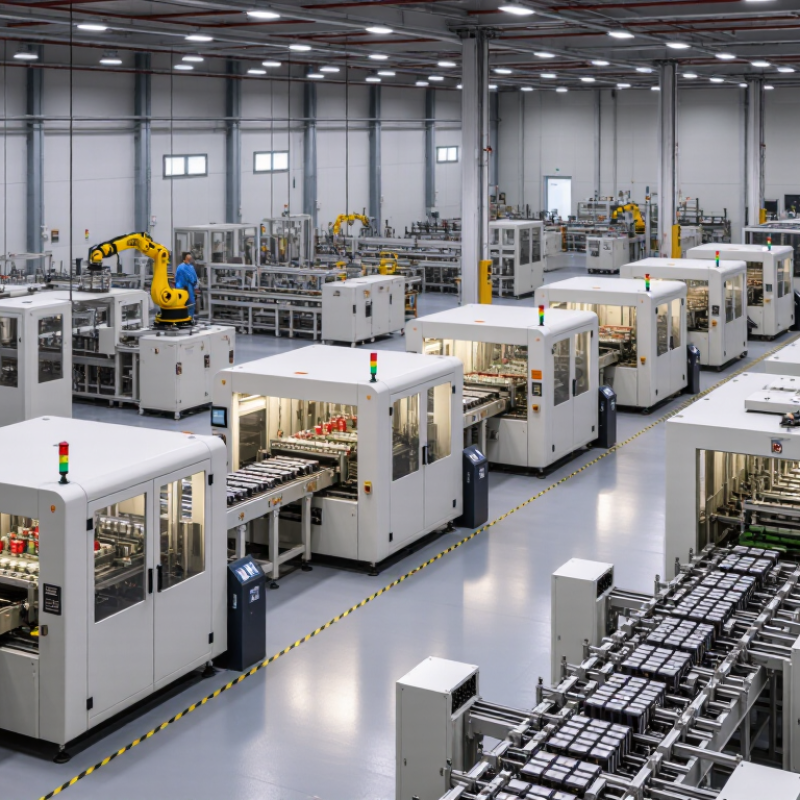
Cell assembly machines turn prepared electrodes and separators into finished battery cells through controlled, repeatable operations. Depending on the cell format, equipment may wind or stack layers, align components, weld current tabs, insert parts into a case, and seal the enclosure. Some lines also meter electrolyte into each cell and inspect seals, dimensions, or electrical performance. Small alignment errors matter. A misplaced layer can affect later quality checks.
These machines are used to make cylindrical, prismatic, and pouch cells for electric vehicles, stationary energy storage, and portable electronics. A vehicle battery plant may connect assembly equipment with robotic handling and in-line inspection. A smaller production line may use more manual loading, especially during pilot runs. The right setup depends on cell design, output targets, and how easily operators can access the process data.
Automation can improve consistency, but it does not remove the need for skilled process control. Temperature, pressure, weld settings, and filling accuracy all need monitoring. Teams should also plan for changeovers, maintenance, and safe handling of materials. The details are easy to underestimate. Some process choices only reveal their weaknesses after extended production, so trial runs and careful measurement remain important.
How Manufacturers Are Evaluated for the 2026 List
The 2026 list evaluates cell-assembly machine manufacturers using verifiable production evidence, not brochure speed alone. The International Energy Agency’s Global EV Outlook 2024 reports that electric-vehicle battery demand reached about 750 GWh in 2023, roughly 40% above 2022. That growth makes reliable throughput important. Yet a quoted cycle time cannot show how many saleable cells a line produces across a full shift.
Our assessment considers demonstrated yield, uptime, changeover time, process control, and consistency across cell formats. We look for evidence from factory acceptance tests, operating references, and service records, while distinguishing measured results from supplier claims. BloombergNEF reported average lithium-ion battery pack prices of $115 per kWh in 2024, down 20% year over year. This signals cost pressure, but does not directly measure machine quality. Numbers need context.
The evaluation also considers spare-parts access, technician training, recipe traceability, and how quickly a machine can recover after a stoppage. Small details matter. Evidence is not always complete: independent access to production lines can be limited, and customer results may not transfer neatly between factories. Where long-run data is unavailable, the assessment treats performance claims cautiously rather than presenting estimates as verified outcomes.
Profiles of the Top 10 Cell Assembly Machine Manufacturers
Profiles of leading cell assembly machine manufacturers in 2026 are best compared by the work their equipment performs, not by marketing claims. Some specialize in electrode stacking, while others focus on winding, tab welding, or cell handling. A useful profile explains compatible cell formats, line speed, changeover time, and how operators access routine maintenance points. Details matter. A guarded weld station, for example, should allow clear inspection without disrupting the full line. Buyers should also check whether quoted output reflects real production conditions or an ideal test run.
The ten profiles can represent distinct strengths: stacking, winding, laser welding, ultrasonic joining, electrolyte filling, sealing, inspection, material transfer, flexible pilot lines, and full-line integration. Each area brings different trade-offs. A high-speed system may need more floor space; a compact line may require slower manual checks. Ask how the supplier handles recipe changes, rejects, traceability, and integration with existing controls. Request sample cycle-time data and a factory acceptance test plan. One caveat: published specifications rarely capture every site-specific delay. That is easy to overlook, and worth questioning before comparing proposals.
Comparing Equipment Capabilities, Applications, and Support
A useful 2026 comparison looks beyond advertised speed. Check which cell formats each machine can handle, including cylindrical, prismatic, or pouch cells. Compare electrode stacking or winding accuracy, tab welding consistency, and inspection options. Ask for cycle-time data from a configuration close to your planned line. Small details matter. A machine designed for pilot production may not suit continuous, high-volume operation.
Applications shape the right choice. Battery research teams may value quick changeovers and flexible recipes, while production facilities often need stable output and clear fault monitoring. Review how easily operators can access settings, replace wear parts, and trace process data. Support deserves equal scrutiny: ask about installation, operator training, spare-part availability, and response times. A polished demonstration is useful, but it cannot replace a documented acceptance test. Real operating conditions can expose gaps.
Tips: Request a sample run using representative materials, and define measurable acceptance criteria before purchase. Ask for service coverage in your region and a parts list for routine maintenance. If a supplier cannot explain expected upkeep clearly, pause and investigate. Some comparisons remain imperfect; published specifications rarely reveal every shift-level constraint.
Key Trends Shaping Cell Assembly Technology in 2026
In 2026, cell assembly equipment is moving toward tighter process control and more connected production lines. Vision systems can check tab position, seal edges, and component alignment while cells move between stations. That matters because a small placement error may cause rework later. Still, inspection data is only useful when teams can trace it to a machine setting, material batch, and production time.
Automation is becoming more modular. A factory may adjust a station for a different cell format without rebuilding the entire line, though changeovers still require careful validation. Robots increasingly handle delicate parts, while sensors monitor force, temperature, and cycle time. Dry-room conditions remain critical; moisture control cannot be solved by software alone. Practical details count.
Another notable trend is predictive maintenance. Equipment can flag unusual vibration or slower cycle times before a breakdown stops production, but alerts need human review. Too many warnings can become background noise. Manufacturers are also paying closer attention to energy use, scrap rates, and how easily machines can share data. These capabilities are promising, yet integration between older equipment and newer systems can be uneven. Buyers should examine real process records, sample changeover procedures, and maintenance access—not just headline throughput—when comparing cell assembly machine manufacturers.