Smart Heating Solutions

China Top 10 Cup Paper Sheet Manufacturers?

Choosing a Cup Paper Sheet manufacturer is not just a price comparison. The right supplier must match the sheet to the cup design, converting equipment, and intended use. Small details matter: a roll that feeds smoothly, a clean cut edge, and a coating that performs as specified. A low quotation means little if production slows or rejected sheets pile up.

This guide introduces ten manufacturers and the questions worth asking before requesting samples. Compare paper grade, basis weight, sheet dimensions, coating options, print quality, and documented food-contact suitability for the intended market. Ask how suppliers manage consistency between batches. Then test samples on your own equipment. Real conditions reveal more than a product brochure. Materials-design expert William McDonough’s principle, “Waste equals food,” offers a useful reminder: consider material choices across their full lifecycle, not only at purchase. It is a guiding lens, not proof that any product is recyclable. That distinction matters. Manufacturer claims should be checked against technical documents and local collection capabilities. This comparison is a starting point, not a substitute for verification. Some specifications may look similar on paper. They may behave differently in production.
China Top 10 Cup Paper Sheet Manufacturers?

What Cup Paper Sheets Are and How They Are Used

Cup paper sheets are flat, food-contact paperboard stock used to form disposable cups. They are not finished cups. A converter cuts or prints the sheets, then shapes them into cup walls; separate circular blanks often form the bases. Many sheets have a thin polymer lining, while others use different barrier coatings. These layers help resist leaks and softening. They do not make every sheet suitable for every drink. Hot beverages need heat-resistant structures, while cold drinks can cause condensation outside the cup. Small details matter.

Useful specifications include basis weight, stiffness, coating type, sheet dimensions, moisture control, and print compatibility. Ask about the intended beverage temperature and forming conditions, not just a “cup paper” label. Test a sample on the actual forming line, then check its seams, rim shape, odor, and leakage. Keep sheets dry and flat; curled edges can disrupt feeding. Sounds straightforward. It often isn’t. Coating thickness and paper fibers may vary slightly, so one successful trial may not represent every batch. Record batch details and repeat tests to make quality checks more reliable.

How Cup Paper Sheets Are Made in China

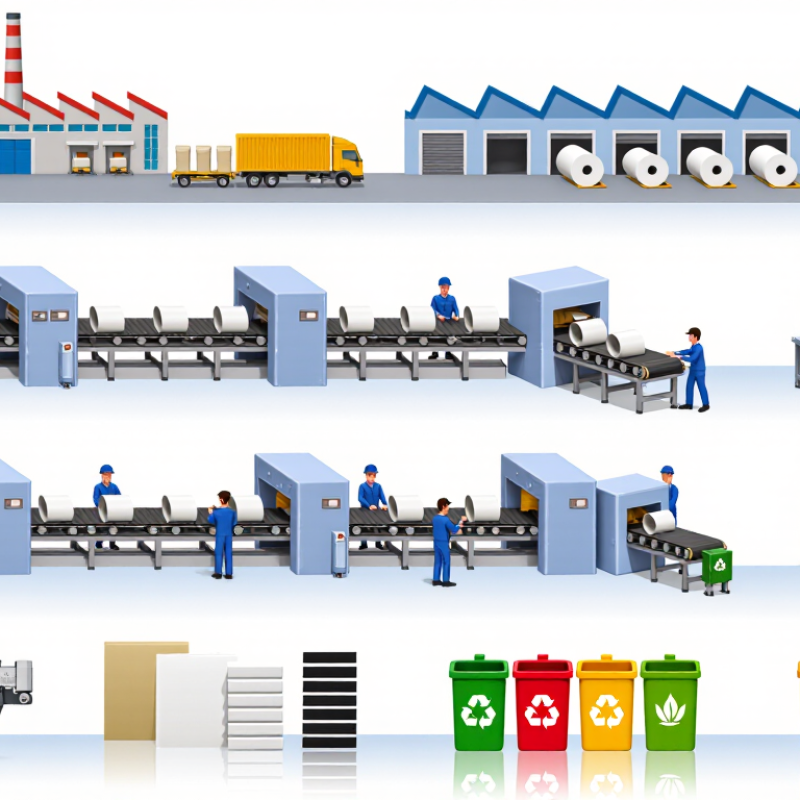
Chinese cup-paper sheets begin with pulp preparation. Mills blend virgin fiber and, where suitable, recovered fiber, then refine the furnish for strength and formation. The China Paper Association reported 127.05 million tonnes of paper and paperboard production in 2023. That figure covers the whole sector, not cup stock alone. The distinction matters. A typical production line forms a wet web on a moving screen, presses out water, and dries it over heated cylinders. Calendering smooths the surface and controls thickness. Operators then apply a barrier coating, often polyethylene or a water-based alternative, before drying and rewinding the board.

Converters slit and cut the rolls into sheets, checking dimensions, moisture, surface defects, and coating consistency. Small details matter. Uneven coating can cause leaks or poor heat sealing during cup forming. A buyer should request test data for grammage, caliper, stiffness, and barrier performance, rather than relying on appearance. China’s large paper industry supports broad sourcing options, but general production totals do not prove a particular sheet’s food-contact suitability. That part needs product-specific documentation and testing. In practice, moisture control can be overlooked; even a well-coated sheet may curl after storage in a humid warehouse. No process is perfectly uniform. Good manufacturers track variation and adjust settings between batches.

Key Criteria for Evaluating Chinese Manufacturers

Evaluating Chinese cup paper sheet manufacturers requires more than comparing quoted prices. Check the paper’s basis weight, thickness, stiffness, and moisture resistance against your cup-forming process. Ask for recent test records and food-contact documentation that matches the specific material and intended use. Verify that certificates are current and traceable to the supplied grade, not simply to the factory. Measure twice. A small difference in sheet thickness can affect feeding, sealing, and finished cup shape.

Request samples from regular production, not only carefully prepared showroom sheets. Run them on your own equipment, noting curl, dust, print adhesion, and how cleanly the sheet cuts. A sample is only a snapshot, not a promise. Ask how the manufacturer controls pulp sourcing, batch identification, inspection frequency, and rejected material. Production consistency matters. Compare stated capacity with actual delivery records and ask how shortages or quality complaints are handled. Review packing details too: moisture barriers, pallet stability, and clear batch labels can prevent damage after shipment. A low quote may exclude useful testing or protective packaging. No checklist removes every surprise; factory claims still need practical verification.

China Top 10 Cup Paper Sheet Manufacturers? - Key Criteria for Evaluating Chinese Manufacturers
No. Evaluation Criterion What to Check Evidence to Request Practical Evaluation Indicator Suggested Weight
1 Food-contact compliance Confirm that the paperboard and any coating or additive are suitable for the intended food-contact application and destination market. Current test reports, material declarations, and documentation identifying the tested product and applicable requirements. Documents match the supplied grade, intended use, and destination-market requirements; verify report scope and validity. 15%
2 Product specifications Review the offered basis weight, thickness, moisture, stiffness, coating type, and tolerances against the buyer’s cup design. Technical data sheet, specification sheet, and recent batch inspection records. Specifications are clearly stated with units, agreed tolerances, test methods, and change-control terms. 12%
3 Sheet quality and consistency Assess sheet dimensions, squareness, flatness, edge condition, surface cleanliness, and uniformity between batches. Representative production samples, inspection criteria, and batch-level quality records. Samples meet the buyer’s written acceptance limits, with defects and sampling rules defined before order placement. 12%
4 Forming and sealing performance Check whether the material runs reliably on the buyer’s cup-forming equipment and produces consistent side and bottom seals. Trial-run records, seal-test results, and samples produced using the intended cup design and process settings. Performance is confirmed in a controlled production trial; acceptance limits for leakage and forming defects are agreed in advance. 12%
5 Coating and print compatibility Verify coating suitability for the application and compatibility with printing, converting, sealing, and any required recycling route. Coating and ink specifications, adhesion or seal test results, and declarations relevant to the intended application. Coating and print performance are tested on the specified material and process rather than inferred from a general product brochure. 10%
6 Quality management and traceability Review incoming-material controls, in-process checks, finished-product inspection, complaint handling, and lot traceability. Quality-system documentation, sample inspection reports, lot-label examples, and corrective-action procedures. Finished sheets can be traced to production lots and relevant raw-material records; nonconformities have a documented response process. 10%
7 Production capacity and lead time Assess available output, schedule flexibility, production planning, and the ability to meet the required order frequency. Capacity statement, typical production schedule, and a written delivery plan for the proposed order quantity. Capacity and lead time are confirmed for the specific grade, sheet size, order volume, and peak-season schedule. 8%
8 Packaging and shipment protection Check moisture protection, pallet stability, sheet-edge protection, labelling, and suitability for the shipping route. Packing specification, pallet photographs or samples, and shipment-marking details. Packaging protects sheets from moisture, contamination, and transit damage; pallet and container requirements are agreed in writing. 7%
9 Sustainability documentation Evaluate fiber-source claims, recycled-content claims, and end-of-life statements relevant to the product and destination market. Applicable chain-of-custody certificates, sourcing declarations, and product-specific supporting documents. Claims are supported by current documentation and apply to the quoted product; certification is checked independently where relevant. 7%
10 Commercial terms and communication Compare quotation clarity, sample policy, minimum order requirements, payment terms, change notification, and issue resolution. Itemized quotation, written terms, sample plan, and named quality or sales contact roles. Specifications, pricing basis, tolerances, delivery terms, and responsibility for nonconforming goods are documented before confirmation. 7%
Total suggested evaluation weight 100%

Use this framework to compare suppliers against the same product specification and evaluation method. It is a buyer’s assessment checklist, not a verified ranking or a claim about specific manufacturers.

Profiles of 10 Cup Paper Sheet Manufacturers in China

China’s cup-paper-sheet manufacturers differ more in process than in appearance. A useful ten-profile comparison might include a producer focused on food-contact base paper, one specializing in PE-coated sheets, and one offering water-based barrier coatings. Another may handle several paper weights, while a fifth focuses on accurate cutting and consistent sheet dimensions. These are practical distinctions, not a ranking. Ask for current specifications and physical samples.

The remaining profiles could cover small trial orders, high-volume production, custom sheet sizes, export-ready moisture-resistant packaging, and technical support for converting lines. Check whether sample sheets feed smoothly through your equipment, and compare coating coverage, edge quality, and thickness across batches. Ask suppliers how they manage production changes and report defects.

Details matter.

A polished catalogue can still leave gaps; I would verify claims directly rather than assume every stated capability applies to every order. A short trial run may reveal issues that a specification sheet misses.

Comparing Manufacturers by Products, Capacity, and Certifications

Comparing ten cup paper sheet manufacturers requires more than checking a product list. Some specialize in coated sheets for hot drinks, while others offer options for cold cups, lids, or custom printing. Confirm the paper weight, coating type, sheet dimensions, and tolerances against your cup-forming process. Small variations can cause trouble on a fast production line.

Capacity figures need context. Ask whether stated output is monthly capacity or actual recent production, and whether it includes every product grade. Request a sample lot and inspect its thickness, curl, surface, and cutting consistency.

Details matter.

Certifications also deserve careful review: check the issuing body, validity dates, and whether the document covers the specific facility and material being quoted. A certificate alone does not prove that every shipment will match your requirements. Ask for proof.

A practical comparison table can track product range, production capacity, lead times, quality checks, and relevant certifications. Verify claims with current documents and samples rather than relying only on a sales sheet. One weakness in this process is that samples may not reflect full-scale output. It is worth asking how manufacturers control batch variation, even if the answer takes time.