Smart Heating Solutions
What Are the Top 10 Rolling Tool Carts to Buy?
Choosing among the top 10 Rolling Tool Carts requires more than comparing drawer counts. A serious cart must survive movement, vibration, uneven floors, and daily loading. It should also keep frequently used tools visible, protected, and within reach.
Industry research supports this practical demand. Grand View Research identifies growing professional-tool consumption, repair activity, and workshop investment as major market drivers. The Freedonia Group also reports continued interest in mobile storage and productivity-focused equipment across maintenance environments. These findings matter because a rolling cart is not merely furniture. It can reduce walking time, organize heavy equipment, and make a crowded workspace safer.
Kenny Koehler, an experienced tool reviewer and editor at Pro Tool Reviews, has repeatedly emphasized a useful principle: “The best tool storage is the storage you will actually use.” That idea guides this comparison. A cart with oversized wheels may cross a garage threshold smoothly, while shallow drawers can frustrate technicians handling bulky accessories. A reinforced handle feels reassuring, but poor drawer locks can undermine the entire design.
No single model fits every workshop. That is the uncomfortable part. Some carts prioritize portability, while others favor capacity, security, or professional durability. This guide examines those trade-offs through wheel construction, steel thickness, drawer movement, weight limits, locking systems, and real-world usability. The ranking is not perfect, and personal preference still matters. However, it offers a clearer path toward selecting Rolling Tool Carts that match actual work rather than attractive specifications alone.
What Is a Rolling Tool Cart and How Does It Work?
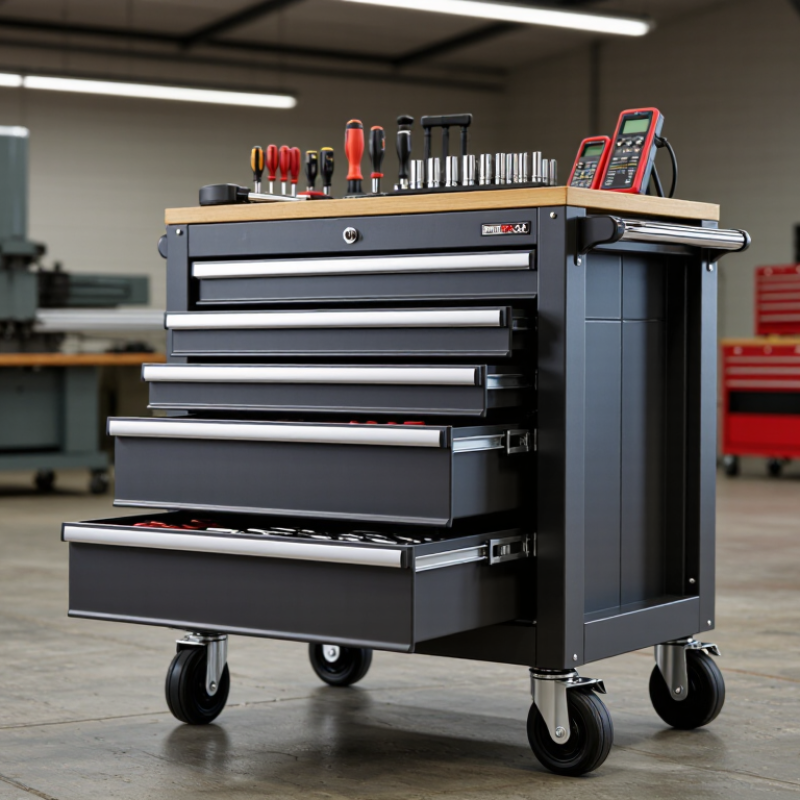
A rolling tool cart is a mobile storage unit with drawers, shelves, casters, and a rigid frame. It keeps hand tools visible, organized, and close to the work area. Most carts use two fixed wheels and two swivel casters. The fixed wheels support direction, while the swivel casters help the cart turn in tight spaces.
The mechanism is simple. A handle transfers pushing force through the frame, and the casters rotate beneath the load. Ball-bearing drawer slides reduce friction and help drawers open smoothly. A locking system prevents movement during use. Keep heavy tools in the lowest drawers. This lowers the center of gravity and reduces tipping risk. Small parts belong in shallow compartments, not loose on the top tray.
The U.S. Bureau of Labor Statistics recorded about 2.6 million nonfatal workplace injuries in private industry during 2023. Poor storage cannot explain every incident, but it can create clutter, awkward reaches, and unnecessary carrying. OSHA’s materials-handling guidance also stresses stable loads and controlled movement. Push it when conditions allow.
Not magic.
A cart still needs inspection. I have seen overloaded drawers strain casters and make a smooth floor feel unsafe. Check wheel condition, drawer latches, handle joints, and weight labels before buying. A useful cart is not merely large; it matches the tools, floor surface, and daily workflow. The wrong height can also encourage bending. That detail is easy to overlook.
What Are the Top 10 Rolling Tool Carts to Buy? - What Is a Rolling Tool Cart and How Does It Work?
A rolling tool cart is a wheeled storage cabinet designed to organize, protect, and move hand tools and small equipment. The specifications below represent common, currently available configurations for home workshops, garages, maintenance areas, and professional workspaces.
| Rank | Cart Type | Drawer Count | Overall Size (W × D × H) | Static Load Capacity | Drawer Load per Drawer | Construction | Wheel Configuration | Locking System | Best Use |
|---|---|---|---|---|---|---|---|---|---|
| 1 | Heavy-Duty Workshop Cart | 8 | 41 × 20 × 40 in | 1,000 lb | 100 lb | 18-gauge steel body | 4 × 5-inch swivel casters; 2 locking | Tubular key lock | Professional garages and repair shops |
| 2 | Large 7-Drawer Service Cart | 7 | 36 × 18 × 39 in | 750 lb | 75 lb | 20-gauge steel with reinforced top | 4 × 4-inch casters; 2 locking | Central locking bar | Automotive maintenance and assembly work |
| 3 | Compact 5-Drawer Tool Cart | 5 | 27 × 16 × 35 in | 500 lb | 60 lb | 20-gauge steel | 4 × 3-inch casters; 2 locking | Single key lock | Home workshops and limited floor space |
| 4 | Wood-Top Rolling Work Cart | 6 | 40 × 20 × 38 in | 800 lb | 80 lb | Steel cabinet with 1-inch hardwood top | 4 × 4-inch casters; 2 locking | Drawer interlock and key lock | General fabrication and light assembly |
| 5 | Open-Shelf Utility Cart | 2 | 32 × 18 × 37 in | 600 lb | 50 lb | Powder-coated steel frame | 4 × 4-inch casters; 2 locking | Lockable upper drawers | Frequently used tools and supplies |
| 6 | Mobile Workbench Cart | 4 | 48 × 24 × 37 in | 1,200 lb | 100 lb | Steel frame with 1.25-inch worktop | 4 × 5-inch heavy-duty casters; 2 locking | Full-length locking drawer system | Large projects and bench-style work |
| 7 | Slim Maintenance Cart | 5 | 24 × 16 × 36 in | 450 lb | 55 lb | Powder-coated sheet steel | 4 × 3-inch casters; 2 locking | Keyed top compartment | Service corridors and small garages |
| 8 | Modular Two-Tier Cart | 3 | 30 × 18 × 37 in | 550 lb | 60 lb | Steel frame with removable trays | 4 × 4-inch casters; 2 locking | Lockable drawer section | Flexible storage and mobile projects |
| 9 | Plastic-and-Steel Lightweight Cart | 3 | 28 × 16 × 34 in | 300 lb | 35 lb | Polymer drawers with steel supports | 4 × 3-inch casters; 2 locking | No integrated lock | Craft rooms, electronics, and light tools |
| 10 | Portable Technician Cart | 4 | 26 × 15 × 33 in | 350 lb | 40 lb | Light-gauge steel with molded top | 4 × 3-inch casters; 2 locking | Removable locking lid | On-site repairs and portable tool storage |
How it works: Tools are placed in drawers, shelves, or compartments, while swivel casters allow the cart to move around a workspace. Locking casters keep it stationary during use, and a keyed or interlocking drawer system helps prevent unauthorized access and accidental drawer opening.