Smart Heating Solutions
Choosing among the Top 10 Rubber Timing Belts Suppliers Worldwide requires more than comparing catalog prices. It requires engineering judgment. A belt may look identical on a screen, yet perform differently under heat, oil mist, dust, or repeated start-stop loads. Tooth geometry, rubber compound, tensile cords, and dimensional control all affect service life. Small differences matter.
Dr. Robert L. Norton, a respected mechanical-design educator, said, “A timing belt drive is only as reliable as its weakest design assumption.” This principle guides the comparison in this article. Supplier quality depends on documented testing, production consistency, technical support, and realistic load data. Certifications help, but they do not replace field experience. A clean factory brochure is not enough.
Real operating details often reveal more. Consider a conveyor running sixteen hours daily, with a 90°C guard temperature and limited maintenance access. The best supplier should provide accurate tooth profiles, suitable temperature ratings, installation guidance, and replacement availability. Some manufacturers excel in automotive applications. Others perform better in industrial automation, packaging, or agricultural machinery.
This ranking is useful, not absolute. Regional stock, product customization, and shipping conditions can change the result. I may also overlook smaller specialists with excellent local performance. That limitation deserves attention. Buyers should verify belt dimensions, pulley compatibility, tension procedures, and warranty terms before ordering. Reliable Rubber Timing Belts reduce vibration, protect synchronization, and prevent avoidable downtime. The right supplier supports all three goals.
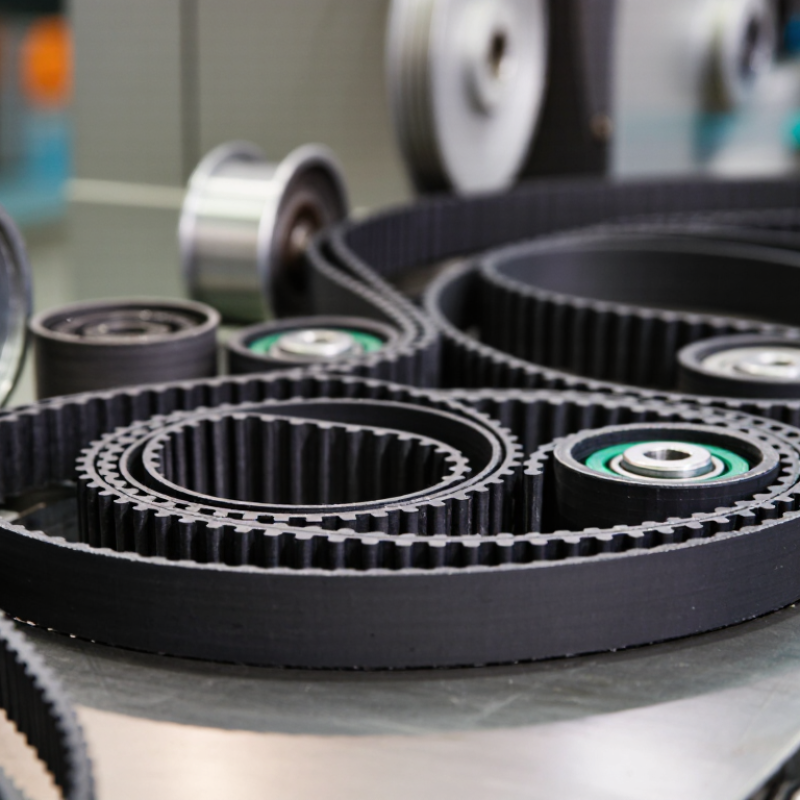
Rubber timing belts are toothed drive components designed to transfer motion between synchronized pulleys. Unlike smooth belts, their teeth engage with matching grooves and reduce unwanted slipping. A typical belt combines a flexible rubber body with internal tensile cords. These cords control stretching during operation. The rubber teeth provide grip, while the outer layer protects the structure from wear.
In modern machinery, timing belts coordinate movement with surprising precision. They can synchronize engine valves, conveyor systems, packaging equipment, printers, and robotic axes. Their controlled motion supports accurate positioning and quieter operation than many chain drives. They also need less lubrication. A small belt can keep several moving parts aligned, even through thousands of operating cycles.
However, rubber timing belts are not maintenance-free. Heat, oil contamination, incorrect tension, and pulley misalignment can shorten their service life. A technician may find polished tooth edges, cracks, or rubber dust around the guard. Those details matter. Selection should consider load, speed, temperature, pulley size, and replacement access. It is easy to trust a standard belt too quickly. In practice, a belt that fits perfectly may still fail under repeated shock loads. Reliable suppliers should provide clear dimensions, material data, testing information, and application guidance.
Ranking the top ten global rubber timing belt suppliers requires more than comparing catalog sizes or factory photographs. The evaluation should begin with verified manufacturing experience, including years in production, tooling control, and performance across automotive, industrial, and agricultural applications. Independent test records matter. So does repeatability.
Technical quality should carry the greatest weight. Reviewers should examine tensile strength, tooth accuracy, temperature resistance, noise levels, and fatigue performance after extended cycling. Samples should be tested under comparable loads, not selected only from premium product lines. That matters. Supplier documentation must also show material traceability, inspection procedures, and compliance with recognized quality standards. Delivery reliability deserves equal attention. Auditors can compare quoted lead times with shipment records, emergency capacity, packaging quality, and regional inventory. Engineering support is another practical measure; responsive teams should explain belt selection, pulley alignment, installation tension, and failure analysis clearly. Numbers can mislead. Public data may be incomplete, while customer reviews can reflect unusual operating conditions. A credible ranking should disclose these limitations and combine factory audits, laboratory testing, verified customer evidence, and expert interviews. Sustainability practices, worker safety, and responsible sourcing should influence the final score, although these areas are often harder to verify consistently. The ranking may still contain judgment calls, but transparent criteria make those decisions easier to challenge and improve.
The ranking framework evaluates the factors commonly used in industrial timing-belt sourcing: product range, manufacturing capacity, quality management, geographic coverage, technical support, delivery reliability, customization capability, and sustainability practices. The percentages represent the relative importance assigned to each criterion in a comparative supplier assessment and do not disclose individual company or brand data.
Top 10 Rubber Timing Belts Suppliers Worldwide
The leading ten rubber timing belt suppliers serve automotive, industrial, agricultural, and automation markets. Their strengths differ considerably. One supplier focuses on high-temperature compounds for engine systems. Another develops compact belts for robotic equipment. A third specializes in oil-resistant materials for demanding factory environments.
A fourth supplier offers custom tooth profiles and reinforced tensile cords. A fifth is known for quiet operation in office machinery and light equipment. One manufacturer supports heavy-duty conveyors with wide, abrasion-resistant belts. Another supplies agricultural belts designed for dust, moisture, and seasonal temperature changes. A specialist in precision manufacturing provides belts for medical and laboratory devices. These suppliers often publish dimensional charts, installation guides, and test data. Still, published performance can vary between laboratories.
The ninth supplier concentrates on short lead times and regional stock availability. This can reduce downtime during urgent maintenance. The tenth combines belt production with pulleys, tensioners, and inspection services. That wider support may simplify system matching. Experienced buyers usually examine tooth engagement, operating temperature, torque capacity, and chemical exposure before selecting a supplier. Material traceability also matters. It is easy to overlook.
Supplier rankings are not permanent. Delivery records, quality controls, warranty terms, and technical support deserve regular review. Some companies present impressive specifications but provide limited field evidence. That gap deserves careful questioning. Practical trials under real load conditions can reveal noise, stretching, or premature wear. A reliable supplier should discuss these risks openly and recommend replacement intervals based on actual operating conditions.
The leading ten suppliers serve automotive, packaging, textile, agricultural, and factory automation markets. Their product ranges usually include standard timing belts, double-sided belts, open-ended belts, and custom profiles. Common materials include neoprene, polyurethane, fiberglass, aramid, and stainless-steel reinforcement. In my experience, tooth accuracy matters more than surface appearance. A belt may look perfect but still produce vibration under load.
Manufacturing strength depends on tooling control, rubber mixing, curing consistency, and inspection records. Strong suppliers test tensile strength, tooth shear, elongation, temperature resistance, and dimensional stability. Some maintain regional warehouses, shortening delivery times for buyers in Europe, Asia, North America, and emerging industrial markets. Others offer engineering support, sample testing, and replacement guidance. However, global coverage does not always mean equal service quality. Communication can fail. Technical drawings may also contain small but costly errors.
Tips: Confirm pitch, width, length, tooth profile, and operating temperature before ordering. Ask for batch traceability and test documentation. Compare the supplier’s actual production capacity, not only its catalog. Request a sample for noise and alignment checks. A short trial can reveal problems that specifications miss.
Top 10 Rubber Timing Belts Suppliers Worldwide
How to Evaluate and Select a Suitable Supplier
Choosing among the top ten suppliers requires more than comparing catalog prices. Examine rubber quality, tooth accuracy, tensile strength, and resistance to oil, heat, and ozone. Ask for current test reports, material specifications, and production samples. A reliable supplier should explain its testing methods clearly. It should also provide traceable batch records and stable dimensional tolerances. Request references from industries with similar operating conditions. One impressive sample proves little.
Check production capacity, delivery performance, and technical support before signing an agreement. A supplier may offer excellent belts but struggle with urgent orders. Confirm minimum quantities, replacement procedures, packaging, and communication response times. Total cost matters more than unit price. Include downtime, installation labor, and premature failure risks. Factory audits can reveal storage problems, inconsistent inspection routines, or weak process controls. These details are easy to miss.
Tips: Compare at least three suppliers. Test samples under real load. Ask how failures are handled. Verify certificates independently. Keep written specifications. Avoid vague guarantees.
Do not overlook fit. Even a strong belt can fail when pulley alignment is poor or tension is incorrect. Share pulley dimensions, speed, torque, temperature, and exposure conditions with the supplier. A careful technical team should ask questions before recommending a product. If it does not, reconsider the partnership. There is no perfect supplier, and our evaluation can be incomplete. Recheck performance after installation.
| Rank | Anonymous Supplier Profile | Primary Region | Main Belt Types | Common Pitch Options | Typical Material Options | Typical Operating Temperature | Customization Capability | Quality Evidence to Request | Best Fit | Evaluation Score (100) |
|---|---|---|---|---|---|---|---|---|---|---|
| 1 | Profile A — Global OEM-Oriented Manufacturer | Western Europe | Trapezoidal, curvilinear, double-sided | MXL, XL, L, H, T, AT, HTD | Neoprene, polyurethane, fiberglass-reinforced rubber | Approximately −30°C to +100°C, application dependent | High; custom length, width, tooth profile, cover and cord options | Material certificates, dimensional reports, batch traceability and fatigue-test data | Automotive and industrial OEM programs | 94 |
| 2 | Profile B — High-Volume Asian Production Supplier | East Asia | Rubber synchronous belts, double-sided belts, raw-edge belts | MXL, XL, L, H, XH, T5, T10, AT5, AT10, HTD | Chloroprene rubber, polyurethane, steel or fiberglass cords | Approximately −25°C to +100°C | High; private-label packaging and production tooling commonly available | ISO 9001 certificate, inspection plan, tensile data and sample approval records | Large-volume aftermarket distribution | 92 |
| 3 | Profile C — Precision Motion-Technology Supplier | Central Europe | High-precision synchronous belts, linear-motion belts, open-ended belts | 2 mm, 3 mm, 5 mm, 8 mm, 14 mm, 20 mm profiles | Polyurethane, steel cord, aramid cord, reinforced rubber | Approximately −20°C to +80°C for polyurethane versions | Very high; welded, joined, coated and machined belt solutions | Runout data, pitch accuracy, splicing records, coating specifications and load calculations | Robotics, packaging and linear automation | 91 |
| 4 | Profile D — Industrial Power-Transmission Specialist | North America | Heavy-duty rubber timing belts, high-torque belts, double-sided belts | H, XH, XXH, 8M, 14M, 20M | Chloroprene rubber, neoprene, fiberglass and aramid reinforcement | Approximately −30°C to +100°C | Medium to high; engineering support for torque and service-life selection | Power-rating charts, belt-life calculations, batch tests and application references | Conveyors, pumps and heavy machinery | 89 |
| 5 | Profile E — European Aftermarket and Replacement Supplier | Southern Europe | Automotive timing belts, wrapped belts, maintenance replacement belts | Automotive tooth profiles, H, L, HTD and metric profiles | Rubber compounds with fiberglass cords and nylon tooth facing | Approximately −30°C to +120°C, depending on compound | Medium; strong catalog coverage with limited special tooling | Part-number cross-reference, dimensional inspection, compound data and warranty terms | Automotive service distributors | 87 |
| 6 | Profile F — Cost-Competitive Custom Belt Producer | Southeast Asia | Standard timing belts, custom endless belts, coated belts | 3M, 5M, 8M, 14M, T5, T10, AT5, AT10 | Polyurethane, chloroprene rubber, steel and fiberglass cords | Approximately −20°C to +80°C for standard polyurethane products | High; custom widths, lengths, coatings and perforations | Pre-production samples, first-article inspection, hardness reports and cord-strength data | OEM component sourcing and private-label programs | 85 |
| 7 | Profile G — Small-Batch Engineering Supplier | East Asia | Metric timing belts, custom profiles, open-ended belts | 2M, 3M, 5M, 8M, 14M, T5, T10 | Polyurethane, neoprene rubber, fiberglass and steel cords | Approximately −20°C to +80°C | High for low and medium quantities; prototype tooling support | Drawing approval, sample measurement, tooth-shear testing and change-control records | Prototypes, laboratory equipment and special machines | 83 |
| 8 | Profile H — North American Distribution and Service Supplier | North America | Standard synchronous belts, replacement belts, maintenance kits | XL, L, H, XH, 3M, 5M, 8M, 14M | Rubber, polyurethane, fiberglass cords and steel cords | Approximately −25°C to +100°C | Low to medium; strong stock availability and technical selection support | Stock records, manufacturer certificates, inspection reports and return policy | Urgent maintenance and MRO purchasing | 81 |
| 9 | Profile I — Specialized Food and Packaging Belt Supplier | Northern Europe | Cleanable timing belts, coated belts, conveyor timing belts | T5, T10, AT5, AT10, 5M, 8M, 14M | Polyurethane, food-contact coatings, thermoplastic profiles and aramid cords | Approximately −20°C to +80°C, depending on coating and cleaning method | High; cleats, guides, profiles, holes and surface coatings | Food-contact declaration, coating specification, cleanability data and traceability documents | Food processing and packaging machinery | 80 |
| 10 | Profile J — Regional Industrial Belt Supplier | South Asia | Standard rubber timing belts, agricultural belts, replacement belts | MXL, XL, L, H, T5, T10 and selected HTD profiles | Neoprene rubber, fiberglass cords and nylon tooth fabric | Approximately −25°C to +100°C | Medium; standard custom lengths and widths available | Incoming-material inspection, dimensional records, tensile tests and warranty coverage | Agricultural equipment and general machinery | 77 |