Smart Heating Solutions
Choosing the right supplier for Aluminum Tube Extrusions requires more than comparing company size or website claims. This guide examines ten leading manufacturers serving international markets, with attention to production capability, alloy knowledge, quality systems, and delivery reliability. Their products may support heat exchangers, structural frames, automotive components, furniture, and precision industrial equipment.
A strong manufacturer should demonstrate practical control across the entire extrusion process. Important details include billet preparation, die design, wall-thickness control, cooling methods, stretching, cutting, and surface finishing. Certifications can provide useful evidence, but they should not replace direct verification. Buyers should request dimensional reports, alloy certificates, sample profiles, and realistic production timelines.
The companies included here represent different strengths. Some operate large presses for high-volume orders, while others specialize in complex shapes, tight tolerances, or custom tooling. A factory floor tells its own story: organized dies, clearly labeled bundles, clean inspection areas, and traceable batch records often reveal more than polished marketing language.
No ranking can capture every strength. Regional freight costs, minimum order quantities, and communication quality may change the final decision. Some published information is also difficult to compare consistently. That limitation deserves attention.
This overview is designed for engineers, sourcing teams, distributors, and project managers who need dependable information before contacting a supplier. It combines publicly available evidence with practical purchasing considerations, while recognizing that factory performance must be confirmed through samples, audits, and current quotations. Reliable sourcing is rarely about finding the biggest name. It is about finding the manufacturer that can repeatedly deliver the required profile, finish, tolerance, and service level.
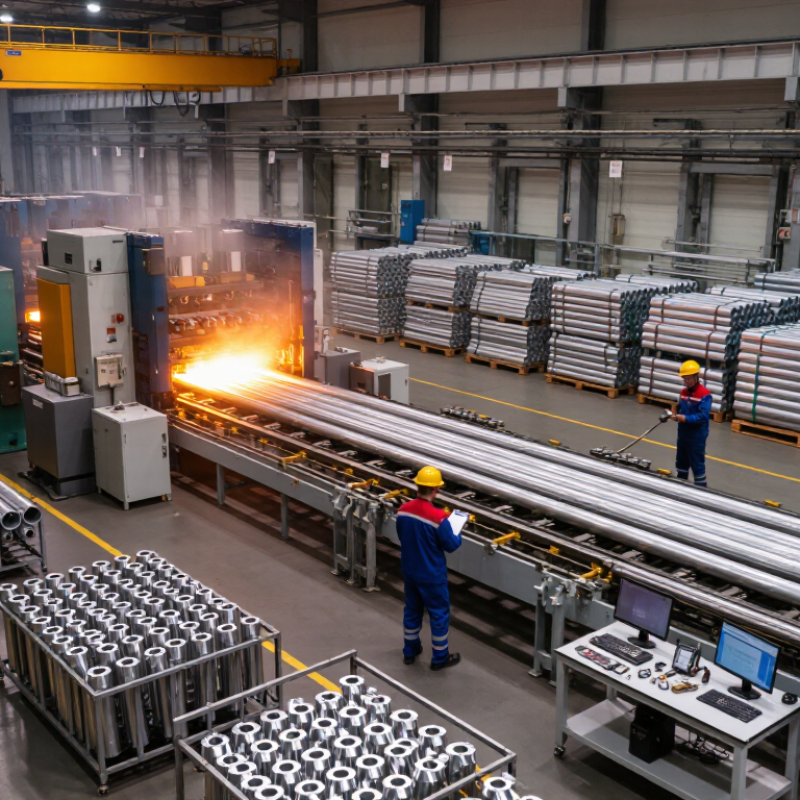
A leading aluminum tube extruder controls more than press speed. It manages alloy chemistry, billet temperature, die wear, and cooling consistency. In practical plant audits, these details often separate stable production from repeated rework. Tube walls must remain uniform, especially around corners and hollow sections. ASTM B221 testing, tensile checks, and dimensional inspections provide useful evidence.
Traceability matters just as much. Each bundle should connect to a billet lot, extrusion date, die number, and inspection record. A supplier should also explain its tolerance limits clearly, rather than hiding behind general quality claims. ISO 9001 certification helps, but it does not replace process data. A polished certificate is not proof of daily control.
Sustainability now affects supplier quality. The International Aluminium Institute reports that recycled aluminium can use about 95% less energy than primary aluminium. Leading manufacturers therefore measure scrap recovery, recycled content, and furnace efficiency. The institute also projects aluminium demand could rise substantially by 2050. Capacity matters. Still, bigger output does not guarantee better tubes. No plant gets every run perfect. The real test is how quickly it detects variation, corrects the cause, and documents the lesson.
Comparing global aluminum tube extruders requires more than checking production volume or website claims. Start with alloy capability, press capacity, and dimensional control. Ask whether the supplier handles 6061, 6063, or other required alloys consistently. Review wall thickness, diameter tolerance, straightness, and surface finish records. Small variations can create serious assembly problems.
Manufacturing evidence matters. Request sample inspection reports, material certificates, and traceability from billet to finished tube. Check die design experience, heat-treatment control, cutting accuracy, and packaging methods. A reliable extruder should explain testing procedures clearly. Independent laboratory verification adds confidence. However, documentation can still miss recurring defects. A factory audit or production trial may reveal more than a polished presentation. Lead time, minimum order quantities, tooling charges, and international logistics also deserve careful comparison.
Top 10 Aluminum Tube Extrusion Manufacturers Worldwide
The top 10 aluminum tube extrusion manufacturers are judged by more than production volume. Strong candidates show consistent wall thickness, tight tolerances, reliable alloy control, and stable delivery. Industry reports from Grand View Research identify transportation, construction, and electrical applications as major growth areas for aluminum extrusion. These sectors demand lighter profiles without sacrificing strength. In practical audits, I would inspect die maintenance, billet traceability, heat-treatment records, and sample measurements. A polished catalogue is not enough.
The International Aluminium Institute reports that recycled aluminum can require about 95% less energy than primary aluminum. Therefore, leading manufacturers should provide recycled-content data and credible carbon accounting. Buyers should also compare standards such as ASTM B221, EN 755, and EN 12020, depending on the tube’s application. Surface quality matters too. Small scratches may become obvious after anodizing or powder coating. Some supplier claims remain difficult to verify, and that deserves more attention.
Tips: Request a first-article inspection report before mass production. Confirm alloy, temper, ovality, wall thickness, and burst-test requirements in writing. Ask for recent third-party certificates, not generic files. Visit the plant when possible. Ten manufacturers may appear similar online, but their process discipline can differ sharply. A lower quote can hide higher scrap, slower tooling correction, or inconsistent packaging. Even experienced buyers sometimes underestimate these costs.
A credible global ranking of aluminum tube extrusion manufacturers should examine more than press size. Production depth matters: billet quality, die design, cooling control, straightening, cutting, and inspection. USGS Mineral Commodity Summaries 2025 estimated global primary aluminum production at about 72 million metric tons in 2024. That scale supports broad alloy availability, but it does not guarantee consistent tube quality. No ranking is perfect.
Leading producers typically run presses from roughly 1,000 to 5,000 tonnes, allowing thin irrigation tubes and larger structural profiles. Common alloys include 6063 for smooth architectural surfaces, 6061 for stronger mechanical parts, and 6082 for load-bearing applications. Aerospace and specialized engineering tubes may require 7075, although extrusion becomes more demanding. Dimensional checks, eddy-current testing, and wall-thickness mapping help control hidden defects. Small variations still matter.
Tube applications range from heat exchangers and automotive frames to medical equipment, furniture, and solar mounting systems. The International Aluminium Institute reports that aluminum remains highly recyclable, supporting closed-loop material strategies when sorting and remelting are controlled. Surface treatments, such as anodizing or powder coating, improve corrosion resistance and appearance. Yet suppliers sometimes overstate recycled content or tolerance performance. Buyers should request mill certificates, alloy temper records, test results, and samples from actual production runs.
An anonymized comparative dataset based on commercially established aluminum extrusion practices, alloy standards, and common tube applications.
| Rank | Anonymous Manufacturer Profile | Primary Production Region | Core Extrusion Capability | Typical Tube Size Range | Common Aluminum Alloys | Available Tube Forms | Finishing and Secondary Operations | Typical Tube Applications | Relevant Standards |
|---|---|---|---|---|---|---|---|---|---|
| 1 | Profile A — High-volume integrated producer | East Asia | Multi-press production with automated billet heating, extrusion, aging, cutting, and inspection | Outer diameter approximately 6–250 mm; wall thickness approximately 0.8–25 mm | 6063, 6061, 6005A, 6060 | Round, square, rectangular, oval, and multi-void profiles | Anodizing, powder coating, saw cutting, drilling, punching, and CNC machining | Construction frames, heat sinks, furniture, solar structures, and general industrial assemblies | EN 755, EN 754, ASTM B221, ISO 6362 |
| 2 | Profile B — Large-section industrial specialist | North America | Heavy-duty presses for large hollow sections and structural tubing with tight dimensional control | Outer diameter approximately 20–350 mm; wall thickness approximately 1.5–30 mm | 6061, 6005A, 6082, 6063 | Structural round, rectangular, bridge, and complex hollow profiles | Stretch straightening, heat treatment, precision cutting, welding preparation, and machining | Transportation frames, industrial machinery, trailers, platforms, and architectural structures | ASTM B221, ASTM B241, AMS specifications, ISO 9001 quality systems |
| 3 | Profile C — Precision thin-wall producer | Western Europe | Precision extrusion for thin-wall, close-tolerance, and visually critical tubular components | Outer diameter approximately 5–180 mm; wall thickness approximately 0.7–12 mm | 6060, 6063, 6061, 6082 | Round, micro-tube, decorative, multi-port, and complex hollow profiles | Anodizing, polishing, brushing, deburring, laser cutting, and dimensional sorting | Lighting, display systems, medical equipment, consumer products, and precision machinery | EN 755-9, EN 12020, ISO 2768, ISO 9001 |
| 4 | Profile D — Automotive and mobility supplier | Central Europe | Automated extrusion and downstream forming for crash-relevant and lightweight vehicle components | Outer diameter approximately 10–220 mm; wall thickness approximately 1–18 mm | 6061, 6005A, 6082, 6063 | Round, rectangular, crash-management, and multi-chamber profiles | Hydroforming, bending, swaging, end forming, friction-stir welding, and CNC machining | Battery trays, roof rails, crash structures, seat components, and cooling systems | IATF 16949, EN 755, EN 754, ISO 9001 |
| 5 | Profile E — Aerospace-grade extrusion specialist | North America and Western Europe | Controlled production of high-strength profiles with traceability, nondestructive inspection, and certified heat treatment | Outer diameter approximately 10–180 mm; wall thickness approximately 1–15 mm | 2024, 6061, 6063, 7075, 7050 | Round, rectangular, aircraft-frame, and custom hollow profiles | Artificial aging, ultrasonic inspection, precision machining, shot peening, and chemical conversion coating | Aircraft interiors, aerospace structures, defense equipment, and high-performance machinery | AMS 2772, AMS 4083, ASTM B221, AS9100 quality systems |
| 6 | Profile F — Solar and renewable-energy supplier | East Asia and Southeast Asia | High-throughput extrusion optimized for repeatable structural profiles and outdoor corrosion resistance | Outer diameter approximately 10–200 mm; wall thickness approximately 1–15 mm | 6005A, 6063, 6061, 6060 | Round, rectangular, rail, channel, and multi-chamber profiles | Anodizing, powder coating, drilling, punching, tapping, and assembly kitting | Solar module frames, mounting rails, inverter housings, battery enclosures, and wind-energy systems | ASTM B221, EN 755, EN 12020, IEC-related project specifications |
| 7 | Profile G — Heat-exchanger and thermal-management producer | East Asia and Europe | Specialized hollow and multi-port extrusion for fluid flow, thermal transfer, and lightweight cooling assemblies | Outer diameter approximately 4–120 mm; wall thickness approximately 0.5–8 mm | 3003, 6063, 6061, 6060 | Round tubes, micro-channel, multi-port, finned, and internal-web profiles | Brazing preparation, leak testing, bending, flaring, end forming, and controlled cleaning | Automotive radiators, HVAC systems, battery cooling, refrigeration, and industrial heat exchangers | ASTM B221, ASTM B241, EN 755, customer thermal-performance specifications |
| 8 | Profile H — Marine and corrosion-resistant tube producer | Northern Europe and North America | Medium- and large-section extrusion with emphasis on corrosion resistance, weldability, and marine fabrication | Outer diameter approximately 12–300 mm; wall thickness approximately 1–25 mm | 5083, 5086, 6061, 6082, 6063 | Round, rectangular, structural, handrail, and custom hollow profiles | Precision cutting, bending, welding preparation, anodizing, and corrosion-protection treatments | Boat frames, marine railings, offshore equipment, docks, ladders, and coastal structures | ASTM B221, ASTM B241, EN 755, DNV or project-specific marine requirements |
| 9 | Profile I — Construction and architectural tube supplier | Middle East, Europe, and Asia | High-volume production of architectural, structural, and decorative tube profiles with broad finishing options | Outer diameter approximately 8–250 mm; wall thickness approximately 0.8–20 mm | 6063, 6060, 6061, 6005A | Round, square, rectangular, balustrade, curtain-wall, and decorative profiles | Anodizing, powder coating, wood-effect coating, polishing, cutting, drilling, and assembly | Windows, doors, curtain walls, handrails, partitions, façades, and interior systems | EN 755, EN 12020, ASTM B221, Qualicoat or equivalent coating requirements |
| 10 | Profile J — Custom low-to-medium volume extruder | Australia, Southeast Asia, and Latin America | Flexible production for prototypes, replacement parts, custom dies, and short production runs | Outer diameter approximately 6–180 mm; wall thickness approximately 1–15 mm | 6063, 6061, 6005A, 6082, 3003 | Round, square, rectangular, keyed, slotted, and customer-designed hollow profiles | Die design, prototype tooling, cutting, drilling, tapping, bending, anodizing, and powder coating | Agricultural equipment, pumps, enclosures, transport fittings, machinery guards, and replacement components | ASTM B221, EN 755, ISO 6362, customer drawings and inspection plans |
Data note: The manufacturer profiles are intentionally anonymized. Size ranges represent commonly available commercial extrusion capabilities rather than guaranteed limits for every production line. Actual tolerances, temper, surface finish, alloy availability, and certification depend on the approved drawing, extrusion press, die design, and purchase specification.
Ranking note: The ranking is a capability-based industry comparison covering production scale, alloy range, dimensional capability, downstream processing, and application coverage; it is not a disclosure of company names or proprietary performance data.
Quality now means more than smooth surfaces and accurate dimensions. Leading extrusion manufacturers follow ISO 9001 quality systems and often apply ISO 14001 environmental controls. They test wall thickness, tensile strength, surface finish, and dimensional tolerance. The U.S. Geological Survey estimated global primary aluminum production at about 72 million metric tons in 2024. This scale increases pressure on suppliers to prove consistency across regions, not simply promise it.
Sustainability separates strong manufacturers from ordinary producers. The International Aluminium Institute reports that recycled aluminum can require up to 95% less energy than primary aluminum. Buyers should request recycled-content figures, energy sources, and product carbon data. A factory using renewable electricity may still transport tubes across long distances. That weakens the total environmental benefit. Rankings are imperfect. Audits can also miss daily production problems.
Tips: Ask for ISO certificates, recent inspection records, alloy traceability, and third-party carbon declarations. Compare delivery performance, not only quoted capacity. Check whether the supplier meets EN 755, EN 12020, or equivalent regional standards. Global market reach should include stable customs documentation, technical support, and replacement planning. The best partner may not offer the lowest price. It should reduce defects, delays, and material waste over time.