Top 10 Custom Commercial Cinema Seating Manufacturers
Choosing the right Custom Commercial Cinema Seating manufacturer involves more than comparing upholstery samples. The decision affects comfort, sightlines, aisle flow, maintenance, and the theater’s long-term operating costs. A seat may look impressive in a showroom yet feel cramped during a two-hour screening. Small details matter.
Design pioneer Charles Eames put it simply: “The details are not the details. They make the design.” That idea applies directly to cinema seating. Consider seat width, recline range, cupholder placement, stitching, and how easily staff can clean between screenings. Ask manufacturers for material specifications, warranty terms, and references from comparable venues. Where possible, test a full seat—not just a fabric swatch.
This guide introduces ten manufacturers serving commercial cinema projects, with attention to customization, product range, and practical suitability. It is intended to help buyers compare options, not to declare one universal winner. Venue size, audience expectations, budget, and service access all change the answer. Comfort is personal. A premium recliner may suit a boutique auditorium but reduce capacity elsewhere. Even a careful shortlist can miss a local constraint, so verify measurements and project details directly with each supplier. The best choice is the one that performs reliably in your specific room, day after day.
Commercial Cinema Seating: Scope and Key Features
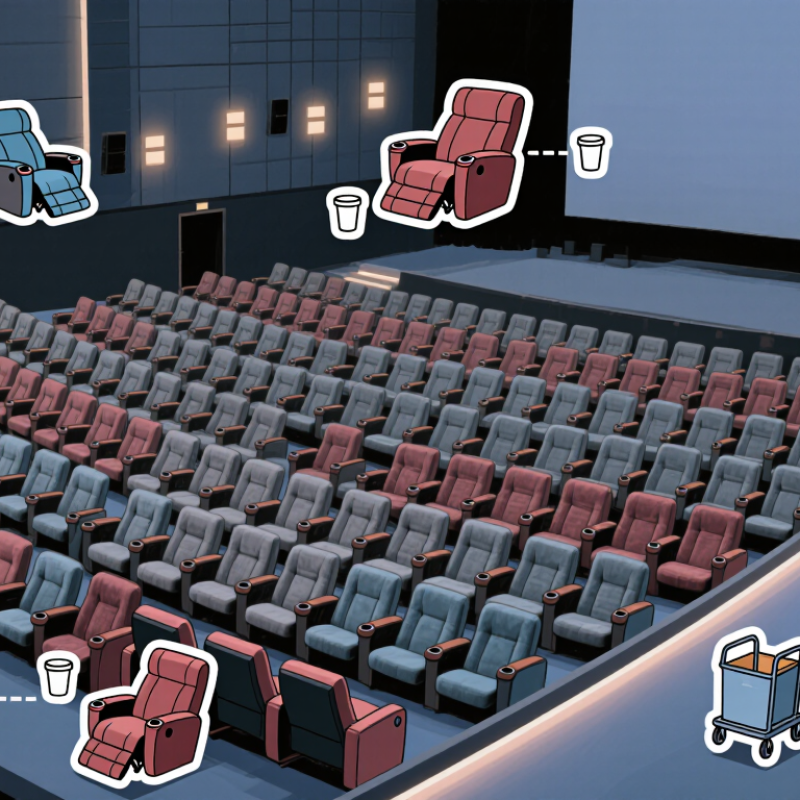
Commercial cinema seating covers more than the chair itself. It includes seat layout, row spacing, aisle access, and how each unit fits the auditorium’s floor plan. Operators typically balance capacity with comfort, since adding seats can narrow legroom or complicate access. Seat pitch, measured between corresponding points on adjacent rows, affects how easily guests pass through a row. Reclining models also need clearance behind them. Small details matter.
Key features include a durable frame, supportive foam, cleanable upholstery, and components that can be serviced without replacing the whole seat. Cupholders should remain stable when bumped, while armrests need to suit the room’s layout and intended use. In practice, upholstery samples can look different under dim, colored lighting than they do in a showroom. Comfort is measurable. A short trial can reveal pressure points that a product sheet will not. Accessibility provisions, companion spaces, and clear aisle routes should be considered during planning, not added as awkward afterthoughts. Maintenance deserves equal attention: seams, hinges, and cupholder inserts often show wear early in busy venues. Even a carefully specified seat may disappoint if its dimensions conflict with the risers or sightlines.
Commercial Cinema Seating: Scope and Key Features
Accessible seating is an important part of cinema seating design. This chart shows the minimum number of wheelchair spaces required under the 2010 U.S. ADA Standards for selected auditorium capacities.
Requirements vary by seating capacity and jurisdiction. U.S. figures are based on the 2010 ADA Standards for Accessible Design, Table 221.2.1.1; wheelchair spaces also have companion-seat requirements.
Source: U.S. Department of Justice, 2010 ADA Standards for Accessible Design
Criteria for Comparing Custom Seating Manufacturers
Criteria for Comparing Custom Seating Manufacturers
Compare manufacturers on measurable performance, not showroom appearance alone. Request frame and mechanism materials, warranty exclusions, replacement-part lead times, and independent test results. BIFMA X5.4-2020 provides strength, stability, and durability tests for public and lounge seating. Ask whether the proposed model was tested to this standard, and request the actual report. For accessibility planning, the U.S. Access Board’s 2010 ADA Standards specify wheelchair-space widths of at least 36 inches; required depth varies by approach, from 48 to 60 inches. Check dimensions against the project layout before approving a seating plan.
Customization also affects long-term maintenance. Compare upholstery abrasion results, cleanability, fire-performance documentation, and whether individual cushions or recliner components can be replaced. The Motion Picture Association’s 2023 THEME Report recorded $33.9 billion in global box-office revenue. That signals substantial venue activity, but it does not predict seat wear; local attendance and cleaning routines matter more. A polished sample can hide a noisy hinge or awkward aisle clearance. I would not judge comfort from a brief showroom sit.
Tips: Request one production-grade sample and test it in a mock row. Measure seat pitch, listen for mechanism noise, and have staff remove and refit a cushion. Keep the results, even if they complicate the comparison.
Profiles of the Top 10 Custom Commercial Cinema Seating Manufacturers
The ten manufacturer profiles represent different approaches to commercial cinema seating. One focuses on modular frames, making row layouts easier to adapt. Another emphasizes ergonomic shaping, with contoured backs and adjustable headrests. A third specializes in premium recliners, where motor noise and footrest clearance deserve close attention. Details matter. A fourth profile centers on durable upholstery and replaceable components. A fifth pairs seating with aisle lighting and practical cable routing.
Other manufacturers stand out through their production methods. One offers broad fabric and finish choices, while another supports custom dimensions for unusual rooms. A seventh profile prioritizes high-volume production; buyers should still check sample consistency. An eighth emphasizes accessible maintenance, including removable panels and straightforward part replacement. A ninth concentrates on compact designs for tighter floor plans. The tenth combines several options, but customization can add lead time and complexity.
These profiles are useful starting points, not proof of performance. Compare seat dimensions, recline range, foam feel, warranty terms, and service response. Ask for a full-size sample when possible. Sit in it. Check whether the armrests feel natural and whether the cup holder is easy to reach in a dark auditorium. Specifications can look convincing on paper, yet a small comfort issue may become obvious during a long screening.
Buyer Considerations for Different Cinema Venues
Choosing cinema seating starts with the room, not the chair catalog. A multiplex needs durable upholstery, replaceable components, and consistent rows that support quick cleaning between screenings. Measure aisle widths, row pitch, riser depth, and sightlines before approving a custom layout. A few centimeters can affect both legroom and access.
Independent theaters may value wider seats, quiet recline mechanisms, or finishes that suit a smaller auditorium. Luxury venues often prioritize generous spacing, power access, and easy-to-clean surfaces around cupholders. Community halls and mixed-use venues need flexible seating for varied audiences and frequent room changes. Ask manufacturers for dimensioned drawings, material samples, load details, warranty terms, and a prototype seat. Check how upholstery seams and moving parts perform after repeated use, not only under showroom lighting. That test can expose flaws.
Tips: Compare quoted seat dimensions with a full-scale aisle and row mock-up. Confirm cleaning instructions and replacement-part availability in writing. Keep one sample for staff review; preferences can differ.