Smart Heating Solutions

Top 10 Types of Luminous Giant Letters for Global Buyers

Choosing the right Luminous giant letters can shape how customers remember a business. Global buyers must consider more than size and brightness. Material, lighting direction, installation method, power supply, weather exposure, and shipping conditions all affect the final result. A beautifully lit sign can still fail if its mounting system is weak.

This guide explores ten practical types for retail stores, hotels, exhibitions, restaurants, offices, and public venues. It compares front-lit channel letters, halo-lit letters, bulb-style designs, acrylic faces, stainless-steel finishes, fabric structures, marquee letters, and other popular options. Each type creates a different visual effect. Some produce crisp white edges. Others cast a soft glow across brick or concrete walls.

Selection should begin with the project environment. A shopping mall may need quiet, low-heat LED lighting. An outdoor hotel sign may require sealed components and strong weather resistance. A trade-show display may prioritize lightweight frames and fast assembly. Buyers should request production drawings, LED specifications, warranty terms, packaging details, and destination-specific compliance documents.

Practical details matter.

Experienced suppliers usually confirm voltage, cable length, mounting access, and replacement procedures before production. However, no single design suits every market. A lower price may conceal thinner metal, weaker diffusion, or difficult maintenance. Even expert recommendations can miss local installation challenges. This overview offers a reliable comparison, but buyers should verify measurements and site conditions before approving their order.
Top 10 Types of Luminous Giant Letters for Global Buyers

What Are Luminous Giant Letters and How Do They Work?

Luminous giant letters are oversized sign letters with internal or external lighting.

They turn a business name, event message, or building entrance into a visible landmark. Common forms include front-lit, backlit, edge-lit, neon-style, and three-dimensional channel letters. Each type creates a different visual effect after sunset.

The working principle is simple. LEDs or flexible light modules sit inside the letter body, behind an acrylic face, or along the rear edge. A low-voltage power supply converts electricity into a safer operating current.

Light then passes through translucent material or reflects onto the wall. Aluminum, stainless steel, acrylic, and coated steel are widely used because they balance strength, weight, and weather resistance.

I have seen installations where letter depth looked impressive but produced uneven lighting. The problem was usually poor module spacing, not weak LEDs. Professional installers check viewing distance, brightness, drainage, cable protection, and mounting strength before production.

Outdoor letters also need suitable sealing and tested electrical components for local conditions. Indoor displays may use lighter materials and softer illumination. A useful detail is the shadow gap behind backlit letters; even a small distance can create a clean halo effect.

Still, brighter is not always better. Excessive glare can reduce readability and make a premium sign feel harsh. Reflective surfaces, nearby windows, and nighttime traffic should influence the final design.

The Top 10 Types of Luminous Giant Letters Explained

Top 10 Types of Luminous Giant Letters Explained

Luminous giant letters create strong visibility for storefronts, exhibitions, hotels, and public venues. Their performance depends on structure, lighting, installation, and weather exposure.

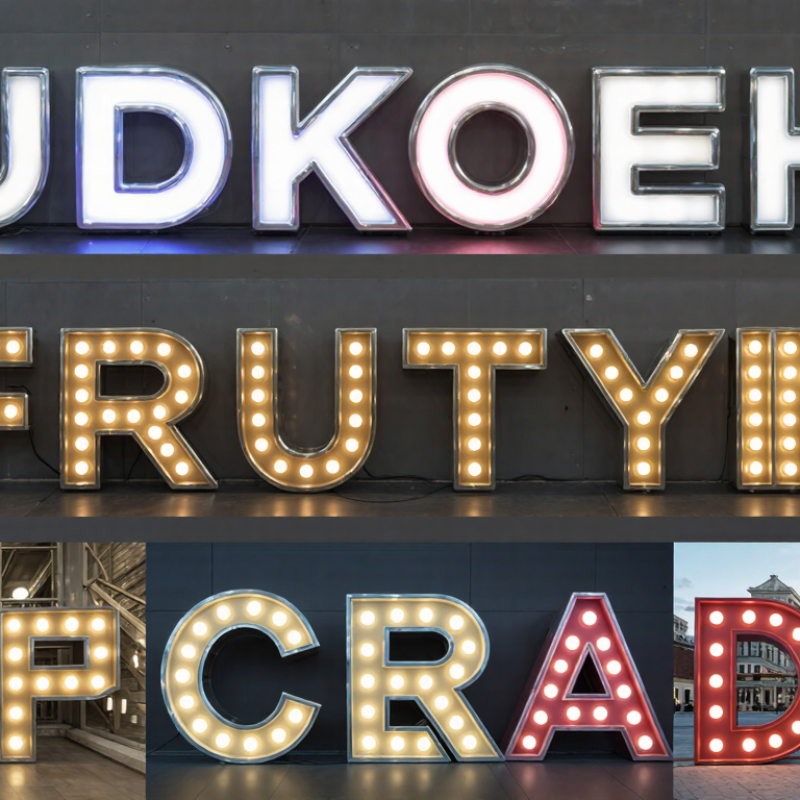
Front-lit channel letters use LEDs behind acrylic faces, producing clear, even illumination. Halo-lit letters send light toward the wall, creating a floating effect. Front-and-halo letters combine both styles for stronger depth. Exposed-bulb letters offer a vintage theatrical appearance, but their bulbs need more frequent cleaning.

Edge-lit acrylic letters use light along the panel edges. They look refined and work well indoors. Internally lit 3D letters place LEDs inside deep metal or acrylic bodies. Vacuum-formed letters provide curved faces and softer light distribution. Stainless-steel backlit letters suit modern architecture and resist corrosion when properly finished. They still require careful drainage.

Neon-style flexible LED letters imitate traditional tubes with lower heat and flexible shaping. Modular outdoor letters simplify maintenance because individual sections can be replaced. Waterproof outdoor letters use sealed components, protected wiring, and suitable drainage paths.

Do not judge quality by brightness alone. Uneven hotspots, weak joints, and poor color consistency often appear after installation.

I would request lighting tests, material samples, wiring diagrams, and a nighttime inspection before approval.

The most dramatic design may not be the most reliable choice. Real conditions matter.

Materials, Lighting Methods, and Construction Features

Top 10 Types of Luminous Giant Letters for Global Buyers

Material choice controls weight, weather resistance, and visual quality. Aluminum returns are lightweight and resist corrosion, making them suitable for large outdoor letters. Acrylic faces create even, bright surfaces, while stainless steel adds strength in coastal environments. For premium depth, buyers often specify 80–150 mm returns, depending on letter height and wind exposure. Front-lit letters use translucent faces and internal LEDs. Halo-lit letters push light onto the wall, creating a softer outline. Hybrid letters combine both effects.

The U.S. Department of Energy’s 2023 Solid-State Lighting R&D Opportunities report identifies laboratory LED efficacies above 200 lumens per watt. Commercial signs deliver less after drivers, lenses, wiring, and heat losses. That difference matters. Face illumination usually needs closer LED spacing, while halo lighting depends heavily on wall color and mounting distance. IP65-rated modules are commonly selected for exposed installations, but sealing quality still depends on assembly workmanship.

Tips: Request a lighting simulation before production. Check night brightness, shadows, and viewing distance. Ask for replaceable power supplies and drainage paths. A perfect specification can still fail when installers ignore thermal expansion or uneven walls. I have seen beautiful letters lose uniformity because the LED layout was copied from a smaller design. Require sample sections, measured luminance, and wiring diagrams before approving the full run.

Top 10 Types of Luminous Giant Letters for Global Buyers

Typical installed power density by construction type, material, and lighting method. Values are representative engineering benchmarks for comparable outdoor letters and may vary with letter depth, size, illumination level, and local electrical standards.

How Global Buyers Can Compare Designs, Quality, and Costs

Global buyers comparing the top ten luminous letter types should evaluate design, performance, and total cost together. Options include front-lit channel letters, halo-lit letters, dual-lit letters, edge-lit acrylic, reverse-lit metal, exposed-neon styles, 3D stainless steel, aluminum letters, flexible LED neon, and face-lit acrylic. Each creates a different visual result. Front lighting gives stronger daytime visibility, while halo lighting produces a softer wall glow. Material thickness, return depth, LED spacing, color consistency, and heat control deserve careful inspection.

Energy performance affects long-term value. The U.S. Department of Energy reports that LED lighting uses at least 75% less electricity and can last up to 25 times longer than incandescent lighting. Its Solid-State Lighting research also highlights improved efficacy and thermal management as key quality factors. Buyers should request lumen data, color-temperature details, ingress-protection ratings, installation drawings, and sample photos taken at night. Small differences matter.

Cost comparison should include fabrication, freight, customs, installation, maintenance, energy, and replacement access. A lower quotation may hide thinner aluminum, weaker power supplies, or limited warranty coverage. Ask suppliers to provide a five-year ownership estimate. The International Energy Agency’s Energy Efficiency 2024 report identifies lighting as a significant electricity-use category, reinforcing the value of efficient systems. However, energy savings alone do not guarantee a good purchase. I have seen attractive samples fail because drainage and cable routing were treated as afterthoughts. That remains an uncomfortable lesson.

Top 10 Types of Luminous Giant Letters for Global Buyers - How Global Buyers Can Compare Designs, Quality, and Costs
No. Luminous Letter Type Design & Lighting Effect Common Materials Typical Letter Depth Typical Power Use Weather Protection Expected LED Life Indicative Cost per Letter Typical Production Time Best Use Quality Considerations
1 Front-Lit Acrylic Channel Letters Opaque returns with a translucent acrylic face provide bright, direct illumination and clear daytime visibility. Aluminum returns, acrylic face, LED modules, waterproof power supply 80–150 mm 8–18 W per 300 mm letter Usually IP65–IP67 for outdoor components 50,000–80,000 hours US$90–350 10–20 working days Retail façades, shopping centers, hotels, offices High Check acrylic thickness, face color consistency, LED spacing, drainage holes, and sealed wiring joints.
2 Halo-Lit Reverse Channel Letters LEDs illuminate the wall behind each letter, creating a soft floating halo effect rather than direct face lighting. Aluminum or stainless-steel body, acrylic back, rear-mounted LEDs 50–120 mm 5–14 W per 300 mm letter Usually IP65 or higher 50,000–80,000 hours US$110–420 12–22 working days Premium façades, hospitality, corporate entrances High Wall color and mounting distance strongly affect the halo; verify standoff brackets and rear heat dissipation.
3 Face-Lit and Halo-Lit Combination Letters Direct front lighting is combined with rear halo lighting for stronger visibility and a layered nighttime appearance. Aluminum body, acrylic face, rear LEDs, internal dividers 100–180 mm 12–25 W per 300 mm letter Usually IP65–IP67 50,000–80,000 hours US$150–550 15–25 working days Flagship stores, casinos, resorts, landmark entrances High Require separate circuits or dimming controls when independent brightness adjustment is needed.
4 Edge-Lit Acrylic Letters Light is injected through acrylic edges, producing a clean, modern glow with a relatively slim profile. Laser-cut acrylic, aluminum frame, LED edge modules 20–60 mm 3–10 W per 300 mm letter IP54–IP67, depending on enclosure design 40,000–70,000 hours US$80–300 8–18 working days Interior branding, reception areas, malls, galleries Medium–High Inspect polished edges, optical uniformity, acrylic protection, and resistance to yellowing or cracking.
5 Front-Lit Metal Channel Letters Metal faces or trims frame a translucent insert, giving a durable architectural appearance with controlled light output. Aluminum or stainless steel, acrylic or polycarbonate face, LED modules 80–180 mm 8–20 W per 300 mm letter Usually IP65–IP67 50,000–80,000 hours US$130–500 15–30 working days Airports, commercial buildings, premium retail, public venues Very High Compare metal gauge, corrosion treatment, weld quality, powder-coat adhesion, and face retention method.
6 Exposed Neon-Style LED Letters Visible LED tubes or modules follow the letter outline, recreating a classic neon appearance with lower operating voltage. Aluminum frame, silicone LED tube or exposed LED modules, acrylic supports 30–80 mm 6–18 W per 300 mm letter IP65 for outdoor-rated tube systems 30,000–50,000 hours US$100–450 12–25 working days Restaurants, entertainment venues, event spaces, hospitality Medium–High Check tube bending accuracy, color uniformity, connector sealing, mounting clips, and replaceability.
7 LED Neon-Flex Outline Letters Continuous flexible LED tubing follows the complete outline, creating smooth lines without individual point-light hotspots. Flexible silicone diffuser, aluminum backing, LED strips or modules 25–70 mm 5–16 W per 300 mm letter IP65–IP68 versions are available 30,000–60,000 hours US$120–500 12–25 working days Decorative façades, exhibitions, restaurants, photo zones Medium–High Verify bend radius, silicone hardness, color bin consistency, end-cap sealing, and outdoor UV resistance.
8 Back-Lit Metal Letters with Cut-Out Faces Light passes through precision-cut openings or symbols in a metal face, producing a sharp graphic effect. Powder-coated aluminum or stainless steel, internal LED modules, translucent diffuser 60–140 mm 6–16 W per 300 mm letter Usually IP65 or higher 50,000–80,000 hours US$140–520 15–30 working days Architectural signage, offices, museums, public buildings High Check cut-out precision, burr-free edges, light-blocking treatment, internal reflectivity, and drainage design.
9 Illuminated Fabric Tension Letters A lightweight tensioned fabric face creates a broad, soft, low-glare illuminated surface, often with tool-free face access. Aluminum frame, tension fabric, LED bars or modules, rear panel 80–200 mm 8–22 W per 300 mm letter IP54–IP65, depending on fabric and enclosure 40,000–70,000 hours US$160–650 18–35 working days Large interiors, showrooms, trade fairs, transport terminals Medium–High Evaluate fabric tension, wrinkle resistance, color reproducibility, frame rigidity, and cleaning requirements.
10 Illuminated Bulb-Style Giant Letters Large freestanding letters use visible LED bulbs or low-voltage lamps for a retro, event-oriented appearance. Aluminum or steel frame, acrylic or metal face, LED bulbs, internal wiring 150–400 mm 20–80 W per 1 m letter IP44–IP65, depending on bulb and enclosure selection 20,000–50,000 hours US$250–1,200 15–35 working days Events, weddings, festivals, retail displays, public installations Medium Confirm base stability, anti-tip provisions, cable protection, bulb replacement access, and electrical certification.

Cost ranges are indicative international project estimates per letter in US dollars for common medium-sized units, excluding freight, taxes, installation, structural engineering, and local permits. Actual pricing varies with letter height, font complexity, materials, lighting color, quantity, control system, certification requirements, and destination-market standards.

Installation, Maintenance, Safety, and International Shipping Factors

Top 10 Types of Luminous Giant Letters for Global Buyers

Luminous giant letters include front-lit acrylic, halo-lit metal, stainless steel, channel letters, and flexible LED designs. Each type needs a different installation method. Front-lit letters often require accurate wall anchors and concealed cable routes. Halo-lit letters need precise spacing from the wall. Measure twice. Uneven spacing becomes obvious at night.

For outdoor signs, installers should check wind load, wall strength, drainage, and waterproof cable glands. Low-voltage power supplies must remain accessible for servicing. Grounding and circuit protection should follow local electrical requirements. Keep it dry. I have seen beautiful signs fail because water entered through one unsealed rear panel. That mistake is easy to prevent, but often overlooked.

Maintenance should include monthly visual checks, cleaning with non-abrasive materials, and testing brightness across every letter. Replace damaged seals early. A dark module can indicate wiring, moisture, or power-supply problems, not only LED failure.

During international shipping, confirm packed dimensions, gross weight, voltage requirements, plug standards, and destination regulations. Use shock-resistant crates, internal padding, moisture barriers, and compliant timber packaging where required. Large letters may need modular construction to reduce freight volume. Customs documents should describe materials, electrical components, quantities, and declared values accurately. Import duties and local installation permits vary by country. I cannot treat one shipping method as universally suitable; climate, building access, and local codes can change the safest choice.