Smart Heating Solutions
What Are the Top Plastic Wheel Types in 2026?
In 2026, choosing a Plastic Wheel means matching its material to the load, floor, and working conditions. The right choice can reduce rolling effort, protect surfaces, and support reliable equipment movement. A wheel that performs well in a warehouse may feel noisy or harsh on a tiled floor. Small details matter.
Nylon wheels are often considered for demanding loads and firm floors, while polyurethane-tread wheels can offer quieter rolling and better grip. Polypropylene wheels are lightweight and resist moisture, making them useful in many general-purpose settings. Phenolic wheels can handle substantial loads, but may create more noise and feel less forgiving on uneven surfaces. These are useful comparisons, not guarantees; exact performance depends on wheel design and manufacturer specifications.
The “top” type is not universal. A buyer should check rated capacity, wheel diameter, tread width, temperature range, and compatibility with the surrounding environment. For example, a loaded cart crossing concrete joints needs different cushioning than a light trolley moving across smooth tile. Also consider the hub, bearing, and mounting style, since the wheel material alone does not determine performance. Inspect wheels for flat spots, cracks, or unusual wear during routine maintenance. One caveat: product labels can use material names loosely, so confirm the construction in the technical data sheet. This guide compares common plastic wheel types by practical strengths, limitations, and suitable uses, helping readers make a more informed choice without assuming one material fits every job.
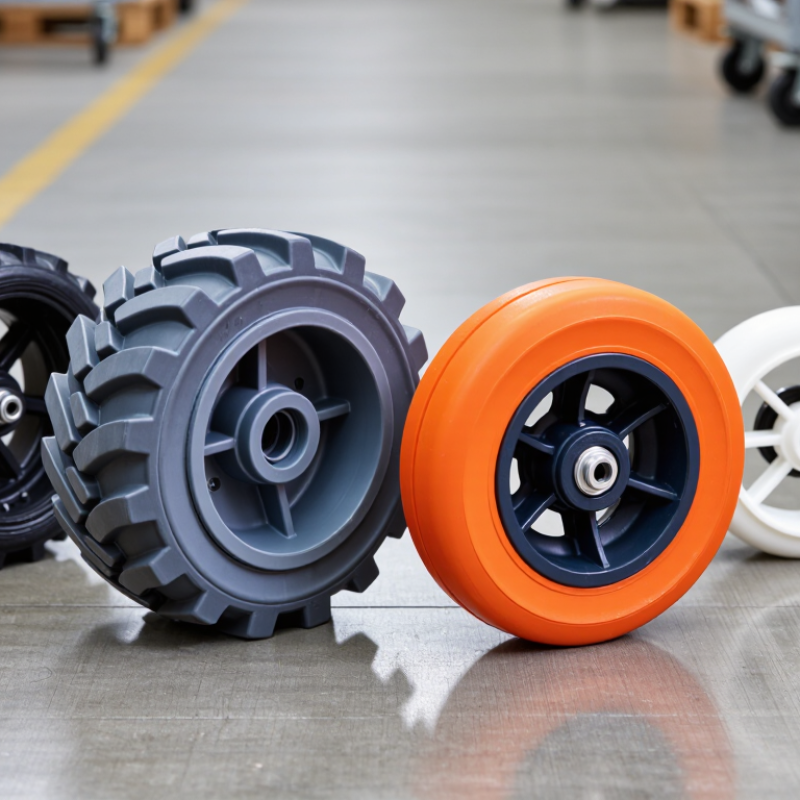
How Plastic Wheels Are Classified by Material and Construction
Plastic wheels are best classified by both polymer and construction. Polypropylene wheels are light and resist many chemicals, making them useful for clean, dry indoor floors. Nylon wheels generally handle heavier loads and abrasion, but moisture can affect their dimensions. Polyurethane treads offer more grip and quieter rolling than hard, bare polymers. Details matter.
Construction changes performance, too. A one-piece molded wheel is simple and economical, but its contact surface may feel harsh on tile. A separate tread bonded to a rigid core combines a softer rolling surface with a supportive center. Some wheels also use enclosed bearings or molded-in hubs; these features affect rolling resistance, maintenance, and fit. ASTM D638 measures tensile properties, while ASTM D2240 measures hardness. They help compare materials, but test results alone cannot predict service life on a rough floor.
Market figures offer context, not a wheel-selection rule. Grand View Research’s 2024 Plastics Market Size, Share & Trends Analysis Report estimated the global plastics market at USD 712.4 billion in 2023, with a projected 4.2% annual growth rate through 2030. That broad figure does not show which wheel material performs best. A practical choice still depends on load, floor surface, temperature, and exposure to moisture or chemicals. Catalog descriptions can make these differences look tidy. Real floors are messier.
What Are the Top Plastic Wheel Types in 2026? — How Plastic Wheels Are Classified by Material and Construction
| Wheel Type | Primary Material | Typical Construction | Key Characteristics | Common Applications | Important Considerations |
|---|---|---|---|---|---|
| Nylon wheels | Polyamide, commonly PA6 or PA66 | Solid molded wheel; may include a separate bearing or bushing | Strong and wear-resistant, with good resistance to many oils and chemicals. Hard running surface offers relatively low rolling resistance on smooth floors. | Material-handling equipment, carts, machinery, and industrial casters | Hard wheels can be noisy and may mark or damage delicate floors. Moisture and temperature can affect dimensions and performance. |
| Polypropylene wheels | Polypropylene (PP) | One-piece molded wheel or molded wheel body with an integrated hub | Lightweight and resistant to moisture and many common chemicals; often selected for economical, light-duty use. | Light-duty carts, bins, display equipment, and applications in damp environments | Generally less suited than engineered nylon to high loads, impact, or sustained elevated temperatures. Capacity depends on design and operating conditions. |
| Polyurethane-tread wheels with plastic cores | Polyurethane tread over a nylon or other polymer core | Two-material wheel with a bonded or molded-on resilient tread and a rigid plastic hub | Combines a quieter, more floor-friendly tread with a comparatively rigid core. Available in different tread hardnesses and formulations. | Institutional and industrial carts, powered equipment, and general material handling | Performance varies with tread formulation, hardness, bonding, load, and floor conditions. Polyurethane wheels are not necessarily suitable for every chemical or high-temperature environment. |
| Thermoplastic rubber (TPR) wheels | TPR, often formed as a resilient tread on a polymer hub | Soft or semi-soft tread molded onto a plastic core, or a molded wheel with an integrated hub | Provides cushioning, quieter travel, and improved grip compared with a hard plastic wheel. | Indoor carts, furniture, light equipment, and applications where noise and floor protection matter | Load capacity and rolling resistance depend on tread hardness and wheel size. Soft treads can develop flat spots under prolonged stationary loading. |
| Thermoplastic elastomer (TPE) wheels | Thermoplastic elastomer, sometimes combined with a rigid plastic center | Single-material molded wheel or a softer TPE tread over a harder polymer core | Elastic, impact-absorbing construction; some grades can be processed as thermoplastics and may be recyclable where suitable collection systems exist. | Light- to medium-duty carts, equipment, and consumer or institutional products | TPE covers a broad family of materials. Heat, chemical resistance, hardness, and load capacity must be checked against the specific grade. |
| Phenolic resin wheels | Phenolic thermoset resin, commonly reinforced with fillers | Compression-molded rigid wheel, often with a separately fitted bearing | Hard, dimensionally stable, and suitable for some demanding industrial environments and elevated temperatures compared with many ordinary thermoplastics. | Industrial equipment, ovens or hot-area service when the wheel is specifically rated for it, and heavy-duty material handling | Phenolic wheels are rigid and can be noisy or harsh on floors. Impact resistance and allowable temperature depend on the formulation and design. |
| Acetal (POM) wheels | Polyoxymethylene (POM), also called acetal | Precision-molded or machined rigid wheel, often used with a bearing or bushing | Low friction, good dimensional stability, and useful wear properties in accurately made components. | Guide rollers, small industrial wheels, mechanisms, and precision equipment | Wheel size, bearing arrangement, load, and temperature determine suitability. Check chemical compatibility for the specific operating environment. |
| Polyethylene wheels | Polyethylene (PE), including high-density grades | Solid molded or machined wheel; may be paired with a separate hub or bearing | Good moisture and chemical resistance, with a relatively low-friction surface. Some grades offer useful impact resistance. | Material-handling equipment, washdown areas, and applications involving contact with moisture or selected chemicals | Stiffness, wear, and load performance vary by grade. Verify creep under sustained load and compatibility with the specific chemicals involved. |
Selection note: “Plastic wheel” can describe a solid polymer wheel or a multi-material wheel with a plastic core and a softer tread. Actual load capacity, speed, temperature range, and service life depend on wheel diameter and width, material grade, bearing, mounting, floor, and operating conditions. Consult the wheel specification for the intended application.