Why Choose a Carbon Fiber Tube for Your Project?
A project often begins with a practical question: how can a structure stay light without becoming too flexible? A carbon fiber tube may help, offering high stiffness at relatively low weight. It can also resist corrosion better than many metal alternatives in suitable environments. That combination makes it useful for frames, robotic arms, camera supports, and other parts that need to move or carry loads. The gains depend on the design, though. Not every tube fits.
Performance varies with fiber direction, resin system, wall thickness, diameter, and manufacturing quality. A tube built for bending may not perform the same under crushing or twisting forces. Even a strong tube can fail at a poorly designed joint. Check published specifications, loading conditions, and connection details before choosing a part. For critical structures, qualified engineering review and appropriate testing matter more than a simple strength claim.
There are trade-offs. Carbon fiber can cost more than common metals, and cutting or drilling it requires suitable tools and dust controls. Repairs may also be less straightforward. Small details count. A real project should consider temperature, impact, moisture exposure, and how the tube will be inspected over time. This guide looks at where carbon fiber tubes offer practical value, what limits to expect, and which questions to ask before buying. The best choice is not always the lightest one. It is the tube whose properties match the job, with enough evidence to support that decision.
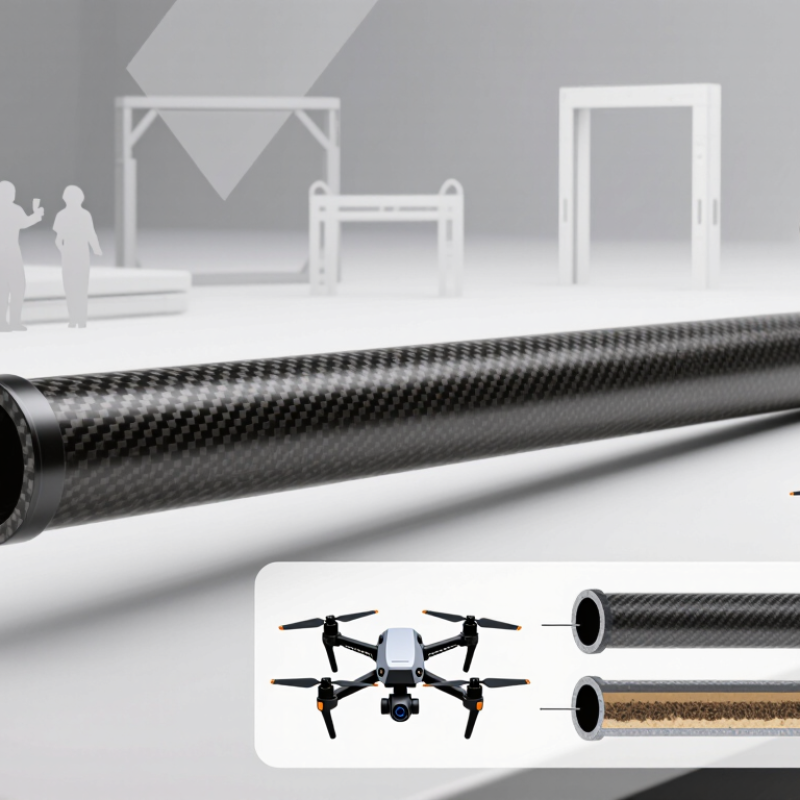
Carbon Fiber Tubes: How Fibers and Resin Form a Structural Composite
Why Choose a Carbon Fiber Tube for Your Project?
A carbon fiber tube is a structural composite, not a solid piece of carbon. Thin carbon filaments carry much of the load, while resin holds them in position and transfers force between them. The resin also helps protect the fibers from abrasion and handling damage. Fiber direction matters. Fibers running along a tube improve stiffness along its length, while other layup angles can support torsional or crosswise loads. The result can be a light, stiff tube, but not one that resists every force equally.
Tips: Match the tube’s fiber orientation and dimensions to the load. Check its datasheet for bending, compression, temperature, and end-load limits. A neat surface alone does not confirm sound internal construction.
Resin type, cure quality, and fiber alignment all affect performance. Small manufacturing defects can matter under repeated loading, so ask how a tube was tested and inspect cut ends for uneven layers or visible gaps. Consider how fittings attach, too: concentrated pressure near a clamp can damage the wall. It is tempting to compare tubes by weight alone, but that leaves out geometry and load direction. I would treat any broad claim of “stronger” with caution until the test conditions are clear.
Typical CFRP Density of 1.5–1.6 g/cm³ Versus Steel at 7.85 g/cm³
Why Choose a Carbon Fiber Tube for Your Project?
A typical carbon fiber reinforced polymer (CFRP) density is 1.5–1.6 g/cm³, compared with steel at about 7.85 g/cm³. For the same volume of solid material, CFRP weighs roughly one-fifth as much. The difference is easy to picture: one litre of CFRP material weighs around 1.5–1.6 kilograms, while one litre of steel weighs 7.85 kilograms. A lighter tube can reduce the load on a moving arm, frame, or handheld tool. Less mass can mean less effort to move it. That matters in practice.
But density alone does not determine a finished tube’s weight or performance. Tube diameter, wall thickness, fiber direction, resin content, and manufacturing quality all affect the result. A hollow steel tube may weigh less than a solid CFRP rod, despite steel’s higher density. CFRP also behaves differently from steel: its strength depends on the direction of the fibers, and local impacts or poorly designed joints can cause damage that is not obvious at first glance. It is not a simple drop-in replacement.
For a fair comparison, check the mass per unit length and the load requirements of the actual parts. Ask for laminate and tolerance details, too. The low-density figure is compelling, but it can make the choice seem easier than it is.
Axial Modulus of 70–150 GPa: How Tube Stiffness Varies by Layup
A carbon-fiber tube’s axial modulus depends on how its fibers meet the load. CMH-17, the Composite Materials Handbook, reports longitudinal moduli around 130–150 GPa for some unidirectional carbon/epoxy laminates. That is not a guaranteed tube value. A tube with more off-axis or hoop-oriented fibers can fall closer to 70–100 GPa along its length. Small angle, big change. In a ±45-degree layup, fibers help resist torsion, but contribute less to axial stiffness than fibers aligned near zero degrees.
For a project, treat 70–150 GPa as a design range, not a specification. A thin tube that feels rigid in your hand may still flex under a long unsupported span. Layup, wall thickness, resin, and manufacturing quality all matter. ASTM D3039 provides a standard tensile-test method for measuring composite coupon properties; tube-level testing is better when the finished part’s stiffness matters. Ask for the test direction and layup details, not just a single modulus figure. One caveat: a very axial-focused tube may be stiff lengthwise but less suited to torsion or impact. There is no perfect layup, and early estimates can be wrong. Test the actual tube under realistic support and loading conditions.
Fiber Orientation and Wall Thickness: Designing for Loads and Buckling
A carbon fiber tube works best when its fiber orientation matches the loads it will carry. Fibers running along the tube resist bending and axial tension. Circumferential fibers help contain splitting and improve resistance to local crushing. Off-axis layers can add torsional strength. The balance matters. A tube built mainly for axial stiffness may twist more than expected under side loads.
Wall thickness also affects buckling, but adding material is not a complete solution. Longer unsupported spans can buckle under lower loads, even with thicker walls. Diameter, end supports, laminate sequence, and manufacturing consistency all influence performance. A small void or uneven wall can become the weak point.
Tips: Sketch the load path and mark where the tube is supported. Compare candidate layups with the expected bending, compression, and torsion. Check the actual wall thickness, not only the drawing.
For a real assembly, test a representative tube with its intended clamps and joints. Clamp pressure can crush a thin wall, while a tight-fitting insert may create stress concentrations. I would not choose the thickest option by default; it can add weight without fixing poor support spacing. Impact damage can also be difficult to see, so inspect the surface after handling or a hard knock. A simple test may reveal assumptions the calculations missed.
Why Choose a Carbon Fiber Tube? Fiber Orientation and Wall Thickness
Estimated Euler buckling load versus wall thickness for three illustrative fiber-orientation scenarios.
Estimates use a 25 mm outside-diameter, 500 mm-long tube with pinned ends and assumed effective axial moduli of 70 GPa (0°), 20 GPa (±45°), and 10 GPa (90°). Values are calculated using the Euler column-buckling equation for an ideal tube; actual performance depends on the laminate, manufacturing quality, supports, and local shell buckling. These are illustrative estimates, not design allowables.
Compare Cost, Impact Resistance, and Joining Requirements Before Choosing
A carbon fiber tube can reduce weight while keeping a structure stiff, but its purchase price is often higher than metal alternatives. Compare the full project cost, not just the price per tube. Cutting, drilling, protective finishes, and specialist labor can add expense. A lighter frame may lower transport or support requirements. That trade-off matters. A cheaper tube may still cost more once the design is complete.
Impact resistance needs close attention. Carbon fiber handles many bending loads well, but a sharp blow can damage the fibers or separate layers. A dropped tube may look intact while hiding internal damage. Metal can dent visibly instead, which is often easier to assess. Neither material is automatically safer; the likely impact location and load direction should guide the choice. Not always obvious.
Joining can change the decision, too. Bolts tightened directly against a thin tube can crush its wall, so sleeves or bonded inserts may be needed. Adhesive joints require clean, prepared surfaces and controlled curing. Clamps are convenient, but excessive pressure can damage the laminate. These steps add time and cost. It is tempting to assume a standard connector will fit, but that assumption deserves checking against the tube’s wall thickness and the project’s actual loads.