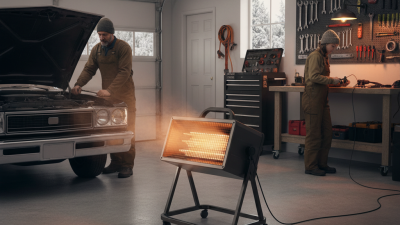
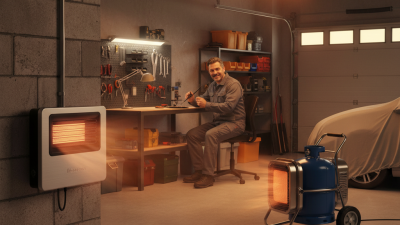
Why Choose an Electric Garage Heater?
Why Choose an Electric Garage Heater?
A cold garage can turn simple tasks into uncomfortable work. Metal tools feel icy. Concrete floors hold the chill. An electric garage heater can change that experience within minutes, creating a steadier workspace for repairs, hobbies, storage, or weekend projects.
HVAC educator John Barba offers a useful principle: “Good comfort starts with choosing the right system for the space.” That idea matters in a garage. Electric models usually need no fuel storage, chimney, or combustion vent. Installation can also be simpler than many fuel-burning systems, especially when the electrical supply already supports the heater’s demand. There is no flame to manage. No exhaust smell.
The best choice still depends on the garage itself. Measure the room, inspect insulation, and check the ceiling height before buying. A drafty two-car garage may need more capacity than a sealed workshop of the same size. Wall-mounted units save floor space. Fan-forced models spread warmth across the room. Infrared options can warm people and nearby surfaces directly.
Convenience is the strongest argument. Press a switch, set the thermostat, and keep working. Quiet operation helps during detailed projects. Yet electric heating is not automatically the cheapest option everywhere. Local electricity rates, insulation, usage time, and heater efficiency all matter. That deserves an honest look.
A reliable garage heater should match the space, wiring, and daily routine. Choose certified equipment and follow the manufacturer’s installation instructions. Warmth feels simple. Safe performance is not.
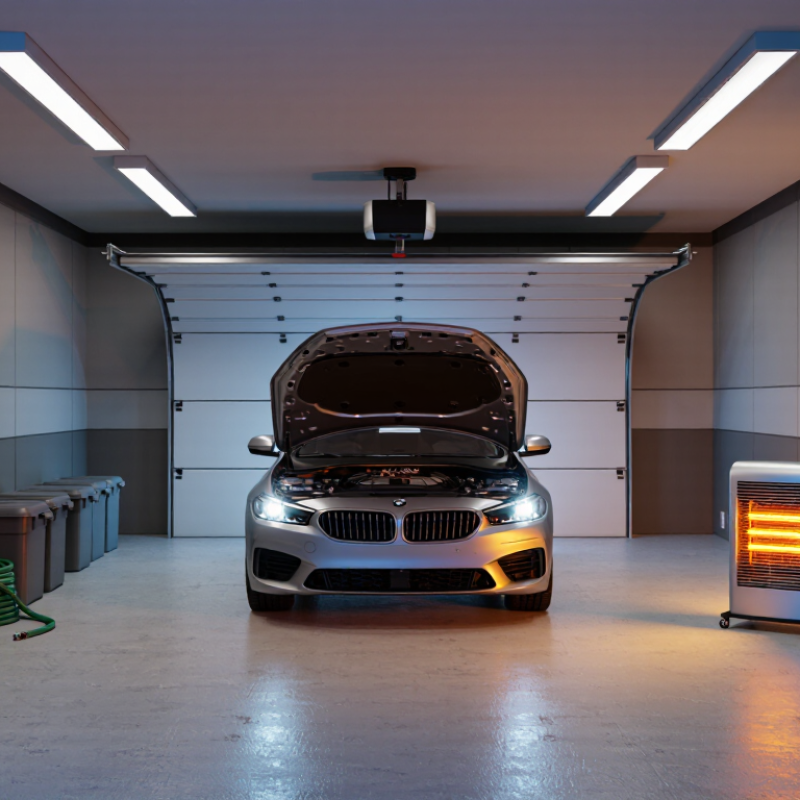
What Is an Electric Garage Heater and How Does It Work?
An electric garage heater warms a space by converting electrical energy into heat. Most models use a resistance element, which becomes hot when current passes through it. A fan then moves air across the element and pushes warm air into the garage. A thermostat measures room temperature and cycles the heater on or off.
It is simple. Yet the details matter. In a typical garage, cold concrete, metal doors, and unsealed gaps quickly pull heat away. A thermostat near a draft may keep the heater running longer than expected. Dust on the intake can also restrict airflow and raise operating temperatures. Regular cleaning helps, but it does not replace proper maintenance.
Electric heaters produce no combustion gases, so they do not need a flue or fuel storage. They still require careful installation. The circuit must match the heater’s voltage and power demand, with suitable grounding and overcurrent protection. Many larger units use 240 volts and need a dedicated circuit.
Local electrical codes should guide the installation, especially in damp or workshop environments. Keep clearance around the heater, and never cover it with tools, clothing, or stored materials.
I would not choose a heater by wattage alone. Insulation, ceiling height, door use, and regional climate affect real performance. A slightly smaller heater may struggle, while an oversized unit can cycle too often.
Key Benefits of Using an Electric Heater in a Garage
Why Choose an Electric Garage Heater?
An electric garage heater can make a cold workspace usable within minutes. It produces heat without burning fuel inside the room. That means no exhaust fumes, soot, or fuel storage near tools. This matters when you paint, repair equipment, or handle dusty materials. A wall-mounted unit also saves floor space around vehicles and workbenches. Many models include thermostats, so the heater can maintain a steady temperature instead of running continuously.
Electric heating offers practical control for changing garage conditions. You can warm the space before a project and lower the setting afterward. In a small, insulated garage, this may reduce heat loss and improve comfort. Dry air circulation can also help prevent cold surfaces from collecting moisture. However, insulation makes a major difference. An unsealed garage door may release heat as quickly as the heater creates it.
The heater is not magic.
Installation deserves careful attention.
Check the circuit capacity before connecting a powerful unit. An overloaded circuit can trip repeatedly or create a serious fire risk. Keep clear space around the heater, especially near cardboard, sawdust, paint, and stored fabric. A qualified electrician can confirm grounding, wiring, and local requirements. I would also test the thermostat on a cold morning, because settings that seem accurate in theory may feel uneven beside a concrete floor. Regularly removing dust from vents helps maintain airflow and performance.
Energy Efficiency and Operating Costs to Consider
Why Choose an Electric Garage Heater?
Energy Efficiency and Operating Costs to Consider
An electric garage heater can make a cold workspace comfortable without heating the entire house. Its efficiency depends on how much heat reaches people, tools, and surfaces. A programmable thermostat prevents unnecessary heating when the garage is empty. That small control can reduce wasted electricity.
Operating costs are easier to estimate than many people expect. Multiply the heater’s kilowatts by daily running hours and monthly usage days. For example, a 1.5-kilowatt heater running four hours daily for 26 days uses 156 kilowatt-hours. At $0.18 per kilowatt-hour, the estimated cost is $28.08. Local electricity rates vary. Thermostat cycling may lower the actual figure.
Insulation changes the calculation dramatically. Sealing gaps around the garage door, adding weatherstripping, and insulating the ceiling help retain warmth. I once treated heater size as the main decision, but that view was too simple. A powerful unit can still waste energy in a drafty garage. Cold air wins. Infrared heating may suit someone working at one bench, while fan-forced heat can warm the wider room faster. Measure the space, check the heater’s electrical requirements, and avoid relying on optimistic estimates. Safety also matters: keep clearances open, inspect cords, and follow professional installation guidance where required.
Why Choose an Electric Garage Heater? - Energy Efficiency and Operating Costs to Consider
Illustrative operating-cost comparison based on delivering approximately 20,000 BTU of heat per hour. Actual costs vary by climate, insulation, thermostat settings, utility rates, and equipment condition.
| Heating Option |
Typical Efficiency |
Energy Needed per Hour |
Estimated Cost per Hour |
Estimated Cost for 500 Hours |
Key Considerations |
| Electric Resistance Heater |
Approximately 100% at the point of use |
5.86 kWh |
$0.94 |
$468 |
Simple installation, fast heat, low maintenance, and no combustion gases. Electricity can be expensive for extended heating periods. |
| Electric Infrared Heater |
Approximately 100% at the point of use |
5.86 kWh |
$0.94 |
$468 |
The electricity use is similar to other resistance heaters, but radiant heat can improve personal comfort by warming people and surfaces directly. |
| Ductless Electric Heat Pump |
COP approximately 2.5 under moderate conditions |
2.34 kWh |
$0.37 |
$187 |
Can provide efficient heating and cooling, but capacity and efficiency may decline in very cold weather. Higher purchase and installation costs are common. |
| High-Efficiency Natural Gas Heater |
Approximately 90% annual fuel utilization |
0.22 therm |
$0.33 |
$167 |
May have lower fuel costs where natural gas is available, but requires combustion venting, gas service, regular maintenance, and carbon-monoxide safety measures. |
Calculation assumptions:
Electricity is priced at $0.16 per kWh, natural gas at $1.50 per therm, and one therm contains approximately 100,000 BTU. The comparison uses 20,000 BTU per hour of delivered heat and 500 operating hours per year. A heat-pump coefficient of performance of 2.5 represents moderate operating conditions rather than the full range of outdoor temperatures.
Practical takeaway:
Electric resistance heaters can be attractive for occasional garage use because they are easy to install, clean, and operate. For frequent or long-duration heating, improving insulation, sealing air leaks, using a programmable thermostat, or considering a heat pump may reduce total energy consumption.
Safety Features and Installation Requirements
Why Choose an Electric Garage Heater?
Safety Features and Installation Requirements
An electric garage heater can provide steady warmth without burning fuel indoors. Its safety depends on correct placement, wiring, and daily maintenance. Unlike fuel-burning equipment, it produces no combustion gases. Still, electricity, heat, dust, and moisture create serious risks. Look for overheat protection, tip-over shutoff, enclosed controls, and a clearly marked disconnect. These features matter during busy garage work. A heater should not share a circuit with welders, compressors, or other high-load tools. Use a dedicated circuit sized by a qualified electrician. Never assume an existing outlet is suitable.
Installation starts with location. Mount the unit according to the manufacturer’s required clearances. Keep it away from cardboard, wood shavings, paint solvents, oily rags, and stored fuel. Avoid areas where a vehicle could strike the heater. An electrician should verify grounding, conductor size, and circuit protection. Local rules may require additional protection, especially in damp garage areas. Requirements vary. Follow the installation manual and local electrical code. Hardwired models need a proper disconnect nearby. Extension cords are a weak point. Avoid them unless the instructions specifically allow their use.
Before first use, inspect the housing, cable, plug, and mounting hardware. Test the thermostat and safety shutoff. Keep airflow paths open. A wall-mounted heater can still collect sawdust around its intake. Clean it only after switching off power and allowing it to cool. Do not cover it. It is easy to focus on heating performance and overlook clearance measurements. I would recheck them after moving shelves or storing tools. That small review may reveal a new hazard.
How to Choose the Right Electric Garage Heater
Choosing the right electric garage heater starts with the room, not the product label. Measure the garage floor area, ceiling height, insulation, and door gaps. A poorly sealed door can erase much of the heater’s output. The U.S. Department of Energy explains that electric resistance heaters convert nearly all incoming electricity into heat at the point of use. However, operating cost still depends on wattage, local electricity rates, and daily runtime.
A 1,500-watt heater draws about 1.5 kilowatt-hours per hour. Check your utility rate before buying. The U.S. Energy Information Administration reported an average U.S. residential electricity price of 16.48 cents per kilowatt-hour in 2023. At that rate, one hour costs roughly 25 cents. Real costs vary. Choose a thermostat with stable temperature control, adjustable power levels, and overheat protection. For a dusty workshop, sealed heating elements and easy-to-clean grilles deserve attention.
Safety must shape the installation. NFPA reported an estimated 44,210 home heating fires in the United States from 2016 to 2020. Keep clearances around the heater, avoid extension cords, and confirm that the circuit matches the required voltage. A qualified electrician should inspect new wiring. My first mistake was choosing by wattage alone. The garage warmed slowly because air leaked around the main door. I also underestimated noise during close work. Quiet operation matters. So does placing the heater where warm air reaches the workspace, not only the ceiling.
Why Choose an Electric Garage Heater? How to Choose the Right Size
Estimated heating output by garage area and insulation level
This planning guide uses a common rule of thumb: approximately 10 watts per square foot for a reasonably insulated garage and 15 watts per square foot for a poorly insulated garage. Actual requirements depend on outdoor temperature, ceiling height, air leakage, insulation, doors, and the desired indoor temperature. Choose a heater with a suitable thermostat and confirm that the circuit can safely support its electrical load.