Why Choose Electric Wall Heaters for Your Home?
Electric wall heaters can warm a chilly bedroom, home office, or bathroom without taking up floor space. Their appeal is easy to picture: a quiet wall-mounted unit, a thermostat within reach, and heat where people need it. But a neat installation does not automatically mean lower energy bills.
The right choice depends on room size, insulation, ceiling height, and how long the space needs heat. A heater that is too small may struggle on cold mornings; an oversized unit can cycle more often than expected. A practical guiding line from “Jordan Lee, residential HVAC specialist” is offered here as illustrative wording, not a verified quotation: “Choose for the room you have, not the room you imagine.” Check the unit’s electrical requirements and installation instructions. For hardwired models or uncertain wiring, consult a qualified electrician.
There are trade-offs. Electric wall heaters can provide straightforward room-by-room control, yet electricity prices and frequent use affect running costs. Dust on the grille can also reduce airflow, so regular cleaning matters. Some rooms may benefit more from improved insulation or sealing drafts than from another heater. That is worth considering. This guide will compare comfort, installation needs, safety features, and operating costs, while noting where a wall heater may not be the best fit. Measure the room first. Then compare models with realistic expectations.
How Electric Wall Heaters Work: DOE Says Resistance Heat Is Nearly 100% Efficient
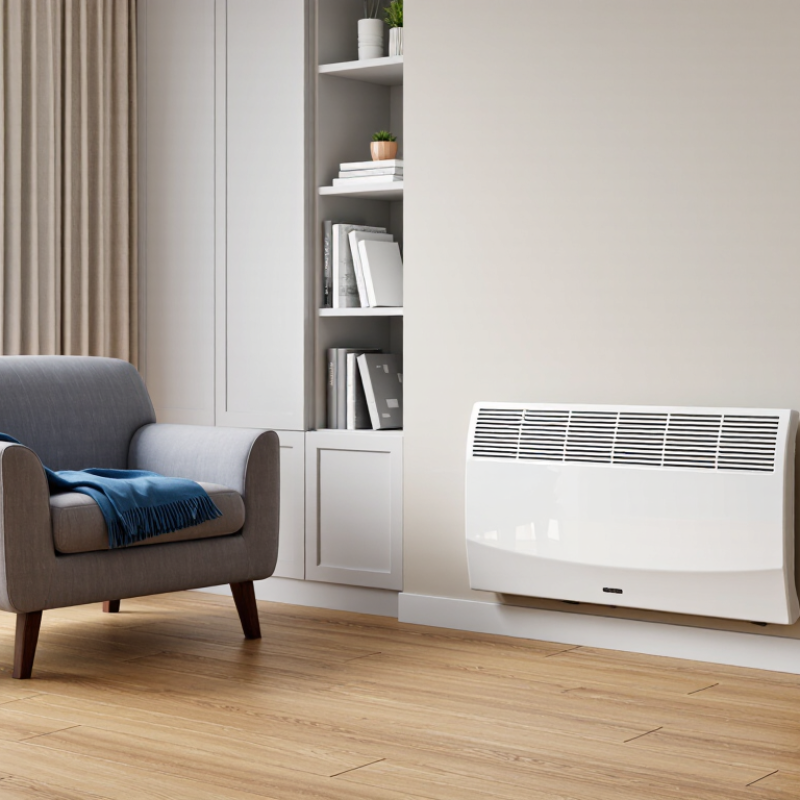
Electric wall heaters use resistance elements to turn incoming electricity into heat. The U.S. Department of Energy describes electric resistance heating as nearly 100 percent efficient at the point of use. In practical terms, almost all the electricity reaching the element becomes heat inside the room. There is no combustion exhaust or flue. That distinction is easy to miss: it describes conversion at the heater, not the full energy journey from power plant to home.
Warmth arrives quickly near the unit. You might feel it while sitting beside a hallway wall, even as a far corner stays cool. A built-in thermostat can help maintain a chosen temperature, while separate room controls allow targeted heating. Placement matters. Keep furniture and curtains clear of the heater, and follow its installation and safety instructions. Check that the wall and circuit can support the unit’s electrical load.
Nearly 100 percent efficient does not automatically mean inexpensive to run. Electricity prices, room insulation, heater size, and daily use all affect the bill. A draft beneath a door can make a small room feel stubbornly cold, prompting longer heating cycles. Resistance heat is simple. Still, it may cost more to operate than some alternatives, and electricity generation can involve energy losses before power reaches your home.
Main Types: Convection, Fan-Forced, and Infrared Wall-Mounted Units
Convection, fan-forced, and infrared wall heaters warm rooms in different ways. The U.S. Energy Information Administration’s 2020 Residential Energy Consumption Survey identifies space heating as a major household energy use. Choosing a heater that fits the room and your routine matters. Convection models warm air gradually and quietly. Fan-forced units push heated air into the room faster, but the fan adds some noise. Infrared models radiate warmth toward people and nearby surfaces. Comfort can feel immediate.
The U.S. Department of Energy notes that electric resistance heating converts nearly all incoming electricity into heat at the point of use. That does not make every wall heater equally economical to run; electricity prices, insulation, and thermostat settings still matter. A small bathroom may suit quick fan-forced heat, while a draft-free reading nook may feel comfortable with gentle convection. Infrared can help when you occupy one spot, though it may not warm the whole room evenly. No type wins everywhere.
Tips: Check the heater’s rated output against the room size, and keep furniture clear of its airflow or radiant path. Try a thermostat and timer, then compare comfort and electricity use over several days. Small details count. I would not assume a warm corner means the entire room is warm.
Sizing and Circuits: A 1,500-W Heater Draws 12.5 A at 120 V
A 1,500-watt wall heater draws 12.5 amps on a 120-volt supply: watts divided by volts. That is more than 80% of a 15-amp circuit’s rating. For continuous loads, that margin matters. NFPA 70 treats fixed electric space-heating equipment as a continuous load, so circuit sizing generally accounts for 125% of the heater’s current. At 125%, 12.5 amps becomes 15.6 amps. A 20-amp branch circuit may be needed; confirm the heater’s instructions and applicable local requirements.
The U.S. Energy Information Administration’s 2020 Residential Energy Consumption Survey reports that space heating accounted for about 42% of household site energy use. That figure is not a circuit-sizing rule, but it shows why heating can be a sustained load. Check the breaker label and other outlets before installation. A kettle, vacuum, or second heater on the same circuit can push demand higher. A tripped breaker is a warning, not a reason to keep resetting it. I would verify the wiring rather than guess.
Wall heaters may be hardwired or plug-in models, and their requirements differ. Check the nameplate for voltage, wattage, and required circuit rating. If the existing circuit is shared, the wiring is old, or the breaker trips, ask a qualified electrician to inspect it. The arithmetic is simple. The actual circuit may not be.
Benefits and Trade-Offs: Room-by-Room Control Versus Higher Running Costs
Electric wall heaters offer close control: heat the home office during work hours, then leave the spare room cool. That convenience is not free. The U.S. Energy Information Administration’s 2020 Residential Energy Consumption Survey found space heating accounted for about 42% of household energy use. A heater’s cost depends on how long it runs, local electricity prices, and the room’s insulation.
For scale, a 1.5-kilowatt heater running six hours daily uses about 270 kilowatt-hours in a 30-day month. At the EIA’s 2023 U.S. average residential rate of 16 cents per kilowatt-hour, that is roughly $43. Your rate may differ. A thermostat and closed door can limit wasted heat, but a cold, drafty room may keep the unit running longer than expected.
Electric resistance heaters turn nearly all their electricity into heat at the point of use, but that does not make them cheap to operate. The U.S. Department of Energy says heat pumps can use about 50% less electricity than electric resistance heating. Wall units can still make sense for occasional use or rooms far from central heating. The trade-off is easy to underestimate: convenient room-by-room control may encourage heating spaces that would otherwise stay cool.
Efficiency Comparisons: DOE Says Heat Pumps Can Use About 50% Less Electricity
Electric wall heaters offer direct, room-by-room warmth. A unit beside a desk can heat a small space without warming an empty bedroom. They are simple, but they use electric resistance: electricity becomes heat at the heater. A heat pump works differently, moving heat from outdoor air indoors. The U.S. Department of Energy says heat pumps can use about 50% less electricity for heating than electric resistance systems. That comparison makes heat pumps worth considering when heating costs matter.
The estimate is not a guarantee for every home. Outdoor temperatures, insulation, thermostat settings, and equipment sizing all affect real-world performance. In very cold weather, some systems may need backup heat, which can raise electricity use. DOE’s guidance is useful, but your home’s bills are the practical test. Compare seasonal energy use, not just a single cold night. Also consider installation costs and whether each room needs independent control.
Tips: Seal drafts around windows and doors before increasing the thermostat. Set wall heaters to warm occupied rooms, and keep furniture clear of heater surfaces. If comparing options, ask a qualified installer to estimate heating needs and expected seasonal use. Estimates can be imperfect; that is worth acknowledging.